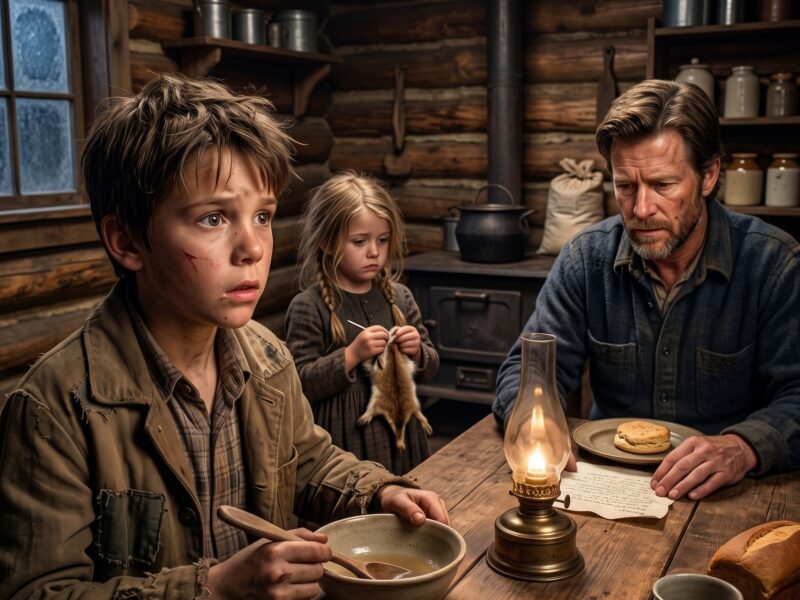
“Can My Sister Stay Too?” the Orphan Asked. The Rancher Quietly Set Another Place
"Can My Sister Stay Too?" the Orphan Asked
“Can My Sister Stay Too?” the Orphan Asked. The Rancher Quietly Set Another Place
By the middle of November, the wind had scraped every soft thing from Bitter Creek. It was a vicious, unyielding force that flattened the yellow prairie grass against the frozen earth, lifted stinging dust from the deeply rutted cattle trails, and drove needles of ice beneath the eaves of Silas Mercer’s house.
The cottonwoods along the creek stood bare and gray, their skeletal branches clicking together through the long, absolute dark of the Wyoming nights. Beyond them, the plains stretched outward toward a perimeter of low mountains that were already buried beneath a suffocating blanket of early snow.
Silas Mercer had spent fourteen winters on this land. He knew its cruelty intimately. He knew exactly where the fatal drifts would gather before the first flakes even fell from the sky. He knew which cedar fence posts would loosen when the permafrost heaved. He could smell a coming storm in the heavy, metallic stillness that settled over the valley just before the clouds came down from the peaks.
More than anything, Silas knew how little the land cared whether a man survived it.
Each morning, long before the sun bruised the horizon, Silas rose from his narrow bed. He lit the cast-iron kitchen stove, the strike of his match the only sound for miles. He boiled bitter coffee, fried strips of salt pork, and ate in total silence at the corner of a heavy oak table that had been built for six. He used the exact same tin plate and the exact same chipped enamel cup every day. When he finished, he washed them immediately in cold water and returned them to their precise spot on the shelf.
Nothing remained on the table. Nothing waited for him there.
He worked until the light bled out of the sky. He pitched hay for the cattle, repaired stiff leather tack with numb fingers, hauled heavy buckets of water from the half-frozen well, and rode the northern fence line where the drifts always came first. He spoke to his old bay gelding, Bishop, far more often than he spoke to another human being. Once every two weeks, he hitched the wagon and drove the eleven miles into the town of Bellweather for flour, coffee, lamp oil, and whatever unsolicited news Mr. Tally, the storekeeper, forced upon him.
Silas never stayed for supper at the boarding house. He never accepted the polite, pitying invitations to Sunday church. Over the years, the people of Bellweather had simply stopped asking. He was a man made of frost and silence, and they left him to his ghosts.
The afternoon the children came, the sky had turned the color of hammered iron.
Silas was behind the house, the rhythmic thwack of his axe splitting cords of cottonwood, when movement caught his eye. He paused, leaning on the hickory handle, his breath pluming in the freezing air. He squinted toward the southern gate.
At first, he thought a fence rail had blown loose and fallen across the wagon road. Then, the shape moved against the wind.
It was a boy.
He was walking up the long drive toward the house. He was terribly thin, perhaps twelve years old, though the hollows of his cheeks and the desperate set of his jaw made him look much older. He wore a heavy wool coat that hung past his knees, clearly made for a grown man, with one sleeve violently torn at the seam. His boots were held together by strips of burlap tied with twine, and he carried a bulging canvas sack slung over one bony shoulder.
The boy stopped exactly ten paces from the chopping block. He did not flinch beneath Silas’s heavy stare.
Silas drove the axe into the chopping stump with a resounding thud. “You lost?”
The boy shook his head.
“You know where you are?”
“Mercer Ranch.” His voice was dry, cracking from the wind, but he held Silas’s gaze without wavering.
Silas looked past the boy, scanning the empty, gray road stretching back toward the horizon. No horse stood at the gate. No wagon waited beyond the rise. There was only the wind.
“How did you get here?” Silas asked, his voice a low rumble.
“Walked.”
“From where?”
“Bellweather.”
Silas narrowed his eyes. Eleven miles. In calm weather, it was a brutal walk. With the wind blowing ice since dawn, it was a death march.
The boy reached deep into the oversized coat and removed a folded piece of paper. His fingers were raw, red, and cracked at the knuckles. He held the paper out.
Silas stepped forward, the snow crunching beneath his boots, and took it. He unfolded the stiff paper. The message had been scrawled in the hurried, uneven handwriting of Mr. Tally, the storekeeper.
Silas, The boy’s name is Elias Carter. Calls himself Eli. His mother died of the lung sickness near the freight station six days ago. Father already gone. He says he can work. Reverend Pike has no room in the parsonage until the county wagon comes through. Thought you might need help through the winter. — Tally
Silas read the message twice, his expression hardening into stone. He looked down at the boy. “I did not ask Tally for help.”
“I know,” the boy—Eli—said. He shifted uncomfortably beneath the weight of the canvas sack, but his chin remained high. “I can mend fence. I can carry wood. I know horses some.”
“Some?”
“My father hauled ore before the silver mine took him.”
Silas slowly folded the paper and slipped it into his pocket. The wind howled, pressing the enormous coat against the boy’s legs, revealing just how little of him there actually was beneath the wool. He was starving.
“The county wagon will come,” Silas said, his tone final. “Reverend Pike will see you fed until then. You should head back before the storm breaks.”
Eli’s jaw tightened. “They’ll send me east. To an orphanage.”
“Maybe.”
“They said there’s a sheep man looking for a boy to muck stalls. I don’t want to go there.”
Silas turned his gaze toward the mountains. A solid white wall was descending over the highest ridge. The storm was an hour away, maybe less. “That is not my concern.”
Eli nodded once. He did not argue. He did not cry. He did not beg. He simply turned around, his thin shoulders bracing against the freezing wind, and started back toward the road.
He managed three steps before he stopped.
Silas waited by the stump.
Eli looked back over his shoulder, his eyes wide and suddenly terribly fragile. “Can my sister stay, too?”
Silas went perfectly still. “What sister?”
Eli pointed with a trembling, red hand toward the southern gate.
At first, Silas saw nothing but the leaning cedar posts and the frozen gray dirt of the road beyond them. But as he stepped past the chopping block and squinted through the blowing dust, a shape materialized.
A small face appeared above the tall, dead grass, sitting beside a broken, wooden handcart with a splintered wheel. It was a girl. She sat huddled beneath a heavily patched quilt, wearing a bright red wool cap. She was clutching a crude wooden doll tightly against her chest. She was so incredibly still that Silas had mistaken her for abandoned baggage.
“You left her at the gate?” Silas demanded, a spark of sudden anger in his chest.
“She couldn’t walk anymore,” Eli said, his voice finally breaking. “Her boots wore through at mile eight.”
Silas looked at the apocalyptic sky, then down at the boy. “How old?”
“Seven.”
“Is she sick?”
“Just cold. Please, mister.”
The first snowflake struck the frozen dirt of the yard. It was hard, dry, and sharp as glass.
Silas pulled the heavy axe from the stump and carried it into the woodshed. He did not answer the boy. He simply walked past him, his long strides eating up the distance across the yard, down the long drive toward the gate.
The little girl watched him approach with wide, terrified eyes. Her face was frighteningly pale beneath a scattering of copper freckles. Beneath the edge of the quilt, Silas saw that one of her boots was entirely missing. Her small foot was wrapped in dirty cloth and tied tightly with butcher’s string.
Silas did not speak. He reached down and took the heavy wooden handle of the broken cart.
“Hold the quilt tight,” he ordered, his voice gruff.
She obeyed instantly, her tiny, blue-tinged fingers gripping the edges of the blanket.
Eli ran up behind them, panting, and followed in silence as Silas hauled the cart up the long, freezing drive, pulling them toward the warmth of the house just as the sky finally broke open.
Related Articles

They Mocked the Widow’s Dirt Cellar—Then the Freeze Left Every Cabin Cold but Hers Warm
They Mocked the Widow’s Dirt Cellar—Then the Freeze Left Every Cabin Cold but Hers Warm…

A Homeless Veteran and His German Shepherd Inherited a Ridge No One Wanted — 35 Feet In, They Found
Chapter 1 / 7 A Homeless Veteran and His German Shepherd Inherit… A Homeless Veteran…

Neighbors Laughed When He Built A Cabin Inside An Old Barn—Until It Kept His Home 35 Degrees Warmer
Chapter 1 / 8 Neighbors Laughed When He Built A Cabin Inside An… Neighbors Laughed…

His Sod House Had No Woodpile in January – Until the Trains Stopped and the Town Came Begging
Chapter 1 / 10 His Sod House Had No Woodpile in January – Until t……

She Built Her Cabin Over the Woodshed and Never Burned Wet Wood Again
Chapter 1 / 8 She Built Her Cabin Over the Woodshed and Never Bu… She…

The Duke Abandoned Her on Their Wedding Day—Years Later, He Discovered What He Had Lost
Chapter 1 / 7 The Duke Abandoned Her on Their Wedding Day—Years… The Duke Abandoned…

He Wedged a Tiny A Frame Into a Crevice Before Winter and His Family Slept at 75°F While Town Hit
Chapter 1 / 7 He Wedged a Tiny A Frame Into a Crevice Before Win……

He Was Too Old to Ride—So He Bought the Ruined Ranch and Found the Room Behind the Fireplac
Chapter 1 / 5 He Was Too Old to Ride—So He Bought the Ruined Ran……

Settlers Laughed at His Underground Heat Recovery Duct — Until It Kept His Cabin 71°F Warmer
Chapter 1 / 9 Settlers Laughed at His Underground Heat Recovery… Settlers Laughed at His…

A Navy SEAL Built a Home Inside a Mountain—Then His Dog Warned Him Before the Storm
Chapter 1 / 5 A Navy SEAL Built a Home Inside a Mountain—Then Hi… A…