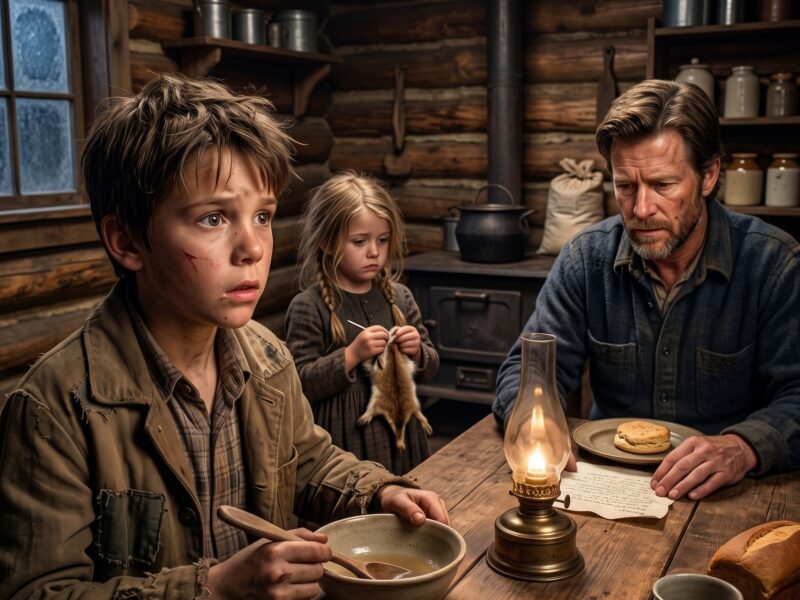
“Can My Sister Stay Too?” the Orphan Asked. The Rancher Quietly Set Another Place
The Weight of Winter
The blizzard raged for two solid days, trapping them in a tense, claustrophobic domesticity.
On the first morning, Silas woke to the smell of woodsmoke. He walked into the kitchen to find Eli already standing beside the roaring stove. The boy was fully dressed in his patched clothes, his hair sticking up wildly at the crown. In the pale, gray light of the storm, his face looked even sharper, all angles and apprehension.
“What needs doing?” Eli asked, his spine stiff.
“Breakfast,” Silas said, reaching for the coffee tin.
“After that.”
“After that, you stay inside so you don’t freeze to death.”
“You said I could work.”
Silas turned, a heavy cast-iron skillet in his hand. “I said no such thing.”
Eli’s expression shifted rapidly. It wasn’t anger that flared in the boy’s eyes; it was stark, unfiltered fear. He believed that if he did not prove his absolute utility, he would be cast out into the snow.
Silas poured thick flapjack batter into the sizzling fat of the skillet. “When the wind drops this afternoon, you can carry kindling from the shed to the porch box.”
“I can carry the big logs,” Eli insisted.
“You can carry the kindling until I decide otherwise.”
Eli looked nervously up toward the loft, where Nora was still sleeping. “All right, sir.”
They ate breakfast in silence. Silas noticed Eli eating quickly, devouring half his biscuit, and then subtly sliding the other half under the edge of his tin plate. When he thought Silas wasn’t looking, Eli wrapped the saved bread in a dirty scrap of cloth and shoved it into his pocket.
“There’s more in the pan,” Silas said without looking up.
Eli’s hand froze inside his pocket. “I’m saving it for Nora.”
“She will have her own hot food.”
The boy did not unwrap the biscuit. He did not trust the abundance.
When Nora finally came down the ladder, clutching her faceless wooden doll, Silas served her a full plate of eggs and a fresh biscuit. She sat at the massive table, staring at the steaming food without touching it.
“You don’t like eggs?” Silas asked.
“I like them,” she whispered.
“Then eat.”
She looked across the table at Eli. The boy gave a microscopic, reassuring nod. Only then did she pick up her heavy iron fork and begin to eat.
After breakfast, the snow had softened to a steady, vertical fall, and the wind had stopped driving it sideways. Silas bundled up and headed to the barn. Eli followed immediately, shadow-like, without being told.
The boy spent the next hour carrying armfuls of split kindling from the woodshed to the back porch. He made trip after trip, his small boots sinking into the drifts. On the fourth trip, as Eli struggled with a massive load, Silas stepped out of the barn and held up a leather-gloved hand.
“That is enough. The box isn’t full, but it will hold until tomorrow.”
Eli looked at the remaining pile of wood in the shed as if leaving it there were a catastrophic moral failure.
Silas sighed. He reached into his coat and pulled out a stiff, bristle grooming brush. He tossed it to the boy. “You can curry the bay. Keep clear of his hind legs, he’s got a sour disposition on cold mornings.”
Eli entered the dim, hay-scented stall. The massive bay gelding turned his heavy head, ears pinning back slightly, and lowered his velvet muzzle to sniff the boy’s thin shoulder. Eli stood perfectly, instinctively still, letting the animal take his measure. After a long moment, the old horse exhaled a massive, warm breath directly against the boy’s chest and relaxed his ears.
Eli’s rigid face suddenly softened. “What is his name?”
“Bishop,” Silas said, leaning against the stall door.
“Why Bishop?”
“Because he thinks he knows better than everyone else in the congregation, and he expects to be served.”
For the very first time since arriving, Eli smiled. It was a brief, brilliant flash of youth that vanished almost instantly back behind his mask of survival, but Silas had seen it.
Nora spent the entire day sitting on a stool beside the kitchen stove, keeping her wooden doll warm. The doll had no painted face, only two dark, burned marks where eyes might have been. Its dress was a crude thing sewn from a flour sack.
That evening, as Silas walked down the short hallway toward his bedroom, he stopped.
Nora was standing before a closed, locked door at the very end of the hall. Her small hand was resting on the cold brass knob, trying to turn it.
“That room stays shut,” Silas said. His voice was sharper than he intended, echoing in the narrow space.
Nora gasped and snatched her hand back as if the brass had burned her. “I’m sorry. I was just looking.”
“Your bed is in the loft.”
“I know.” She looked at the white-painted door one last, lingering time, clutching her doll, and then hurried past him back to the kitchen.
Silas waited in the shadows until he heard her climb the ladder. He walked to the end of the hall and tested the brass knob himself. It was locked tight. It had been locked for eight years. The key remained hidden in the top drawer of his dresser, buried beneath heavy wool socks, where it belonged.
Three days later, the county road to Bellweather was still buried under four feet of impassable drifts.
The children settled into the rhythms of the house with the hyper-vigilant caution of wild animals waiting for a steel trap to snap shut. Eli rose in the freezing dark before Silas. Nora meticulously folded her coarse blankets each morning, though her small hands could never make the corners meet perfectly.
Neither child ever asked for anything. When Silas put venison stew on the table, they ate it without complaint. When he gave them chores, they completed them with a terrifying, desperate perfectionism. When he told them to rest, they sat rigidly in chairs beside the stove, staring at the fire, as if ‘resting’ were simply another difficult task that had to be performed to the master’s satisfaction.
Eli watched Silas constantly. If Silas frowned at a loose hinge on the barn door, the boy was there five minutes later with a hammer, trying to beat it back into place. If Silas rubbed his aching shoulder after carrying hundred-pound sacks of grain, Eli magically appeared beside the next sack, trying to drag it. If a wrench went missing, Eli searched the snow blindly until his fingers bled to find it.
Nora, in turn, watched Eli. She did not speak unless he spoke. She did not enter a room until he had entered it first and deemed it safe.
At night, lying in his bed, Silas still heard them whispering in the loft. But he never, ever heard them laugh.









