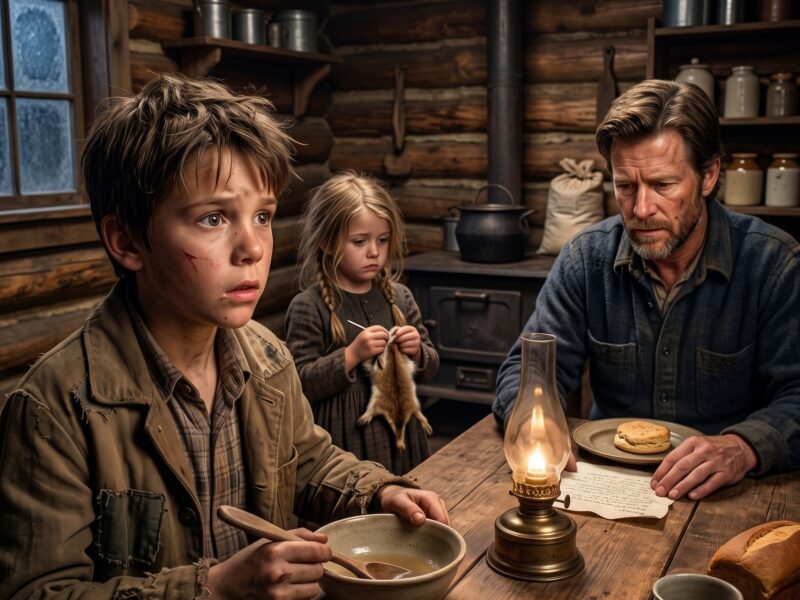
“Can My Sister Stay Too?” the Orphan Asked. The Rancher Quietly Set Another Place
A Place Set
Six months later, on a crisp November afternoon, Judge Hale rode out in his private buggy to visit the Mercer Ranch.
He found Eli, taller and broader in the shoulders, expertly repairing a heavy gate hinge with a wrench, while Silas watched from the fence line, offering quiet advice. He went inside and found Nora in the warm kitchen, reading aloud fluently from a McGuffey Reader while a massive pot of beef stew simmered on the hot stove.
He asked to examine the blue room.
There were now two neatly made beds inside. There were two wooden pegs for coats. There were two school slates resting on a desk. There was a glass mason jar filled with dried autumn meadow flowers. And sitting proudly on the shelf were three carved wooden horses and a willow whistle, shared among siblings.
The judge stayed for supper.
Nora proudly set four tin plates at the table.
When the meal was finished, and the coffee was poured, Judge Hale pulled a fountain pen from his coat pocket and signed the permanent, irrevocable adoption order right there on the kitchen table.
The second winter arrived early that year.
Snow covered the northern pasture before Thanksgiving, burying the dead grass. The vicious Wyoming wind returned to the eaves of the house, howling like a wolf, searching every wooden board and window frame for a weakness.
But Silas had spent the summer repairing the roof and banking thick earth against the stone foundation. Eli had chopped and stacked wood nearly to the rafters of the shed. Nora had filled the pantry shelves with rows of neatly labeled glass jars of preserves, working under Mrs. Vail’s patient instruction.
On the first night of the great blizzard, the three of them gathered around the kitchen table.
Eli had grown tall enough that his boots finally rested flat on the floorboards. Nora wore her bright red wool cap indoors, simply because she claimed it helped her think better while she did her arithmetic.
Silas stood at the stove and served the steaming stew.
Nora counted the tin plates as he set them down. “One for me. One for Eli. One for you. That is three.”
Eli buttered a piece of bread. “I know how to count to three, Nora.”
She ignored her brother. She looked toward the frosted windowpane, where the violent snow moved in swirling sheets through the absolute darkness outside. “What if someone else comes out of the snow, Silas?”
Silas paused. He glanced over at the wooden shelf above the sink.
Three clean, unused tin plates remained stacked there in the shadows. He reached back, took one down, wiped it with a towel, and set it gently at the empty, fourth side of the oak table.
“Then there will be a place for them,” Silas said.
Nora smiled, picked up her spoon, and began to eat.
Silas Mercer sat at the head of his table. He listened to the comforting clink of the tin spoons against the bowls, the warm, popping crackle of the fire settling in the iron stove, and the sound of his children arguing quietly over who had forgotten to give Bishop his apple that evening.
Outside, the brutal winter wind battered the walls, searching the house for a way in. But the house was full, the fire was lit, and the cold could not find them.









