“Can My Sister Stay Too?” the Orphan Asked. The Rancher Quietly Set Another Place
The Runaway
Silas did not tell them. He believed, in his stoic, foolish heart, that he could shield them from the terror of the bureaucracy by simply solving the problem in secret.
For the next week, he left the ranch long before sunrise and returned long after dark, leaving Eli in charge of the chores. He rode Bishop to exhaustion. He went to the bank in Belle Fourche and learned the agonizing, exact amount needed to clear his mortgage note entirely. He met secretly with Reverend Pike, Mr. Tally, the blacksmith, and the town doctor who had examined Nora in February, begging them for written affidavits of his character.
He spoke with an expensive, cynical attorney in a smoky room above the saloon.
The attorney, a man named Higgins, read the county notice and sighed, pouring a whiskey. “Rusk is going to paint you as a cheap bastard who took in orphans for free slave labor, Mercer.”
“I sent them to school every day,” Silas countered.
“He will say you are a bachelor, incapable of raising a young girl.”
“I can cook. I keep a clean house.”
“That may be your absolute weakest argument,” Higgins said dryly.
Silas placed both large, scarred hands flat on the mahogany desk, leaning over the lawyer. “What will the judge need to see to say yes?”
“Cold, hard proof that you can financially support them without state aid. Proof they are physically safe. And proof you intend something far more legally binding and permanent than a cozy winter arrangement.”
Silas looked out the dusty window toward the street below. Bishop stood tied to the hitching rail. And tied securely behind the gelding was Silas’s massive, muscular red breeding bull. It was the absolute finest animal on the ranch, the genetic future of his entire herd, worth a small fortune.
Higgins followed his gaze out the window. “You planning to sell that monster?”
“Yes.”
“Mercer, that bull could improve your cattle line and make you rich for the next ten years.”
“I need to clear the bank note today.”
“If the judge says no anyway, you could lose the kids and your livelihood.”
Silas picked up the county notice from the desk. “No.”
The sale of the prize bull paid the massive debt with exactly fourteen dollars remaining. Silas carried the stamped, official bank receipt inside the inner pocket of his coat, over his heart.
He returned to the ranch long after sunset and found Eli waiting for him in the shadows of the barn. The lantern light flickered over the boy. Eli had grown inches since November; his wrists now poked out awkwardly from the sleeves of the shirt Silas had bought him.
“You sold the red bull,” Eli said flatly, looking at the empty stall.
“Yes.”
“Why?”
“I needed the money.”
Eli stepped out of the shadows. “Are we costing you too much to feed?”
Silas paused in the act of removing Bishop’s heavy saddle. “No, Eli.”
The boy did not move. His hands were balled into fists at his sides. “Mr. Tally asked me today at the store if we were packing our bags. He asked if we were leaving.”
Silas hung the bridle violently on its wooden peg. “Tally asks far too many damn questions.”
“Mrs. Vail looks at us all week like someone died!” Eli shouted, his voice cracking.
Silas turned, his face tight. “I am handling it.”
“Handling what, Mr. Mercer?!”
“Go inside to your sister, Eli.”
Eli’s face slammed shut like an iron vault. The vulnerability vanished, replaced by the hardened, feral street orphan who had first walked up the drive in November. “Yes, sir.”
The words sounded as cold and formal as they had on that very first morning.
Two days before the custody hearing, disaster struck. Eli did not return from school.
Mrs. Vail arrived at the ranch near dusk in a panic, with Nora crying softly beside her in the buggy.
“I thought he walked ahead of us,” Mrs. Vail said, her voice shaking as Silas ran out to meet them.
Silas looked at Nora. “Where is your brother?”
Nora’s lower lip trembled uncontrollably. She clutched her wooden doll. “He… he was hiding under the schoolhouse steps. He heard Mr. Rusk talking to Mrs. Vail through the window.”
Silas felt the solid earth physically shift and tilt beneath his boots. “What exactly did he hear, Nora?”
“That they are taking him away to the sheep place with the bad men,” she sobbed. “And they are taking me to Cheyenne to be a maid.”
Mrs. Vail reached out and touched Nora’s shaking shoulder. “I’m so sorry, Silas. He bolted. He jumped the fence and left the schoolyard before I could even run outside to stop him.”
Silas didn’t say a word. He sprinted to the barn, threw a bareback pad and a bridle on Bishop, and rode out like a demon.
He found Eli three miles east of town, walking with grim determination along the iron rails of the Union Pacific train track. The boy carried the familiar, battered canvas sack slung over his shoulder, leaning into the wind.
Silas rode up beside him, slowing the blowing horse to a walk. “Get on the horse, Eli.”
Eli kept walking, staring straight ahead at the ties. “No.”
“Where do you think you are going?”
“Rawlins,” the boy said, his voice hard. “I can follow the tracks.”
“Rawlins is more than a hundred miles away across the desert, boy. You’ll die of thirst before you make it.”
“I’ll get there.”
“And what about Nora?”
“I thought you might keep her if I wasn’t here eating your food,” Eli said bitterly.
Silas slid off the horse while it was still moving. He stepped in front of the boy, blocking the tracks. The evening sun was setting, stretching their long, distorted shadows across the wooden ties.
“You plan to just walk away and leave her?” Silas demanded.
“If I go to the sheep ranch and turn myself in, maybe Mr. Rusk will leave her alone! Maybe they won’t come for her if they have me!”
“That is not how the law works, Eli.”
“Then tell me how it works!” Eli screamed, throwing his canvas sack to the gravel. “Tell me!”
Silas stood there. He had no plain, simple answer to offer the boy. The bureaucracy was a machine that ground up love and spat out paper.
Eli’s angry eyes suddenly filled with hot tears, but the boy stubbornly refused to wipe them away. He glared at Silas, his chest heaving. “You should just keep Nora. She is little. She doesn’t eat very much, and she can gather the eggs without breaking them now. I’ll tell the county man you never wanted me. I’ll tell them I ran away because you beat me.”
Silas stepped forward and picked up the canvas sack from the dirt. “I never said I didn’t want you.”
“You didn’t say anything!” The boy’s voice broke completely on the final word, a shattering sound of absolute heartbreak. “You never say anything!”
Silas looked away, staring toward the distant, purple mountains.
For the entire, brutal winter, he had foolishly trusted food, warm boots, chopped wood, and honest work to say all the things his scarred heart could not verbalize. He had believed the children intuitively understood he loved them, simply because he so desperately needed them to understand.
He saw now, standing on the tracks, that a man’s silence could shelter him from his own grief, while simultaneously leaving everyone who stood beside him freezing in the emotional cold.
He turned back to the boy. He dropped the sack, reached out, and pulled Eli into a fierce, crushing hug against his heavy canvas coat. Eli stiffened for a second, then collapsed, burying his face in Silas’s chest, sobbing violently.
“Come home,” Silas whispered into the boy’s hair.
Eli pulled back slightly, wiping his nose on his sleeve. “Is it home?”
Silas looked the boy dead in the eyes, stripping away fourteen years of carefully built emotional armor. “Yes. It is your home.”
Eli stood very still. “Both of us?”
“Both of you.”
“What if the judge says no?”
Silas set his jaw. “Then he will have to say it to me more than once, and he will have to fight me to take you.”
Silas picked up the canvas sack, boosted Eli up onto Bishop’s back, and swung up behind him.
They returned to the ranch long after dark. Nora was sitting anxiously at the kitchen table, still wearing her dusty school dress. Mrs. Vail had gone home, leaving a heavy iron pot of beef stew simmering on the stove.
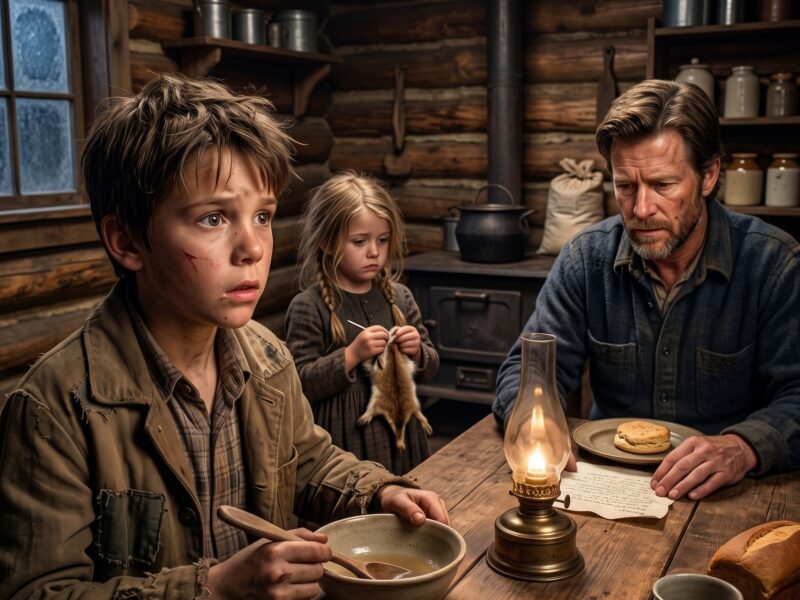
Silas walked in, took off his hat, and went to the shelf. He removed three clean tin plates. He set one at the head of the table. He set one gently before Nora. Then, he placed the third deliberately before Eli, who was standing nervously near the door.
Silas pulled out his chair and sat down. He looked at both of them.
“I sold the red bull to pay off the bank note on the ranch,” Silas said clearly, filling the silence of the room.
Eli looked at him. “Why?”
“Because Amos Rusk trusts paid bank notes more than he trusts people.”
“Are you trying to keep us?” Nora asked, her voice tiny.
“Yes.”
“You never said,” Eli murmured.
“I know. I should have.”
Nora looked between the two men. “Will the bad men still try to take us away?”
“They may try on Thursday,” Silas admitted honestly.
Eli finally stepped forward and took his place at the table. He looked at Silas, asking the question that had haunted him since November. “Why do you want us, Mr. Mercer? We aren’t yours.”
Silas rested his large, heavy hands on the table beside his plate. They were heavily scarred from barbed wire, winter frost cracks, rope burns, and years of relentless, punishing work. He had used these exact hands to bury a beloved wife, and to bury a young son. He had used these hands to lock the door of the blue room and turn the key, trying to lock away his heart.
Now, two abandoned children waited for an answer.
“The house was empty,” Silas said simply, looking around the warm, lamplit kitchen.
Eli watched him, waiting for the rest.
Silas looked back at the boy, and then at the girl. “Then, you arrived. And it wasn’t empty anymore.”
That was all he said. And for the first time in their lives, it was enough.









