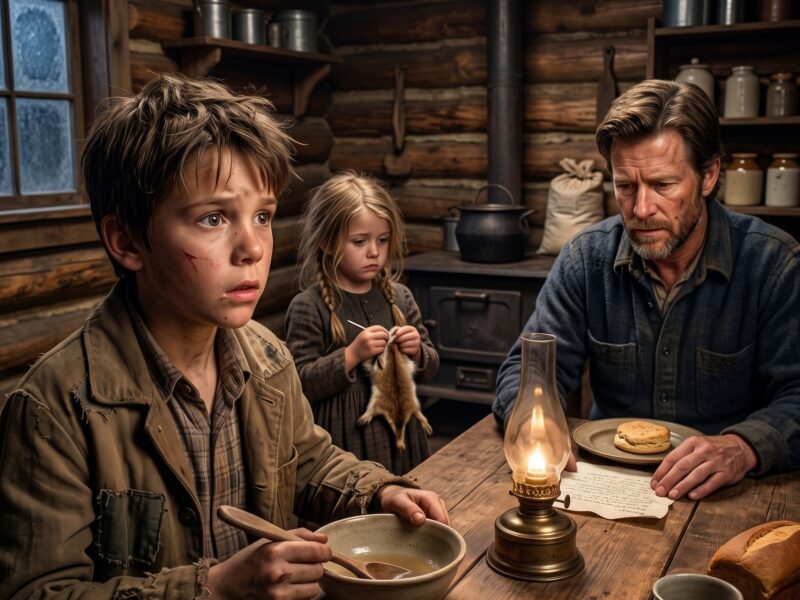
“Can My Sister Stay Too?” the Orphan Asked. The Rancher Quietly Set Another Place
The Thaw
By December, the children had fully memorized the shape of Silas’s days.
They knew he required two cups of black coffee before he would speak more than three words. They knew the barn lantern must be filled with kerosene before dusk, never after. They knew Bishop bit at coat buttons to demand apples, but never broke skin.
Eli officially became responsible for the chickens, the kindling box, and mucking the stalls. Nora, bundled in layers of Silas’s old shirts, gathered eggs when the snow was not too deep. She carried them in a wicker basket lined with raw sheep’s wool, walking with agonizing slowness, both hands clutching the handle, terrified of making a mistake.
The first time she broke an egg, disaster struck.
She was crossing the icy yard when her boot slipped. The basket tipped, and a single brown egg rolled out and cracked against the frozen earth.
Nora stood over the bright yellow stain in the snow and began to shake uncontrollably. Her breath hitched in panicked gasps.
Silas came around the corner of the barn, carrying a pitchfork. He stopped, taking in the scene.
“It slipped,” Nora whispered, tears finally spilling over her pale cheeks. “I didn’t mean to. I’m sorry. I’m so sorry.”
Silas walked over. He looked down at the broken shell, then down at the terrified girl. “I can see that it slipped.”
“There are… there are eight more in the basket,” she offered desperately, holding it up as a shield.
Silas nodded slowly. “Then we lost one egg.”
He waited. She stood frozen, waiting for the shout, the strike, the punishment her young life had taught her to expect for failure.
Instead, Silas gently took the basket from her trembling hands and carried it toward the house. After a few steps, he stopped and looked back. She hadn’t moved.
“Nora.”
She looked up, bracing herself.
“Come inside. Your nose is turning blue, and the stove is hot.”
That evening at supper, a profound shift occurred. For the first time since she had arrived, Nora spoke without waiting for Eli to give her permission.
“Mr. Mercer,” she said softly, her fork hovering.
Silas looked across the table from under his heavy brow. “Yes?”
“Could I please have more potatoes?”
Silas reached for the iron bowl and passed it to her. “Eat what you want, child.”
In late January, the temperature plummeted so violently that the iron nails in the roof shingles contracted and cracked like pistol shots in the night.
The loft became a freezer. Silas moved the children’s mattresses down to the kitchen floor, placing them as close to the radiant heat of the stove as he dared. He slept in a chair for three days, waking every two hours to shove more wood into the firebox to keep them from freezing.
On the third night, he woke from a doze to find Eli sitting bolt upright beneath his blanket, staring into the dark.
“What is it?” Silas whispered, his voice thick with sleep.
“Nora’s coughing,” the boy said, panic edging his voice.
Silas knelt beside the girl. She was tossing fitfully. He felt her forehead; it was cool. The cough was a dry, hacking spasm caused by the brutally arid, freezing air of the house, not a fever. He moved quickly, heating a tin cup of water and stirring in a generous spoonful of crystalized honey from a jar he had been hoarding for two years.
He lifted Nora’s head, helping her drink. The warm, sweet liquid coated her throat, and within minutes, she fell back into a peaceful, quiet sleep.
Eli, however, remained wide awake, his knees pulled to his chest.
“She used to get sick like this right after Pa died,” Eli whispered into the dark.
Silas sat on the floor, leaning his tired back against the warm iron leg of the stove. “What took your mother, Eli?”
“Fever. Down in the lungs. We were staying in a tent near the rail yard.”
“Was there a doctor?”
“Not one close enough. And not one that would come for free.”
Silas stared at the glowing stove door. A thin, fierce line of orange light showed around its edge, fighting back the dark.
Eli reached over and pulled the wool blanket higher over his sister’s small shoulder. “Before she died… she told me to keep us together. She made me promise.”
“You have,” Silas said softly.
“So far.”
The words hung in the air between them, heavy with the unspoken reality of the county guardian, the orphanage, and the fragility of their existence. Silas rose silently, added another heavy piece of wood to the fire, and went back to his chair.
The next morning, while the children were eating, Silas walked into his bedroom. He opened the top drawer of his dresser, moved aside the heavy wool socks, and took out an old, tarnished brass key.
He walked down the hall and stopped before the closed white door. He inserted the key. It turned with a stiff, protesting click.
Silas pushed the door open.
Dust danced thickly in the shafts of gray light fighting through the cracks in the drawn curtains. A narrow wooden bed stood beneath the window, still immaculately made with a faded blue, hand-stitched quilt. On a wooden wall shelf sat three intricately carved wooden horses and a small, polished willow whistle. A woman’s wicker sewing basket rested untouched beside a small rocking chair in the corner.
Silas walked in. He opened the heavy curtains, letting sunlight flood into the room for the first time in eight long years.
He moved to the shelf, his hands trembling slightly. He removed the wooden whistle and the three carved horses. He placed them carefully in a small cardboard box and carried the box to his own bedroom, sliding it under his bed.
Then, he returned to the room. He stripped the dusty sheets from the bed, took the blue quilt outside and beat the dust from it until his arms ached, and opened the window to let the crisp, freezing air scour the stale memory from the space.
When he turned around, Nora was standing tentatively in the doorway, clutching her doll.
“Whose room was this?” she asked, her voice hushed, sensing the sacredness of the space.
Silas kept his broad back to her, staring out the open window at the snow. “My son’s.”
“Where is he?”
“Gone.”
She stood quietly for a long time, processing the weight of the word. After a moment, she took a brave step inside and reached out, touching one corner of the freshly beaten blue quilt.
“Is it mine now?”
Silas turned. He looked at the tiny, fragile hand resting on the cloth his dead wife had sewn for their dead boy. He swallowed the massive, jagged lump of grief in his throat.
“If you want it,” Silas said.
She nodded solemnly.
That afternoon, Eli helped Silas haul one of the mattresses from the loft and place it on the floor beside the bed, so the siblings could stay together.
“I can stay upstairs,” Eli offered, misreading the situation. “The loft is too cold for her, but I don’t mind. Nora might want the room to herself.”
“The boy belongs with his sister,” Silas said simply.
Eli understood. They slept in the blue room that night, safe and warm.
Silas sat alone at the kitchen table long after the kerosene lamps were blown out. He looked at the shelf above the sink. Three washed tin plates stood leaning against the wood. He had once believed, with every fiber of his being, that an empty house was easier to keep. He had not understood how physically heavy the quiet of grief could become, until he felt it finally begin to lift.
Winter passed with agonizing slowness, but inside the house, the ice was melting.
The children grew wonderfully, terrifyingly less careful. Nora began humming tuneless, happy songs while she swept the floorboards. Eli stopped hoarding scraps of bread in his pockets, trusting that the pantry would be full tomorrow.
Once, in late February, Silas went to the barn and found Eli fast asleep, sitting in the straw with his back against Bishop’s stall door, a curry brush still clutched in his hand. Silas didn’t wake him. He fetched a heavy horse blanket, draped it gently over the boy, and finished mucking the stalls himself in silence.
On Sundays, they began a new ritual. They rode to Bellweather in the wagon.
Silas sat through the church service at the very end of the last pew, glaring at anyone who stared too long. Nora sat beside him, swinging her legs, wearing a pretty gingham dress that Mrs. Vail, the young schoolteacher, had altered from an old one she had found in a trunk. Eli sat on the other side, wearing a crisp new cotton shirt Silas had bought from Tally’s store without ever explaining why.
After the service, the townspeople gathered around the children, curious about the hardened rancher’s new acquisitions. Silas remained standing close by, his arms crossed, close enough to hear every single question.
Mrs. Bell, the mayor’s busybody wife, leaned down and asked Nora if she was being properly fed out there on that lonely ranch.
Nora looked up at Silas, a mischievous glint in her eye. “He makes too many beans.”
Mrs. Bell laughed heartily. Silas did not, but the corner of his mustache twitched.
Mr. Tally pulled Eli aside and asked if the rancher was paying him a fair wage for his labor.
“I get all the food I can eat, and new boots,” Eli said proudly.
“That is not wages, boy,” Tally scoffed.
“I also broke a shovel handle last week and didn’t get beat for it,” Eli shot back.
Tally looked over at Silas in shock.
“He did,” Silas said flatly, confirming the broken shovel. “It was a good hickory handle, too.”
By early March, Silas made a decision. He marched both children into the small, one-room schoolhouse in Bellweather and enrolled them.
Eli fiercely resisted. “I’m needed at the ranch, Mr. Mercer. Spring is coming.”
“You are needed in a school desk,” Silas countered, standing on the schoolhouse steps.
“I already know my numbers!”
“You can count cattle. That is not the same as knowing numbers.”
“I can read the feed sacks!”
“Then you will have less trouble reading the books,” Silas said, ending the argument.
Nora stood beside the wagon, clutching a small slate chalkboard Mrs. Vail had given her. She looked up at Silas, her eyes suddenly wide with the old fear of abandonment.
“Will you pick us up?” she asked, her voice trembling.
Silas knelt down in the mud so he was eye-level with her. “Yes.”
“When?”
“When the school bell rings that it’s finished.”
“You won’t forget us here?”
Silas reached out and gently tapped the brim of her red wool cap. “No. I will not forget.”
She smiled, turned, and marched up the steps. Silas arrived in the wagon an hour early that first afternoon, sitting in the cold, just to make absolutely sure he was the first thing she saw when the doors opened.









