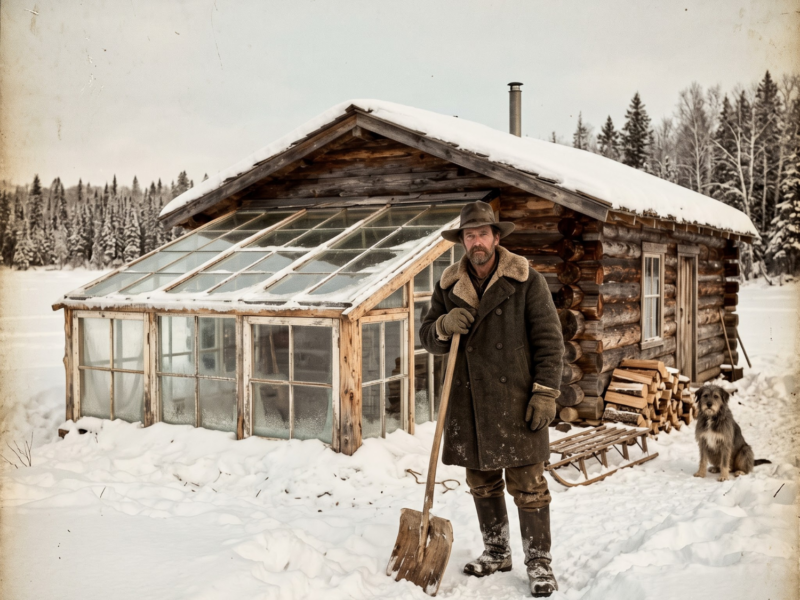
Everyone Laughed At His “Glass Shed” — Until It Heated His Cabin to 80°F for Free
THE LESSONS OF THE FIRST WINTER
Two years earlier, Lars Jensen had arrived in the Dakota Territory with little more than the clothes on his back, a set of wood-working chisels, and a head full of what his new neighbors immediately dismissed as impractical, European notions.
His first winter had nearly killed him.
The sod cabin he had thrown up in the late summer of 1884 followed standard homestead practice to the letter: twelve feet by sixteen feet, seven-foot interior height, with walls built from heavy prairie sod blocks cut three inches thick and laid like massive, earthy bricks. It had one small window, two-and-a-half by three feet, facing south, and a single wooden door centered on the west wall that opened directly into the main living room.
When the first serious cold arrived in December of 1884, the reality of the prairie set in. The interior temperature hovered stubbornly between forty and forty-five degrees at dawn, even with the small iron stove banked with fuel overnight. Outside temperatures dropped near zero, and his small cast-iron box ran almost constantly, consuming nearly two cords of precious, hard-to-find wood by February.
That first brutal winter taught Lars what every homesteader eventually learned: the thin margin between surviving a winter and living through it in misery could be measured entirely in degrees and cordwood.
While his neighbors accepted frozen water buckets inside their homes and visible plumes of breath indoors as normal, unavoidable parts of frontier life, Lars remembered the thick-walled timber houses of his Norwegian childhood. There, enclosed entry rooms—svalganger—trapped biting cold air in a buffer zone before it ever reached the living quarters.
More importantly, he recalled a New England saltbox house he had marveled at during his train journey west, where a small glass sunroom on the south side stayed warm enough for shirt-sleeves even on bright, freezing winter days.
By the spring of 1885, Lars had sketched his solution on a scrap of wrapping paper.
His plan called for an eight-by-ten-foot lean-to attached directly to the south wall of his cabin, with a roof sloping at roughly forty-five degrees to capture the low winter sun. The materials required salvaged window sashes—the kind that cost two to three dollars per pane new in town, but could be scavenged for the price of a few days’ labor if a man knew where demolished town buildings left their useful scraps.
Through the summer of 1885, Lars traded hard carpentry work with a merchant in town to acquire six old two-by-four-foot window sashes from a storefront being torn down. Forty-eight square feet of glass for less than five dollars in labor, compared to the thirty or forty dollars required for new windows of the same size.
When Lars mentioned his plans at the general store, Amos Reed had snorted openly.
“Going to grow cabbages right up against the house, Jensen?” Reed mocked.
Lars had kept his real intentions simple. “Just want a clean space for tools and boots.”
Reed shook his head. “That’s four good windows you’re throwing away on a mud porch. What keeps a cabin warm is solid wooden walls, not sunshine.”
Other customers nodded in vigorous agreement. Glass belonged inside a house, providing light and a view. Using it to enclose what amounted to an oversized doorstep struck them as the kind of expensive mistake greenhorn immigrants made before harsh experience taught them true frontier sense.









