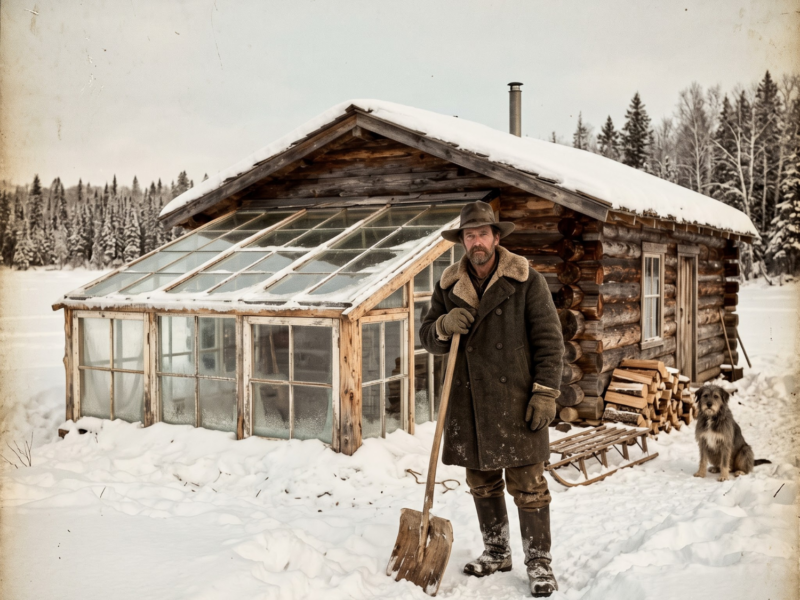
Everyone Laughed At His “Glass Shed” — Until It Heated His Cabin to 80°F for Free
THE BLIZZARD OF JANUARY 9TH
December 1886 brought the kind of early blizzard that separated successful homesteaders from those who would abandon their claims come spring. Eight to ten inches of snow fell in eighteen hours, driven by winds that turned the air white.
Lars prepared for this test by installing two mercury thermometers in his glass shed and one more in the main cabin, all hung at chest height to provide consistent readings. His neighbors considered this record-keeping another sign of impractical immigrant thinking, but Lars understood that precise measurement would prove his methods more reliably than subjective impressions.
On the blizzard’s first morning, with snow still falling and wind howling around the corners of every structure, Lars recorded his initial readings: outside temperature ten degrees above zero; glass shed temperature at dawn twenty degrees; main cabin temperature with the stove banked overnight fifty degrees—a full five to eight degrees warmer than he had achieved the previous winter with the exact same fuel consumption.
By midday, despite heavy overcast skies, the glass shed climbed to thirty-five degrees, while the main cabin maintained sixty degrees on minimal wood. The water barrels began their intended function, storing what little heat penetrated the clouds and releasing it slowly as afternoon temperatures dropped.
The airlock effect proved equally significant. When Tom Walker stopped by to check on his neighbors, Lars demonstrated the difference between conventional and buffered entry systems.
Walker opened his own cabin door to show how a gust of cold air immediately swept through his interior, making curtains flutter and dropping room temperature several degrees within minutes. At Lars’s place, Walker stepped into the glass shed that felt warm compared to the howling storm outside. When Lars then opened the inner door to the main cabin, warm air spilled outward rather than cold air rushing inward. The temperature drop in the main cabin registered less than two degrees.
Through late January, as neighbors struggled with frozen water buckets and interior temperatures dropping into the thirties overnight, Lars’s temperature log revealed consistent patterns. Dawn readings near zero showed the glass shed holding twenty to twenty-five degrees, while the main cabin remained above fifty degrees on banked coals alone.
By noon on clear days, even with outside air at fifteen below, the glass shed reached sixty-eight degrees and the main cabin climbed to sixty-three degrees with only a small maintenance fire.
Fuel consumption comparisons provided the most compelling evidence. Through January and February, Lars burned approximately two and a quarter cords total—a thirty to forty percent reduction compared to his neighbors’ consumption—while maintaining interior temperatures that never dropped below fifty degrees, even during the worst overnight cold snaps.









