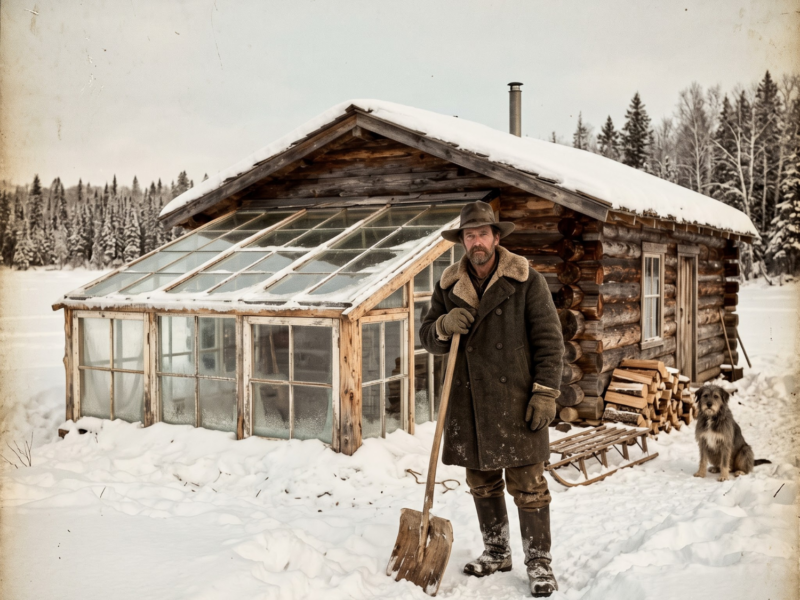
Everyone Laughed At His “Glass Shed” — Until It Heated His Cabin to 80°F for Free
THE SPREAD OF THE INNOVATION
By late February, as the worst of the killing cold finally began to moderate, quiet recognition of Lars’s achievement spread among the surviving homesteaders.
Tom Walker, whose criticism had been loudest during construction, spent four nights sleeping on the glass shed’s packed earth floor while tending his frostbitten son, deeply grateful for the warmth that made recovery possible. Eli Kaufman stopped by specifically to examine the thermal mass system and asked detailed questions about barrel placement and solar angles. Even Amos Reed, the skeptical storekeeper, admitted that maybe there was more to catching sunshine than most folks figured.
The spring of 1887 brought more than relief from the killing cold. As homesteaders emerged from the longest winter in territorial memory to assess their losses, a quiet revolution in frontier building practices began taking root across the northern plains.
Tom Walker became the first convert, spending most of April salvaging window glass from abandoned homesteads whose owners had fled south. His version of Lars’s design scaled down to available resources: a six-by-eight-foot addition using oiled paper for half the glazing and three salvaged storm windows from town for the critical south-facing exposure.
Eli Kaufman took a different approach, using his German background in masonry and thermal mass to create a more substantial version. His eight-by-ten-foot addition incorporated a stone wall along the back where Lars had used water barrels, creating permanent thermal mass that would never freeze or require maintenance.
By 1888, five different homesteads within a ten-mile radius had added some version of an enclosed south-facing entry space to their existing cabins. Each adaptation reflected its builder’s skills, available materials, and understanding of the underlying principles, but all shared the core elements that made the system effective: glazed south exposure to capture solar energy, thermal mass to store daytime heat for nighttime release, and an airlock configuration that prevented heated air from escaping during daily entries and exits.
Lars Jensen’s Norwegian understanding of thermal barriers and cold-climate building techniques had proven more relevant to Dakota Territory survival than the rapid construction methods that prioritized speed over comfort and assumed unlimited fuel supplies would always be available.
Word of the glass shed’s performance spread beyond immediate neighbors through the informal networks connecting scattered homestead communities. Traveling merchants and county officials carried stories of the immigrant farmer who heated his cabin to eighty degrees using only sunshine and salvaged windows.
County records from 1889 and 1890 reference several homesteaders who built sun porches or glass entries that kept their cabins unusually warm during severe winters, documenting the spread of what historians would later recognize as indigenous passive solar design on the American frontier.
The photographic record preserved by Clara Jensen, Lars’s granddaughter, showed the humble structure in its original form: rough wooden framing, salvaged window glass, and packed earth floors that appeared primitive compared to the substantial farm buildings replacing frontier cabins by the early 1900s. Yet the temperature readings written in Lars’s careful handwriting told a different story—documenting performance levels that modern passive solar designers would consider successful by contemporary standards for energy efficiency and thermal comfort.
Working with natural forces like solar energy and thermal mass produced better results than fighting them with increased fuel consumption and brute-force heating. The glass shed represented applied intelligence rather than lucky accident; traditional knowledge rather than folk superstition.
On the frontier, as Clara Jensen would later tell visitors to the old homestead, the men who lasted weren’t the ones who shouted the loudest about American methods and frontier independence. They were the ones who let old knowledge and free sunlight do the slow, quiet work that nobody believed in until the thermometer proved it effective.









