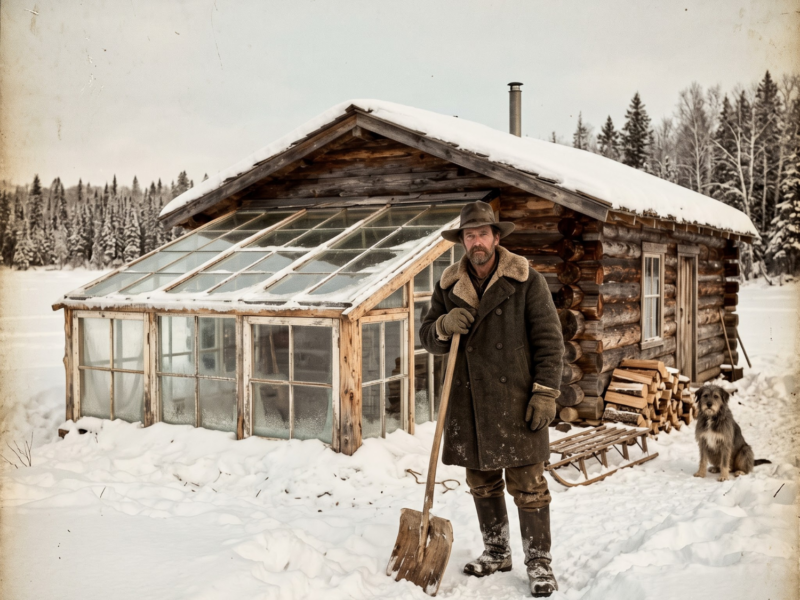
Everyone Laughed At His “Glass Shed” — Until It Heated His Cabin to 80°F for Free
THE FIRST WINTER TESTS
October 1886 brought the season’s first hard frost. While his neighbors focused entirely on banking extra sod around their foundations and splitting additional cordwood, Lars spent his daylight hours making his structure function as intended.
The salvaged window sashes required individual fitting and meticulous weatherproofing to prevent drafts. Because no two frames matched exactly, Lars spent three full days shimming and adjusting the lower row using strips of wood and packed moss.
The thermal mass system demanded equal precision. Modern passive solar guidelines suggest roughly one cubic foot of thermal mass for each square foot of south-facing glass. With forty-eight square feet of glazing, Lars needed approximately forty to fifty cubic feet of effective mass. His water-filled barrels provided close to forty-five cubic feet—a ratio that would prove nearly optimal for the climate.
Testing began immediately as the structure neared completion. On clear autumn days with outside temperatures hovering in the forties, the glass shed reached seventy to seventy-five degrees by mid-afternoon, demonstrating the massive solar potential that would become crucial during the winter months.
More importantly, the cabin interior—with its stove burning only moderately—held a steady sixty-two degrees instead of the previous mid-fifties. The difference represented the complete elimination of cold air infiltration through repeated door openings, plus the bonus of pre-warmed air from the solar buffer zone.
The community response remained overwhelmingly critical as winter approached. Eli Kaufman, a German homesteader whose cabin sat two miles east, warned that glass breaks when it gets too hot too fast. Amos Reed continued spreading skepticism from his general store.
Even Marta Jensen expressed quiet doubts. She appreciated the enclosed space for hanging wet clothes and storing tools where they wouldn’t freeze, but wondered if the effort might have been better spent on a larger stove.
“It’s a fine mudroom,” she told Lars one evening. “But I hope it does more than keep snow out of our boots.”
The first serious test came with a three-day storm in mid-November that dropped eight inches of snow and sent temperatures into the single digits. Standard frontier wisdom called for firing stoves constantly during such weather, burning through precious cordwood to maintain barely tolerable conditions.
Lars chose instead to let the solar heating carry as much load as possible, feeding his stove only enough to prevent the cabin from dropping below fifty degrees overnight.
On the storm’s second day, with heavy clouds blocking direct sunlight, the glass shed still reached forty-five degrees while outside temperatures held steady at seven above zero. When the sun broke through on the third afternoon, temperatures inside the addition climbed rapidly to over sixty degrees, and the main cabin maintained comfortable conditions with minimal firing.
Most significantly, Lars burned only half a cord of wood through November, while Tom Walker and other neighbors with standard single-door cabins consumed nearly a full cord while maintaining similar interior temperatures. The fuel savings alone would pay for the glass shed’s construction costs within two winters.









