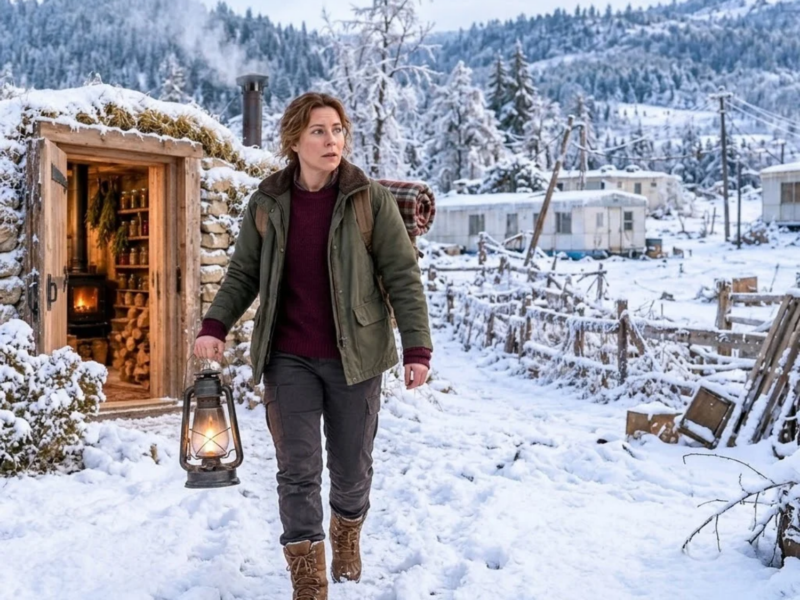
Evicted in October, She Moved Into a $60 Hillside Root Cellar — Then the Ice Storm Cut Power 9 Days
The Dirt and the Smoke
That night, she lit the kerosene lamp and looked at what sixty dollars had bought her: a mud floor, rotted shelving furred with white mold, and a smell like the inside of an old boot. One corner of the stone wall had slumped, spilling dirt in a fan across the floor, and something had died in it once, long enough ago to be only a stain and a few small bones.
The lamp hissed. The dark leaned in around the little ring of light.
“All right,” Pam said out loud, to the dirt, to the bones, to the whole grinning town at the bottom of the hill. “All right, then.”
She started with the shovel. Forty buckets of mud and rot came out of that cellar the first week, hauled up the slope one aching armload at a time, her breath smoking in the October air, her shoulders screaming by noon.
She tore out the rotted shelves and burned them in a pit outside, the smoke smelling like vinegar and dead years. She rebuilt the slumped corner with the stones that had fallen out of it, fitting them back like a puzzle her granddad had taught her forty years before, tapping each one home with the butt of the maul. Dry stack work, cold work. By the end of each day, her fingertips were split at the corners—little red mouths that opened again every morning when she made a fist.
Walt’s straw went up next. Bales stood against the stone walls two deep, a skin of warmth between her and the hillside. She laid down shipping pallets from behind the IGA and fledged them over with planks from Walt’s fallen tobacco barn, and for the first time, her boots didn’t sink when she walked.
The cellar stopped smelling like a grave and started smelling like a barn, which was an improvement nobody down the hill would have understood.
The stove nearly broke her. Walt pointed her at the old Pine Fork schoolhouse on the back of his land, its chimney collapsed into the weeds in a heap of hard orange brick. “Take all you can carry,” he said.
So she carried for three days, brick by brick, in a wheelbarrow with a wobbling wheel, uphill in rain that turned the path to grease. She mixed mortar in a feed pan with water so cold it ached to the elbow. And she built a firebox the size of a breadbox against the back wall, learning as she went, tearing down two days’ work once because the courses leaned. She ran salvaged stovepipe up through a gap she’d framed beside the door, packed round with clay and tin.
The first fire filled the cellar with smoke in four minutes flat. It rolled off the ceiling beams and came down at her like a falling blanket, and she crawled out the door on her hands and knees, coughing until she wretched, eyes streaming, and sat in the dead grass in the dark with the smoke pouring out over her head.
Below, the lights of Maple Run glittered, warm and electric and easy. She could see the blue flicker of Doyle Crance’s television through his window. She sat there a long time with her arms around her knees.
That was the night she nearly quit. She had her sister’s number in Dayton on a scrap in her coat pocket, and she took it out and looked at it by lamplight—a phone number that meant a fold-out couch, a brother-in-law’s sighing patience, and every word Doyle had said made true forever.
The wind came over the hill and moaned against the oak door behind her, a low animal sound. She listened to it and understood in a bare-knuckle kind of way that nobody in the world was coming up that hill to help her, and that she had maybe known that her whole life, and that it was almost a relief to finally see it plain.
She put the number back in her pocket.
In the morning, she borrowed a ladder, added four feet of pipe above the doorframe so the flue cleared the brow of the hill, and wired a damper plate into the stack. The next fire drew like it was being pulled from above. The smoke went up and out, and the little brick box ticked and creaked and threw heat, and Pam Hutchkins stood in her hole in the ground with her hands open over the stovetop and laughed until she had to sit down.









