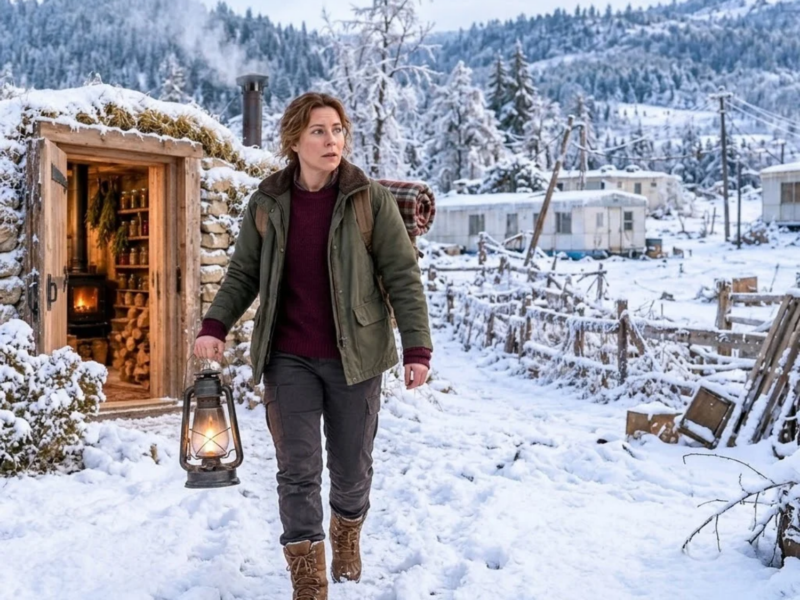
Evicted in October, She Moved Into a $60 Hillside Root Cellar — Then the Ice Storm Cut Power 9 Days
The Glass World
Then, on a Thursday in the middle of January, the radio on the shelf crackled through the weather and said a word that made Pam set down her cup: Ice.
Freezing rain beginning Friday night. A half-inch, maybe more. Power crews on standby across three counties.
Down the hill, Maple Run glowed and flickered, warm and electric and easy. Pam looked at her woodpile, then went out in the falling dusk and started splitting more. The maul rose and fell in the failing light until her shoulders burned, and the stack by the door stood chest-high, and still she split.
Because the radio’s voice had been too calm, and calm voices on a weather report were like calm doctors. They’d already seen the chart.
She hauled the last armloads inside, filled every bucket and jug she owned at Walt’s spring, banked the stove, and lay down, listening to the first of it arrive after midnight. Not the rattle of sleet, but something softer and worse—a whisper. Freezing rain laying itself down on the world drop by drop, turning to stone where it touched.
By Friday night, the whisper had become a crackling, groaning dark. Pam cracked the oak door and shone the lamp out into it, and the light came back at her off a hillside sheathed in glass. Every blade of dead grass cased in ice; every cedar bowed like a mourner; the blackberry canes bent to the ground in silver hoops.
Somewhere down the valley, a limb let go with a crack like a joint popping. Then another, then a whole tree at once—a long, tearing crash that rolled up the slope.
And then the sound she’d been waiting for without knowing it: a sharp blue-white flash from down past the park, lighting the bellies of the clouds, and a bang like a shotgun in a culvert—a transformer. Then a second flash farther off.
Then the lights of Maple Run—every porch bulb, every warm window, the blue flicker of Doyle Crance’s television—went out all at once, and the valley fell into a dark so total it was like the lid of the world had been shut.
Pam stood in her doorway with the lamp, one small ring of orange on the whole black hillside. And the rain kept whispering down, coating the stovepipe, beading on the oak planks, finding nothing it could get into.
The cold came in behind the rain like a second army. Saturday, the thermometer outside read 19. Sunday, 11.
The radio, running on its batteries, said crews were cutting their way toward lines that were down in 300 places. It said the word days. It said shelters were opening in the school gym two towns over for anyone who could get there—and nobody could get there, because every road out of Cane Ridge was a glazed chute strewn with fallen timber.
Down at Maple Run, she could see them fighting it. Kerosene heaters glowing dull orange through windows. Truck engines idling in driveways. Families huddled in the cabs for heat, exhaust rising in thin, desperate columns.
A trailer was a tin can on blocks, skirted with plywood, floored with a draft. Without electric heat, it went to freezing in hours and kept falling. She watched a man take an axe to his own porch rail for firewood Sunday afternoon and burn it in a barrel in his yard, standing close, turning like meat on a spit.
Her cellar held at 54° before she lit the morning fire. With the stove going, it sat at 68°, the beams ticking gently, the straw walls holding the heat like cupped hands. She cooked beans and cornbread on the stovetop. She melted ice for washwater.
On the second night, with the wind screaming over the brow of the hill hard enough to bend the lamp flames, she slept eight hours straight and woke almost ashamed of it.









