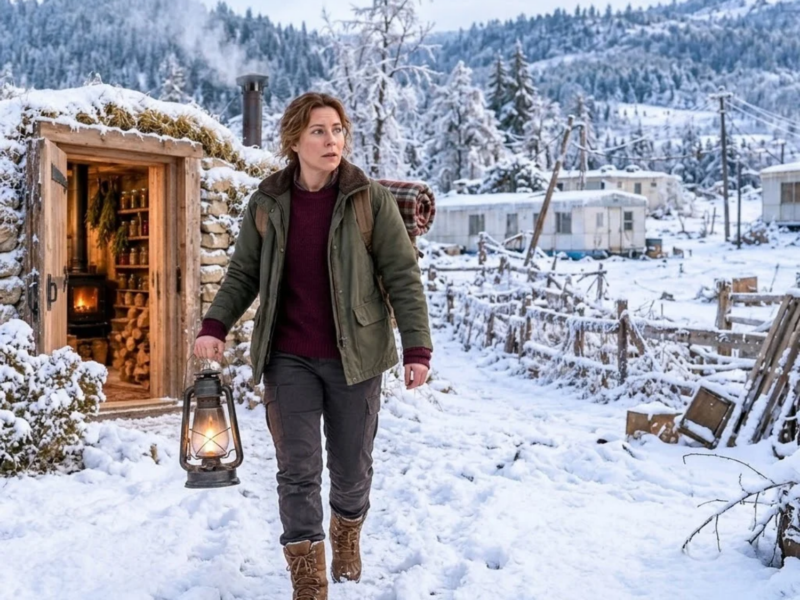
Evicted in October, She Moved Into a $60 Hillside Root Cellar — Then the Ice Storm Cut Power 9 Days
The Village in the Hill
They stayed nine days—not just the three of them—before it was over.
Word moves downhill fast, and by the fifth morning of the blackout, there were eleven people sleeping in shifts in Walt Simmons’s father’s root cellar: the Crances; the young couple from Lot Nine with a baby that had cried itself gray in the cold; two old bachelor brothers from the end row bedded on straw.
Walt hauled down on his tractor with chains on the tires, feeding out his own beans and a deer one of the brothers had in his freezer that wasn’t a freezer anymore.
It was warm every single hour of every single day while the valley below them stayed black, and the radio counted the outage in column inches. Twelve feet into the hill, the storm of the decade was a sound on the far side of four feet of earth. The baby slept. The old men played cards by lamplight. Ida sat propped like a queen nearest the stove and told stories about winters before the power ever came, when every farm on this road had a cellar like this one, and nobody laughed at a single word.
Doyle worked. That was the thing nobody down the hill would have bet on. The man split wood from first light until his hands bled into his gloves, hauled water from the spring with ice in his beard, and never once sat down to eat until Pam had.
He didn’t make speeches. Men like Doyle don’t. But on the seventh morning, Pam came out to find him standing at the woodpile with the maul hanging from his fist, looking down at the dead black park where his double-wide sat with its pipes burst and its warmth long gone.
He said without turning around, “$60.” He shook his head slow. “I spent more than that last month on satellite TV.”
The maul came down. The oak cracked clean. “You want to know what I had, Pam? I had everything hooked to a wire. One wire.” He set the next round. “You cut the wire, and I had a tin box and a smart mouth.”
“You had a strong back,” Pam said.
“Turns out,” he almost smiled—it looked out of practice—”casket joke? I’d take that one back if the Lord sold refunds.”
“Keep it,” Pam said. “It kept me splitting.”
Epilogue: The Foundation
The power came back on the ninth day in the afternoon, porch lights blinking on down the rows of Maple Run like the valley opening its eyes.
There was a little silence in the cellar when they heard the cheer float up the hill. Then there was packing and awkwardness—Rhonda hugging Pam too hard and too long, the young mother crying again (warm tears this time), and the bachelor brothers each shaking her hand with both of theirs.
Ida went up the hill path on her son’s arm. At the top, she stopped, turned, and looked back down at the oak door in the hillside for a long moment, the way you look at a church.
Things were different in town after that, in the unspoken way small towns are different. The laundromat women talked to her now instead of around her. At the diner, men who’d laughed in October asked her quietly, almost shily, what a fellow would want to look for in a slope—how deep was deep enough, what she’d done about the flue.
Come spring, there were three new cellars dug into hillsides around Cane Ridge, and Doyle Crance was the first. Pam laid out the stone courses for him herself, and he paid Walt for the bricks. When somebody at the Gas & Go started to rib him about it, witnesses say Doyle looked at the man so long and so level that the joke died of natural causes.
Pam stayed on the hill. She had a town’s worth of warm houses she was welcome in now, but she visited and came home to the lamp, the stove, the straw walls, and the deep quiet of the earth.
Some nights, with the wind running over the hill like water over a stone, she’d lie there and think about October: about the taped notice, the coffee can, the small feet running away from her door, and about how sure they’d all been—how comfortable, how loud.
The ground had known better. She had known better.
The trick, her grandfather’s voice said somewhere behind her ribs, was never that the crowd was cruel. The trick was that the crowd was certain, and certainty is cheap when it’s somebody else’s winter.
She’d bank the stove and watch the lamplight on the beams until her eyes closed. Fifty-four degrees before the morning fire. Paid in full.









