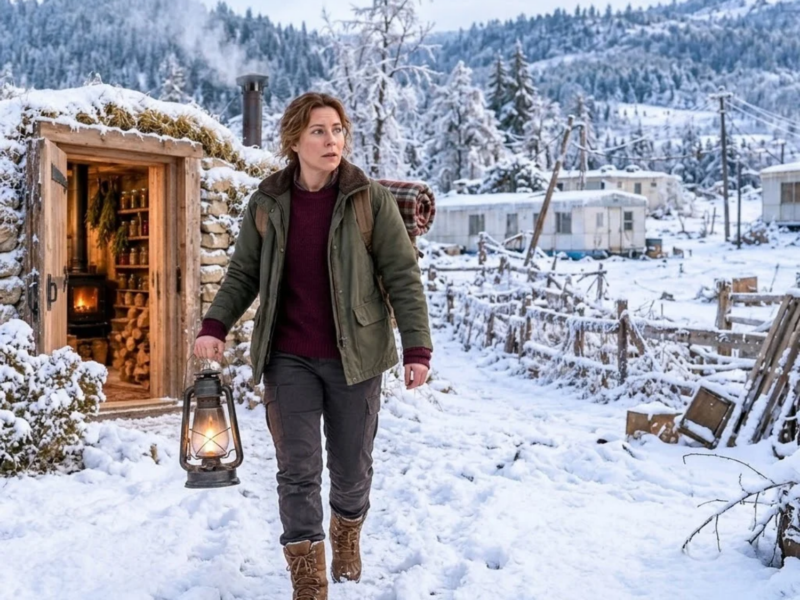
Evicted in October, She Moved Into a $60 Hillside Root Cellar — Then the Ice Storm Cut Power 9 Days
The Door Opens
On the third night, the knocking came.
It was past ten. The fist hit the oak door hard, three times. Then three more, panicked, and a voice she knew came through, the planks cracking down the middle of every word:
“Pam! Pam, you in there? God—Pam!”
She lifted the lamp and swung the door open, and the cold poured in over her boots like floodwater.
Outside stood Doyle Crance. No toothpick, no grin. His coat was zipped to the chin and iced across the shoulders. His bare hands were the color of raw chicken, and his eyes in the lamplight were the eyes of a man who had been doing arithmetic for three days and had finally run out of numbers.
Behind him, Rhonda stood hunched under two coats, and between them, wrapped in a quilt with only her face showing—small as a child against her son’s chest—was Ida.
“It’s Mama,” Doyle said. His voice broke, and he hated it breaking; she could see him hate it. “Heater’s been out since morning. We’ve been burning what we got. It’s… it’s 26° inside the house, Pam. I can see my breath standing at my own stove. She quit shivering about an hour ago. She quit shivering. And I didn’t know where else…”
He stopped. His jaw worked. Ice cracked off his sleeve and fell glittering.
“I know what I said. I know every damn thing I said.”
Pam looked at him for one second—just one—long enough for the whole of October to pass between them: the cold air, the fence, the toothpick, the casket joke, the laughing men. Doyle stood in it and took it because his mother was freezing to death in his arms, and he had carried her up an iced hill in the dark to the door of the hole he’d laughed at.
Then Pam stepped back and held the door wide.
“Get her by the stove,” she said. “Mind the step down.”
They came in out of the dark into the warm, and Rhonda made a sound at the threshold—not a word, just a gasp, the sound a body makes when 68° closes over it after days at 26°.
Pam pulled her own straw tick around in front of the firebox, and Doyle laid his mother down on it like she was made of eggshell. Ida’s lips had a gray cast, and her eyes were half-open and far away. Pam had seen cold like that in calves; she knew the rule: slow heat from the core out.
She put the kettle on, warmed a brick on the stovetop, wrapped it in a towel, and set it against the old woman’s breastbone, then another at her feet. She spooned warm sugar water between her lips a sip at a time while Doyle knelt on the planks with his mother’s hand swallowed in both of his, saying, “Mama. Mama,” in a voice no one at the Gas & Go would have recognized.
It took an hour. The lamp hissed. The stove ticked. The wind clawed the hillside above them and found nothing.
And somewhere past midnight, Ida Crance began to shiver again—hard, rattling, her teeth clicking—and Pam let out a breath she’d been holding, because shivering meant the furnace inside had relit. A while after that, the old woman’s eyes came the rest of the way open and traveled slow around the straw walls, the brick stove, the strings of dried beans, the lamplight on the oak beams, and landed on Pam.
“Whose house is this?” she whispered.
“Mine,” Pam said.
Ida looked at it all again. “It’s warm,” she said with wonder, like a verdict, and went to sleep.
Doyle sat back against the straw and put his face in his hands, and his shoulders went for a while silently. Pam put coffee in front of him and looked somewhere else until he was done.









