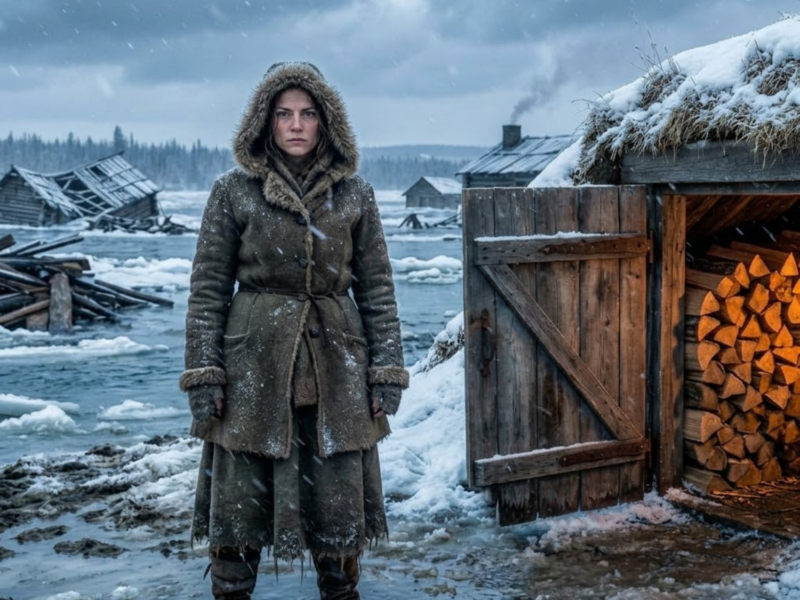
Exiled at 16 for “Lying” About the Winter Floods… She Built the Only Shed That Kept Firewood Dry
THE CAPTAIN’S DAUGHTER
To know why Emma Larson saw what others missed, one had to look at the life of Henrik Len.
For a quarter-century, Henrik had captained sternwheelers on the Columbia and the Willamette—monsters of cedar and iron that fought the current with four-foot paddles and high-pressure boilers. A riverboat captain on the mid-century frontier was part meteorologist, part gambler, and part priest. He had to smell a bar forming in the dark three miles ahead, read the color of a mud-slick to know if a mountain creek was dumping silt from a slide, and calculate the height of a spring freshet by the shape of the foam curls eddying around a piling.
Emma had been his clerk, his shadow, and his second pair of eyes since she was nine years old.
While other girls in the valley were learning to embroider samplers and press dried ferns into leather books, Emma was standing beside her father in the wheelhouse, squinting through the salt-etched glass as the black basalt walls of the Columbia Gorge rushed past at twelve knots.
“Look at the cloud-shelf over Mount Hood, Emmy,” Henrik would say, his hand resting heavy on the varnished spokes of the walnut wheel, his beard graying at the temples like wood-ash. “See how it’s flat on the bottom and feathered at the edges? That’s not a west wind. That’s a Chinook rolling off the salt chuck. It’s eating the snow off the timberline even as we talk. When you see that cloud in October, you don’t bank on a dry winter. You bank on water.”
In 1868, the river began to change—or perhaps the company changed around him. Steam was giving way to rail; the Oregon Steam Navigation Company wanted younger men who didn’t argue about water levels with eastern-schooled directors in San Francisco. Henrik took his severance, bought a stubborn eighty-acre farm three miles upriver from Willamette Falls, and settled down to break the red clay with a two-horse team and an iron plow.
It was a hard life, but a quiet one, until the July morning in 1874 when Henrik sat down on the front porch to grease his boots, gave a short, sharp sigh, and toppled sideways off his bench with his heart stopped cold in his chest.
He left Catherine Larson and his daughter with twenty cleared acres, a barn that needed new cedar shakes, an old bay mare named Bess, and a head full of unwritten river lore that the settlement leaders regarded as the harmless eccentricities of an old man.
Except that Henrik had been right about the 1862 flood—the one that washed away the lower warehouses at Linn City. And he had been right about the late ice of ’69.
And Emma, who had inherited his cool, gray-eyed observation, had spent the late summer of ’74 watching the signs align with the terrifying precision of a clockwork mechanism.
The first warning came from the mountains. In August, two trappers coming down from the high meadows near Mount Jefferson stopped at the Larson farm to buy buttermilk. They were lean, bearded men who smelled of pine gum and woodsmoke.
“Never saw anything like it, little miss,” one had told Emma while tipping a tin cup to his lips. “The elk are moving down out of the timber a month early. And the snow up in the cirques—it ain’t powdery like it usually is in late summer. It’s packed hard, heavy, gray stuff. Like it’s already holding water.”
The second warning came from the fish.
In September, the salmon run in the Willamette behaved with a strange, frantic perversity. Instead of lingering in the deep pools below the falls to spawn in the shallows, the chinook were driving themselves against the rocks in massive, suicidal schools, fighting water that wasn’t yet high enough to help them over the ledge.
Emma knew what that meant. The water temperature out in the Pacific was running three degrees above normal. The warm Kuroshio current was pushing farther north than usual, pulling moisture-laden air straight toward the Oregon coast like a wet sponge dragged across the sky.
When she tried to explain this to the town council on October 10th, she used the terms her father had used: atmospheric blocking, thermal inversion, snowpack saturation.
To Chairman Morrison, these were not scientific observations. They were the insolent noises of a girl who refused to know her place.









