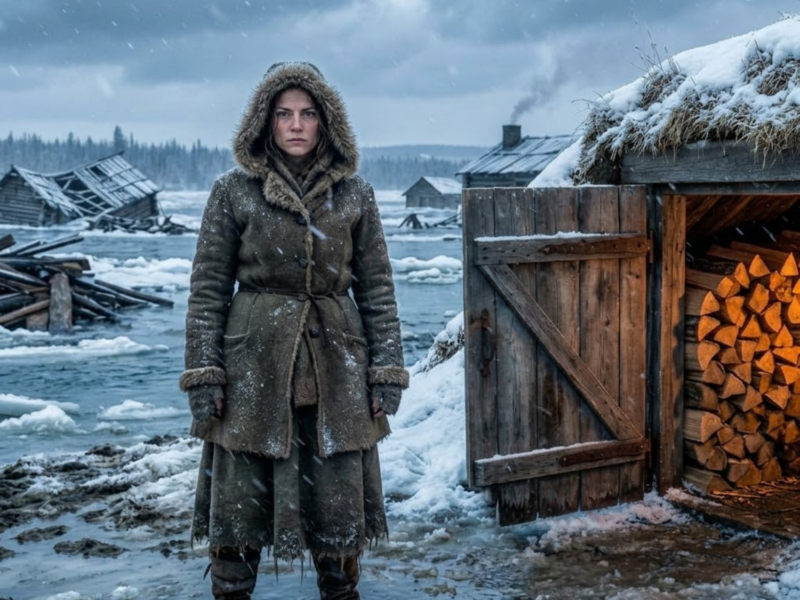
Exiled at 16 for “Lying” About the Winter Floods… She Built the Only Shed That Kept Firewood Dry
THE WARM RAIN
The change came on the night of December 26th.
Up until Christmas Day, the valley had enjoyed a crisp, sparkling frost. The grass was silver with rime every morning, the puddles on the wagon tracks were frozen two inches deep, and the woodsmoke from the chimneys of Willamette Falls rose straight up into the pale blue sky like gray ribbons hung from the ceiling of the world.
People in the town had begun to laugh about the Larson girl’s “ark on stilts.”
The general store had even started a running joke: Go on up to Emma’s bench if you want to see a girl who’s more afraid of a damp stick than an Indian raid.
Then the wind shifted.
At midnight on the 26th, a low, ominous groaning sound rolled down the Columbia Gorge—the sound of millions of tons of warm, maritime air slamming into the cold continental barrier anchored over the Cascades.
By dawn on the 27th, the temperature had climbed twenty-five degrees in four hours. The frost vanished from the grass in a single steaming hour, replaced by a gray, greasy mist that turned the valley roads into red-clay porridge.
And then the rain began.
It wasn’t a shower. It was a solid, unrelenting wall of water dropped directly from the belly of the Pacific. It hammered on the cedar shakes of Emma’s tent with the roar of a thousand drumsticks beating on leather.
Up in the high country, four thousand feet above the valley floor, the rain was hitting the four-foot snowpack with the temperature of a lukewarm bath.
Six feet of snow, saturated with moisture and pounded by forty-mile-an-hour gales, didn’t melt; it liquefied. Millions upon millions of gallons of gray, sludgy water began to pour off the timberline, roaring down the steep ravines of the Clackamas, the Santiam, and the upper Willamette into the main stem of the river.
By the morning of December 29th, the river had risen four feet.
By New Year’s Day, it was eight feet above normal winter level—higher than the average spring high-water mark, and January hadn’t even shown its teeth yet.
Down in Willamette Falls, the panic did not arrive all at once; it crept in through the floorboards.
Thomas Fletcher woke up on January 3rd to find that the cold, grey water of the river was lapping lazily against the lower three steps of his front porch. His six cords of oak and fir—stacked neatly on the ground beneath a canvas tarp behind his barn—were already half-submerged in a tea-colored eddy of river silt and floating cornstalks.
“It’s just a rise,” Fletcher told his wife, his voice shaking slightly as he tried to light his pipe with a damp match that hissed and died. “The water always comes up a bit when the mountain rains hit. It’ll drop by tomorrow.”
It didn’t drop.
January brought the exact cyclical terror Emma had described to the council chamber three months before.
First, a three-day freeze would drop down from the north, coating the flooded yards in jagged sheets of black ice and turning the rising water into a sluggish, slush-choked slurry. Families would huddle around their hearths, burning green wood that hissed, smoked, and produced more tears than heat.
And then, just as the children’s lips were turning blue and the old people began to cough with that hollow, rattling chest-infection that meant pneumonia, the Pacific pump would turn back on.
Another warm, moist storm would roar inland, dumping four inches of rain in twenty-four hours, melting the newly formed snowpack, and driving the river up another three feet over the previous high.
By January 15th, the river had climbed sixteen feet above normal.
Willamette Falls was no longer a town; it was a collection of muddy islands connected by flat-bottomed boats and floating fence rails. The lower commercial district—including Morrison’s sawmill and Whitfield’s grain warehouse—was sitting under four feet of swirling brown water. Desks, ledgers, barrels of salt pork, and bolts of calico were floating out the broken windows and heading downstream toward Portland.
And in ninety different homesteads and town lots, the great crisis of the winter revealed itself in all its grim, freezing reality.









