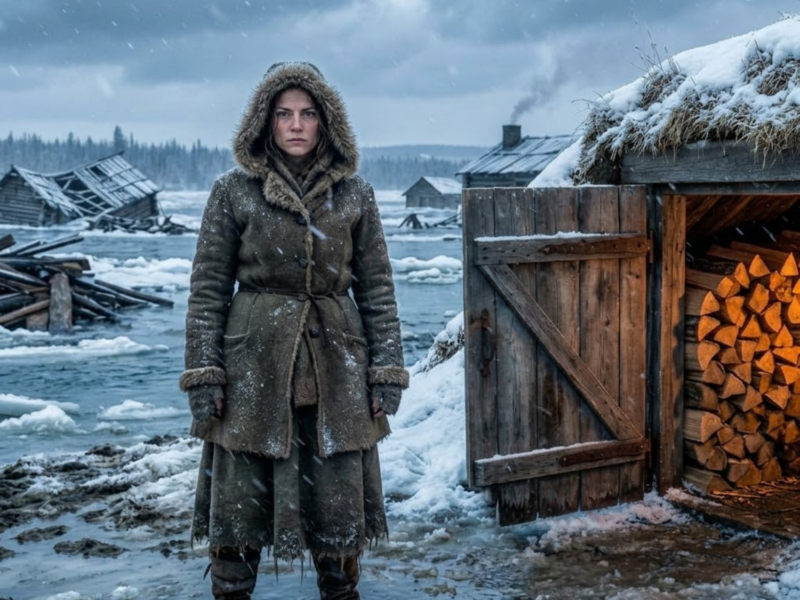
Exiled at 16 for “Lying” About the Winter Floods… She Built the Only Shed That Kept Firewood Dry
THE SPRING OF THE ADVISOR
The floods did not recede until the middle of March.
When the river finally dropped back within its basalt banks on March 8th, 1875, the damage was tallied: twelve buildings completely swept away, thirty homes structurally ruined, and nearly fifty thousand dollars in lost property across the settlement.
Yet, despite two months of biblical inundation and an arctic freeze that had split stones, the human toll had been held to those two tragic deaths from the first night of the cold snap.
Every other soul in Willamette Falls had survived—warmed, cooked for, and kept alive by the thirty cords of dry timber Emma Larson had hauled down the hill on sledges during the height of January.
On March 1st—the exact day her sentence of exile had officially expired—the town council held an emergency meeting.
They couldn’t meet in Morrison’s sawmill office; the lower floor was still coated in a three-inch layer of dried gray river silt. Instead, they gathered in the dry, sunlit clearing of Emma’s bench land, standing respectfully before her cabin door like suppliants before a queen.
William Morrison, looking ten years older and walking with a permanent hitch in his left knee from the damp, stepped forward holding a heavy parchment document embossed with the town seal.
“Emma,” Morrison said, clearing his throat. “The town council has met. By unanimous vote—four to zero, with one abstention from a man who is currently drying out his grain bins—we have formally rescinded your order of exile. Furthermore, we wish to offer you the permanent position of Community Flood Advisor to Willamette Falls, with an annual stipend of one hundred dollars from the municipal treasury.”
Emma looked at the paper. She looked at Morrison, then at Whitfield, who nodded slowly, his expression chastened and sincere.
“I’ll take the position, Mr. Morrison,” Emma said, taking the parchment from his hands. “On one condition.”
“Name it,” Morrison said quickly.
“Every new structure built below the fifty-foot contour line must use elevated piling foundations for storage rooms, and every firewood bin in this settlement must be built off the ground with louvered ventilation, exactly like the one behind me.”
Morrison smiled—a tired, genuine smile that reached his eyes for the first time in a year. “Done. We’ll pass the ordinance at the next sitting.”
EPILOGUE: THE IRON WIDOW OF CANEMAH
Emma Larson did not remain an exile for long, nor did she remain a lonely prophet on the hill.
In 1878, she married a quiet, deeply observant Swedish immigrant carpenter named Eric Peterson who had come up from Astoria to help rebuild the ruined mills. Eric had a genius for structural stress and water drainage; together, they formed Larson & Peterson Builders, a firm that specialized in flood-resistant commercial structures, elevated timber docks, and dry-storage warehouses that could laugh at a ten-foot rise in the Willamette.
They had four children—two boys who went on to study civil engineering at the state agricultural college, and two girls who inherited their mother’s sharp, gray-eyed appraisal of the sky.
Emma lived until 1938, dying at the age of eighty in a white-painted farmhouse that sat proudly on the high bench above Canemah, looking down across a valley that never forgot the winter the river tried to swallow them whole.
When her obituary appeared in the Oregonian, it didn’t focus on her business success or her grandchildren. It focused entirely on those seventy-two hours in October 1874 when a sixteen-year-old girl packed her bags, walked out into the mud, and built an ark out of cedar shakes and stubborn truth.
Modern hydrologists, studying the records of the 1874–75 winter decades later, confirmed what Henrik Len had known from the deck of his sternwheeler: the flood had been a rare, violent atmospheric river event—a phenomenon of warm Pacific moisture hitting a trapped arctic front that would not be formally classified by science for another hundred years.
Yet science wasn’t what saved Willamette Falls.
Preparation saved it. Listening saved it. And the cold, unyielding courage of a girl who knew that when the sky turns the color of a bruised plum, you don’t trust forty years of comfortable assumptions.
You build your floor four feet off the ground, you split fifty cords of fir, and you wait for the water to come.









