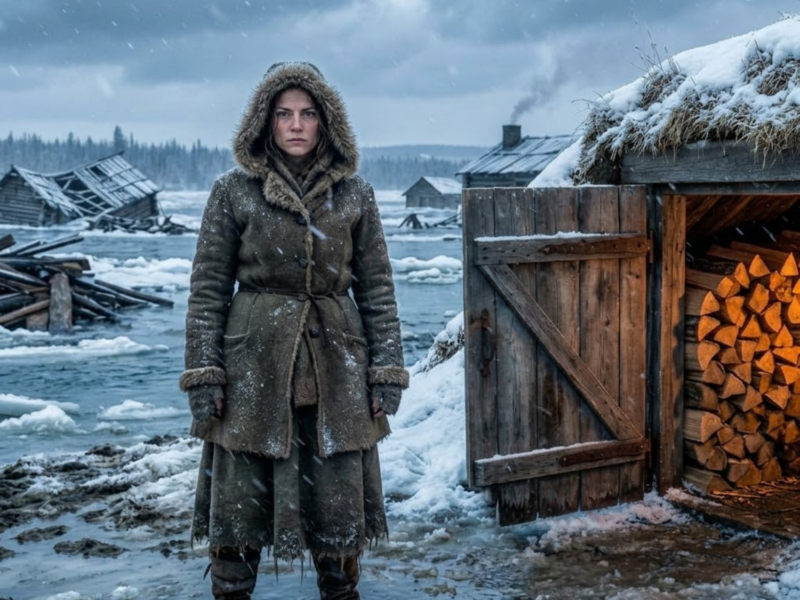
Exiled at 16 for “Lying” About the Winter Floods… She Built the Only Shed That Kept Firewood Dry
THE FREEZING OF THE SETTLEMENT
Thomas Fletcher’s firewood pile was the first to demonstrate the fatal flaw of conventional frontier storage.
On January 10th, needing dry fuel to keep his three youngest children from developing lung fever, Fletcher waded out into the icy water behind his barn to pull logs from his stack.
The water was up to his thighs, numbing his legs until he could barely feel the jagged rocks beneath his boots. He reached for the top layer of his stack, expecting at least some dry wood beneath the canvas tarp.
When he lifted the canvas, a cloud of foul, moldy steam hit his face.
The tarp, weighted down by pools of rainwater, had leaked at the seams. Every single billet in the top third of the stack was swollen, gray-green with furry mold, and dripping wet.
When he dug deeper, pulling away the outer logs to reach the center of the pile, he found that the bottom half of the stack had been sitting in four feet of standing water for a week.
The oak logs had wicked the moisture upward like giant wooden sponges. When he tried to split one open with his froe, water beaded on the fresh-cut grain.
That night, Fletcher tried to burn the wood in his stone fireplace.
He used half a tin of lamp oil and three dry tallow candles to coax a flame. The logs caught grudgingly, but instead of throwing out the fierce, red heat of seasoned oak, they hissed like angry snakes, vomiting thick, acrid columns of white smoke that filled the cabin until his wife and children were coughing uncontrollably, their eyes streaming.
The fire didn’t warm the room; it cooled it, sucking the heat out of the air to vaporize the water trapped inside the wood cells.
By midnight, the temperature inside the Fletcher cabin had dropped to thirty-eight degrees. A thin skim of ice had formed across the surface of the washbasin by the door.
Across the settlement, the story was identical.
Sarah Morrison had her eight-cord supply stored under the low eaves of her barn. When the flood rose four feet, the entire stack was submerged for four days. When the water finally receded six inches, her wood was a waterlogged mass of dead weight, useless for anything except rotting.
James Whitfield, the great landowning councilman who had shouted Emma down with such righteous fury, fared no better. His open-sided shed had kept the vertical rain off his supply, but the rising groundwater had saturated his bottom three cords, and the wind-driven gales had soaked the rest.
By January 25th, an estimated seventy percent of Willamette Falls’s total winter fuel supply—nearly four hundred cords of split timber—was too wet to burn.
And then the sky cleared, and the bottom dropped out of the thermometer.
On the morning of January 26th, a high-pressure arctic cell dropped down from the Fraser River canyon, slamming into the saturated Willamette Valley with a merciless, bone-snapping dry cold.
The temperature plummeted to five degrees below zero—a reading the old-timers swore they hadn’t seen since the winter of ’61.
The standing water in the streets, the flooded cellars, and the saturated yards froze solid in a single night, turning the town into a glittering, cruel labyrinth of jagged ice and ruined timber.
Inside their unheated cabins, families resorted to desperate, terrifying expedients.
They tore down their kitchen tables with axes and fed the mahogany and pine legs into the grates. They burned fence posts, tool handles, spare floorboards, and old cedar shingles stripped from outbuildings.
When those ran out, they tried mixing wet green wood with small amounts of coal hauled up from the town’s flooded blacksmith shop, but the coal was gone within forty-eight hours.
Children huddled under quilts on the kitchen floors, their lips blue, shivering with violent, uncontrollable spasms. The elderly, already weakened by the dampness of the autumn, began to fail.
On January 28th, within six hours of each other, two elderly residents—a retired cooper named Miller and a widow who had lived alone near the ferry landing—were found dead in their beds, killed not by the river, but by the relentless, inescapable frost that crept through their floorboards while their hearths hissed and smoked with worthless, waterlogged logs.
The town council, sitting in the freezing, water-damaged shell of Morrison’s sawmill office with their overcoats buttoned to their chins and their breath pluming white in the air, finally broke.
“We have to go to her,” William Morrison said, his voice cracked and old, his hands trembling as he held them toward a small, smoking tin can filled with burning coal chips—the only heat left in the building.
James Whitfield didn’t look up. He was staring at his own boots, his face gray with exhaustion and terror. His own mother was sick with a lung rattling that sounded like a death-knell.
“Go where?” Whitfield whispered.
“To the Larson girl’s bench,” Morrison said. “She has wood. Everyone in the valley saw her building that monster of a shed before the rains started. If she’s got half the head her father had, she’s got fifty cords sitting four feet off the ground, bone-dry.”
Whitfield swallowed hard, the pride of thirty-five years of landowning dying a quiet, ugly death in his throat. “She won’t give it to us. We exiled her. We told her she was a public nuisance and chased her into the mud.”
“She’s Henrik Len’s daughter,” Morrison said bitterly. “And we were fools.”









