Exiled at 16 for “Lying” About the Winter Floods… She Built the Only Shed That Kept Firewood Dry
THE PROCESSION TO THE ARK
On the morning of January 29th, a pathetic, ragged delegation of survivors set out from the frozen docks of Willamette Falls.
William Morrison led them, walking with the aid of a hickory staff on the crusty, frozen mud of the high trail. Behind him came Thomas Fletcher, pulling a hand-sled loaded with two sick children wrapped in horse blankets, and a dozen other men and women whose eyes were hollow with the desperate, hunted look of people who had looked into the face of the freeze and found no mercy.
They climbed the steep, rocky path up to Emma Larson’s bench land, slipping and sliding on the frozen clay until they reached the level clearing thirty feet above the river.
The sight that greeted them stopped them in their tracks.
Below them, the valley was a dead, white-and-gray wasteland of ice-locked water and ruined cabins.
But here, on the bench, everything was astonishingly, impossibly normal.
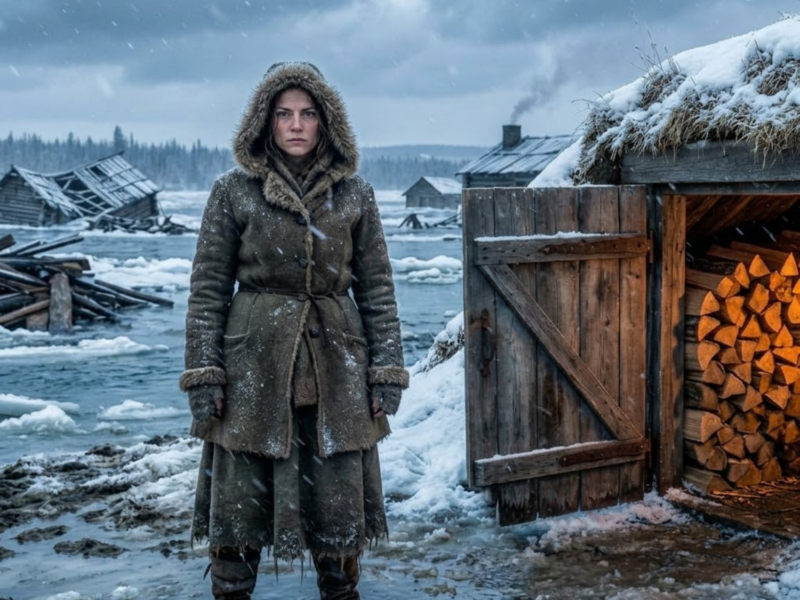
Emma’s elevated firewood shed stood square and proud against the gray sky, its steep cedar roof free of ice, its louvered vents clean and dry. A thin, steady curl of blue woodsmoke drifted from the stone chimney of a small, tight cabin Emma had managed to throw together behind the shed during December—a cabin with a sound floor and a dry, stone-lined hearth.
Emma was standing by the door of the shed, splitting a four-foot fir round with an eight-pound iron wedge and a heavy mallet. Her cheeks were ruddy with health, her woolen coat was clean and dry, and her eyes were clear.
She laid down the mallet as the ragged group stumbled out of the timberline, stopping twenty feet away as if they had hit an invisible wall of shame.
William Morrison stepped forward, dropped his hickory staff into the snow, and slowly—with agonizing stiffness—lowered his old knees onto the frozen ground.
“Emma,” Morrison said, his voice breaking into a dry, ragged croak. “We were wrong. We were arrogant, blind fools. The river came down exactly as you said it would. Our wood is ruined. Seventy families are freezing in the dark, and two of our people are dead in their beds.”
He bowed his head until his wool cap touched the crusted snow.
“We didn’t come to order you. We came to beg. In the name of God and the valley, if you have dry wood, sell it to us. Take whatever we have left—our horses, our deeds, our silver. Just don’t let the children die.”
Emma stood very still. She looked down at the old man kneeling in the dirt—the man who had signed the parchment casting her out into the autumn rain with seventy dollars and a handcart. She looked past him at Thomas Fletcher, the man who had spat tobacco juice on her ferns and called her tetched.
She felt a brief, hot flash of vindication—the bitter, tempting urge to cross her arms, smile, and tell them to go back down the hill and burn their wet logs.
And then she saw the children on the hand-sled.
She saw the little girl’s blue lips, the way the mother was rocking back and forth with her eyes closed, praying silently as the wind cut through her thin shawl.
Emma dropped the mallet. She walked over to the heavy plank door of the elevated shed, pulled the iron latch, and swung it wide.
The rich, sweet, resinous smell of five thousand split billets of dry fir and oak rolled out into the freezing mountain air like the breath of a summer forest.
“My shed holds fifty cords,” Emma said, her voice clear, steady, and loud enough to carry across the clearing. “I only need ten of it for myself through March. The rest… the rest belongs to the valley.”
She walked down the steps of the platform, past the kneeling chairman, and stopped right in front of Thomas Fletcher.
“You don’t have to sell me your deeds, Mr. Fletcher,” she said softly. “Go back down and get your wagon. Bring your neighbors. Take whatever wood you need to keep your children warm. We’ll settle accounts when the spring comes and the road is dry.”
Fletcher stared at her, his jaw working silently, before a great, dry sob broke out of his chest. He reached out and grabbed her hand, squeezing it so hard his knuckles turned white, pressing his forehead against her woolen sleeve.
“Thank you, Emma,” he choked out. “God forgive us, thank you.”









