He Found a Root Cellar Beneath an Abandoned Gas Station—6 People Survived 2 Montana Winters There
CHAPTER TEN
The siege finally broke in mid-January.
When the winds died and the sun finally broke through the gray clouds, the valley emerged to assess the devastation. Livestock losses were catastrophic. Several families had abandoned their homes to huddle in the town church.
But word quickly spread of what had happened at the Jansen place.
Mr. Hayes, the extension agent, was the first official to arrive once the plows cleared the main road. He brought a calibrated scientific thermometer, refusing to believe the rumors.
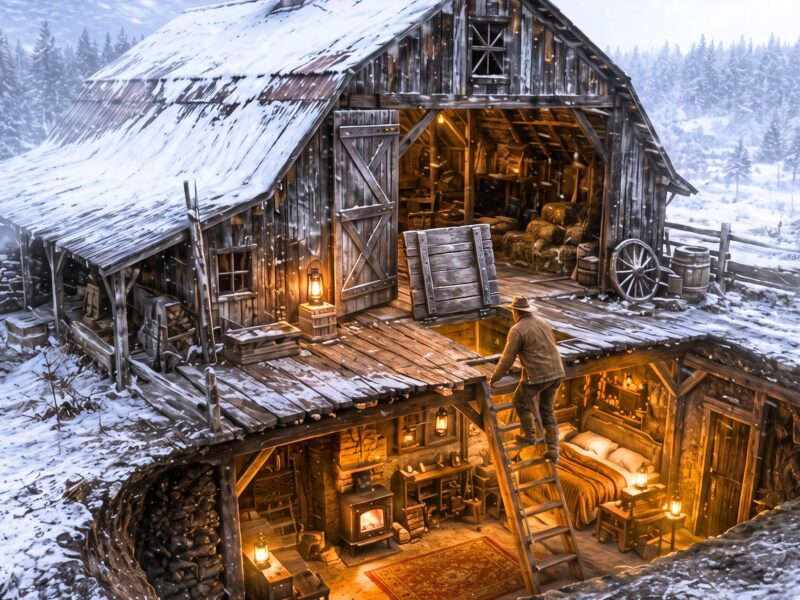
He spent an hour in the subterranean room, taking readings of the walls, the floor, and the ambient air. His face was a mask of professional shock. The data was irrefutable. Earl had used less than a cord of wood for the entire month to maintain a steady 64 degrees.
“It’s not a house,” Hayes muttered, staring at his notebook. “It’s a thermal battery.”
But it was Calvin Dreker who truly changed the valley.
At a town meeting two weeks later, when whispers about the “Badger Hole” started up again, Dreker stood up in front of the entire community.
“My grandson is alive because of Earl Jansen,” Dreker announced, his voice carrying the heavy weight of a humbled man. “For seventy years, we’ve been building in this valley all wrong. We’ve been fighting the wind. Earl outsmarted it. If you have a brain in your head, you’ll ask him how.”
The adoption began that spring.
It wasn’t a revolution of grand new architecture; it was an adaptation of survival. Ranchers started digging thermal cellars into hillsides, connecting them to their kitchens. They framed them with railroad ties, insulated them with packed clay, and relied on the earth’s constant temperature to bypass the brutal Wyoming winters.
In the fall of 1950, Mr. Hayes published a government bulletin titled Subgrade Thermal Shelters for High Plains Environments. It was filled with Earl’s data and blueprints. The manual spread across the Dakotas and Montana, anticipating modern passive geothermal design by nearly a century.
A week after the snow melted, Margaret sat at the small table in the subterranean room, penning a letter to her brother Thomas.
She wrote about the blizzard, the temperatures, and the survival of the valley. But she kept the ending brief.
Thomas, she wrote. You worried that Earl living in the ground meant he had lost his nerve. You were wrong. He didn’t dig a hole out of fear. He dug it out of love. And while the rest of the world was freezing, we were warm.
Above them, the Wyoming wind continued to howl across the high plains, furious and relentless. But down in the dark, surrounded by the quiet, heavy embrace of the earth, the Jansen family didn’t hear a thing.
They just listened to the steady, comforting crackle of the fire, safe in the shelter of the ground.









