He Found a Root Cellar Beneath an Abandoned Gas Station—6 People Survived 2 Montana Winters There
CHAPTER FOUR
The knock on the cabin door came three days before the bank’s deadline.
Earl opened it to find Calvin Dreker standing on the porch, accompanied by the county extension agent, Mr. Hayes, and a reluctant-looking Deputy Sheriff.
“Morning, Earl,” Dreker said, a sickeningly polite smile plastered on his face. “Mr. Hayes here has received several formal complaints regarding illegal and hazardous structures on this property. Endangering minors.”
Earl’s jaw tightened. “There’s no hazard here.”
“That’s for the county to decide,” Hayes said, holding a clipboard. He was a young bureaucrat from back East, clearly intimidated by Dreker’s local influence. “I need to inspect the subterranean dwelling.”
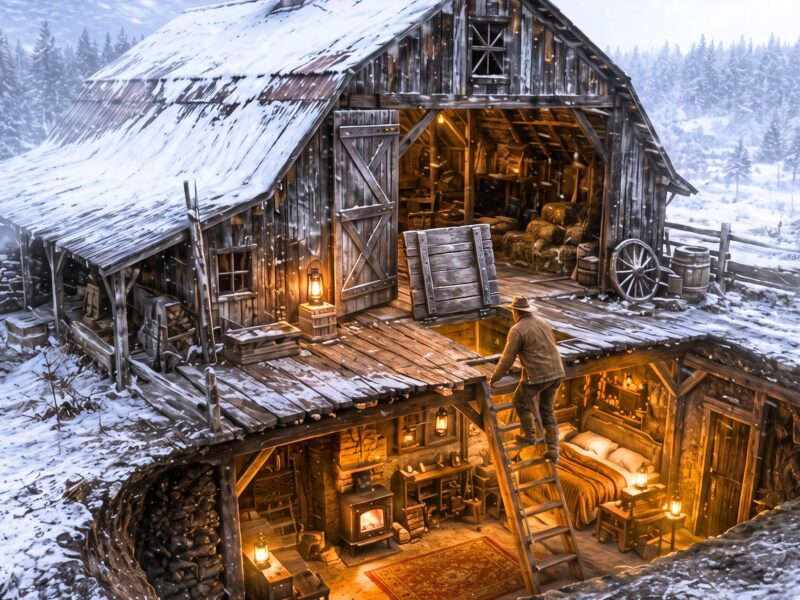
Earl led them into the kitchen and opened the heavy floor hatch. Dreker snorted in derision as they descended into the warm room.
The space was clean and dry. Two sturdy wooden bunks for the girls sat against one curve of the steel, a larger bed for Earl and Margaret against the other. The sheepherder stove hummed quietly.
Hayes tapped the steel walls with a pen, scribbling furiously. “Mr. Jansen, this is highly irregular. Sub-grade structures without conventional vapor barriers collect radon, carbon monoxide, and damp rot. I’m afraid I have to issue a formal condemnation order. The structure is unfit for human habitation. You cannot keep children down here.”
Dreker’s smile widened. “Which means, Earl, you have no primary residence. The bank takes the land tomorrow.”
“It’s fully ventilated,” Earl said, his voice deadly calm. “I have intake and exhaust shafts running independent of the cabin.”
“Unproven design,” Hayes countered, ripping a red tag off his clipboard.
“Actually,” Earl said, stepping between Hayes and the wall. “It’s a very proven design. Department of the Navy, Engineering Directive 4-B. Issued 1944.”
Hayes paused, his pen hovering. “Excuse me?”
Earl pulled a battered military manual from his back pocket and tossed it onto the small table. “This isn’t a residential basement, Mr. Hayes. It’s a civil defense bunker. Built to the exact military specifications of an Aleutian forward operating base. Since the Federal Civil Defense Act passed last year encouraging rural citizens to construct fallout shelters, state law prevents county agents from condemning them based on residential zoning codes.”
Hayes stared at the manual, then at Earl. He nervously adjusted his glasses. “A… a fallout shelter?”
“Fully compliant,” Earl said, staring unblinkingly at the young agent. “Unless you want to write a report to the federal government explaining why you’re condemning a veteran’s civil defense structure during a Cold War?”
The Deputy Sheriff barked a laugh, attempting to cover it with a cough.
Hayes’s face turned bright red. He slowly put the red tag back into his pocket. “I… I will need to verify the statutes. But for now, the structure… remains.”
Dreker’s face twisted in absolute fury. The legal loophole had completely outmaneuvered him. The bank couldn’t foreclose on a technicality if the residence was legally protected.
“You think you’re clever, Jansen,” Dreker hissed, stepping into Earl’s personal space as the others climbed the stairs. “But a piece of paper won’t keep you warm. When the frost heave pops these tin walls like a tin can, you’ll be burying your girls in the same hole you dug.”
Dreker stormed up the stairs.
That night, the first heavy flakes of snow began to fall. The siege had begun.









