He Found a Root Cellar Beneath an Abandoned Gas Station—6 People Survived 2 Montana Winters There
CHAPTER THREE
For six weeks, Earl vanished into the earth.
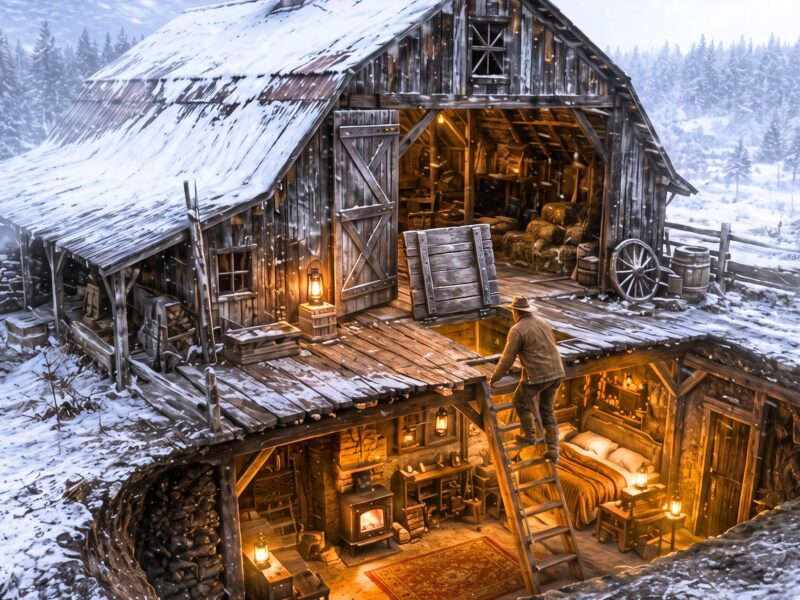
He didn’t just erect the Quonset hut inside the twelve-by-twenty-foot pit he had carved under the barn. That would have been suicide. Moisture was the lethal enemy of any subterranean structure. If the earth became damp, it would leach the heat straight out of the steel, turning the room into a freezer.
His Seabee training took over. He dug a smaller trench at the bottom of the pit and filled it with six inches of coarse gravel, creating a French drain that angled toward a deeper sump pit in the corner.
Then, he did something that utterly baffled the neighbor boys who peeked through the barn slats. He spent three days hauling gray clay from the riverbed, mixing it with water until it formed a thick, heavy paste.
He lined the entire raw earth wall of the pit with a six-inch layer of this packed clay. He was essentially building a waterproof hull, treating the earth like an inverted ship.
When he finally assembled the steel ribs and bolted the corrugated panels into place, it looked like the skeleton of a metal whale resting in a dry dock. He backfilled the gap between the clay wall and the steel ribs with dry sand. The barn above would break the wind. The earth would provide thermal mass. The sand would block moisture, and the clay liner was his final defense against groundwater.
On a crisp late-September evening, Margaret climbed down the wooden ladder into the completed shell.
It was silent. The ever-present howl of the Wyoming wind was completely gone, replaced by a deep, resonant stillness.
“It’s so quiet,” she whispered, touching the curved steel walls.
“It’s a vault,” Earl said. “But a vault needs to breathe.”
He showed her the two ventilation shafts he had cut, running up through the earth and exiting just above the barn’s foundation, protected by heavy iron hoods. One for cold intake, one for warm exhaust.
“A sealed room underground is a death trap,” Earl explained, pointing to the small, high-efficiency sheepherder stove he had bolted to the floor. “This stove will drive the convection. It will pull fresh air in and push the heavy, stale air out. The fire breathes for us.”
He connected the steel room to the main cabin’s kitchen via a ten-foot-long tunnel, framed in heavy timber and insulated with packed straw. From the kitchen, you simply lifted a trapdoor, walked down three steps, and entered the tunnel.
The next day, Earl shoveled three feet of dirt over the top of the steel roof, burying it completely. He leveled the barn floor. From the outside, the “Badger Hole” ceased to exist.
But Calvin Dreker hadn’t forgotten. And he wasn’t about to let Earl Jansen survive the thirty-day foreclosure window.









