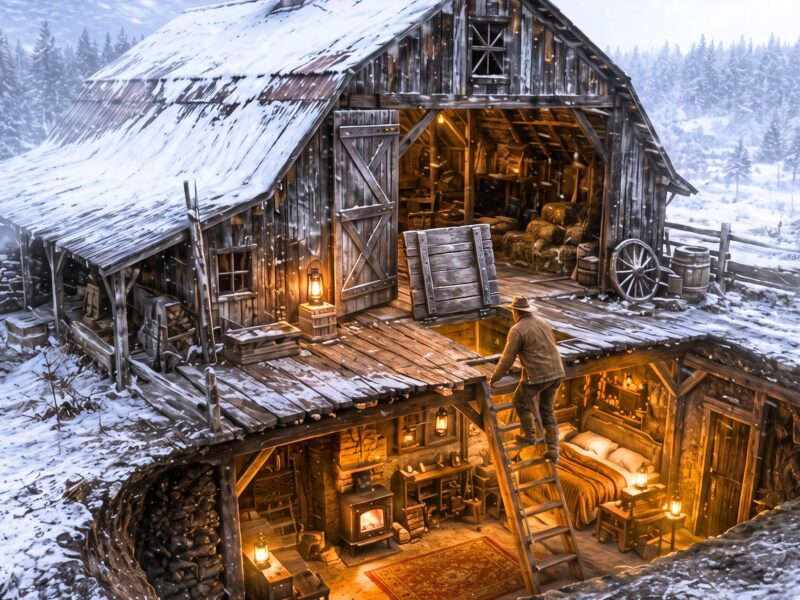
He Found a Root Cellar Beneath an Abandoned Gas Station—6 People Survived 2 Montana Winters There
CHAPTER FIVE
The climatology archives still refer to the winter of 1949 as the “White Hurricane.”
It did not hit with a dramatic clap of thunder. It rolled over the high plains on December 8th like an advancing glacier. The temperature plummeted to minus-18 overnight. By December 12th, it fell to minus-31.
But it was the wind that broke the valley’s spirit. It blew a steady forty miles per hour, creating wind chills that plunged to eighty degrees below zero. The snow was fine, granular, and packed into a dense, concrete-like mass that buried fence lines and sealed roads entirely.
Inside the main cabin, Earl and Margaret were losing the battle within three days. The oakum chinking shrank in the extreme cold, allowing needle-thin drafts to pierce the room. The kitchen water bucket froze solid by noon.
“It’s time,” Earl said, his breath fogging in his own living room.
They moved the girls down the hatch.
The transition was immediate and jarring. The roaring, vibrating chaos of the cabin vanished the moment the heavy insulated door was shut. Down in the steel belly of the earth, the silence was profound.
Earl lit the sheepherder stove. He had calculated the thermal dynamics meticulously. Five feet down, the earth remained a constant 50 degrees Fahrenheit, completely immune to the minus-40 degree blizzard above. The stove didn’t have to fight the entire Wyoming winter; it only had to raise the temperature of the room by fifteen degrees.
Within two hours, Margaret took off her heavy wool coat.
Lily and Sarah, who had been shivering uncontrollably all morning, sat on their bunks and began to play with their dolls, their cheeks returning to a healthy pink.
Earl hung a glass thermometer on the steel wall.
The red line climbed steadily. 55. 60.
It stopped and held perfectly at 64 degrees.
Outside, livestock were freezing where they stood. Inside, Margaret wept silent tears of profound relief as she realized her children were safe.
But on the fifth night of the blizzard, Earl woke with a pounding headache.
The room was pitch black. The fire in the stove had gone out.
He sat up, his lungs feeling strangely tight, the air heavy and metallic. He tried to light a match to check the lantern, but the flame sputtered and died instantly.
Oxygen starvation.
“Margaret,” Earl rasped, shaking his wife. She groaned, lethargic and unresponsive.
Panic, cold and sharp, flooded Earl’s veins. He scrambled in the dark to the intake vent pipe near the ceiling. He held his hand against the opening.
Nothing. No draft. The room had stopped breathing.
If he didn’t clear the intake, they would all suffocate from carbon dioxide poisoning within the hour.









