He Found a Root Cellar Beneath an Abandoned Gas Station—6 People Survived 2 Montana Winters There
CHAPTER TWO
The terror of the previous winter still haunted Earl’s hands every time the wind picked up.
It had been a brutal, soul-stealing education. The cabin that came with the land was solid by frontier standards—thick logs chinked with oakum and mud. But the wind out of the north didn’t just chill the air; it acted like a physical predator, finding every microscopic fissure, stripping the heat directly from the timber.
He remembered January. He had burned through four cords of wood in twenty days, feeding the firebox every three hours, his eyes red and stinging from smoke. Yet, he would still wake to see frost feathering the inside of the walls. His daughters, seven-year-old Lily and nine-year-old Sarah, slept in their coats, huddled under piles of quilts, their lips perpetually blue.
One night, the water bucket ten feet from the roaring stove had skinned over with ice. The ambient temperature in the cabin had been a shivering 42 degrees.
Earl had sat by the fire, listening to the wind scream, and realized he was fighting a losing war. A 30-mile-per-hour wind at zero degrees had the cooling power of minus-40. His cabin was standing dead-center in the firing line.
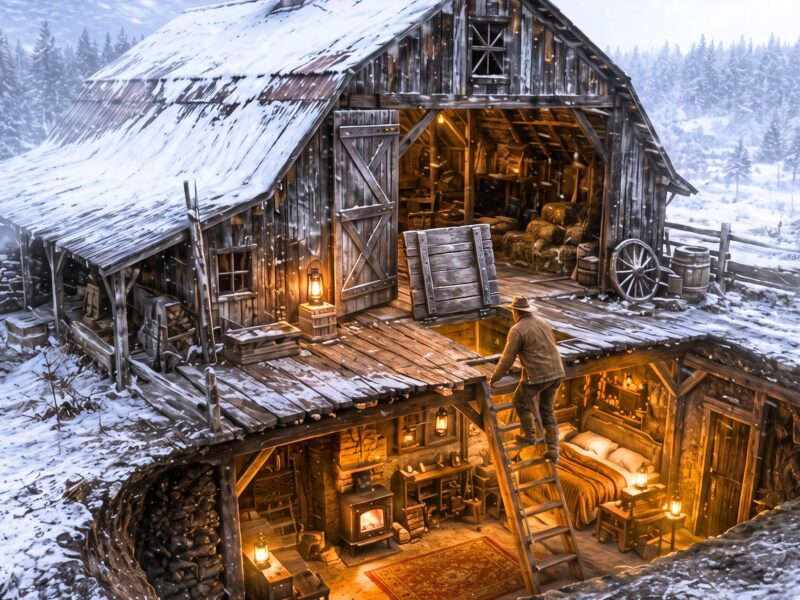
But Earl also remembered Adak Island. When his Seabee battalion couldn’t erect proper heated structures fast enough to beat the deadly Aleutian storms, they had stopped building up. They had dug down. They framed pits with timber, covered them in steel, and buried them. While the wind howled like a banshee overhead, the earth—a massive, silent thermal battery—held the interior at a steady, manageable temperature.
That was why Earl was standing at a government surplus auction in Cheyenne a week after Dreker’s visit, staring at a dismantled Quonset hut.
It was a rusted pile of curved, corrugated steel ribs and panels designed for military barracks. Most ranchers used them for tractor sheds because they were notoriously impossible to heat. But Earl didn’t want to heat it. He wanted its structural integrity. It was engineered to hold a crushing load.
“Do I hear fifty?” the auctioneer barked.
“Fifty,” Earl called out.
“Sixty,” a voice countered instantly.
Earl turned. Standing near the back of the crowd was one of Dreker’s mill foremen, smirking. Dreker was trying to bleed his cash reserves dry.
“Seventy-five,” Earl said, feeling the sweat prickle on his neck. It was nearly every dollar he had left to his name.
The foreman frowned, calculating, then shook his head. The gavel fell. Earl owned the steel.
When he drove the flatbed back to the property, Margaret was waiting on the porch. She was a practical, resilient woman, but the sight of the rusted metal brought a shadow of deep anxiety to her eyes.
“Earl,” she said softly, holding out a piece of paper. “A letter arrived from my brother Thomas.”
Earl took it. Thomas was the hardware merchant who had lent them the down payment for the ranch.
Margaret, the neat script read. People are writing to us from your valley. They say Earl has lost his nerve. They say he’s building a dugout and plans to force you to live in a hole in the ground like animals. If he cannot provide a proper home, I will come and collect you and the girls before the snow flies. This reflects on us all.
Earl folded the letter carefully and handed it back. “What are you going to tell him?”
Margaret looked at the pile of steel, then at the exhausted, dirt-stained face of her husband. She reached out and took his calloused hand.
“I’m going to tell him,” she said, her voice steadying, “that we don’t care about what the valley thinks. But Earl… this has to work. If it doesn’t, we lose the girls. We lose everything.”
“It will work,” Earl said.









