His Farm Was Dying Without Water… Until His Daughter Noticed Something Everyone Missed
The Padlock
A century later, the sun beat down mercilessly on a land that had forgotten water.
By the time the sun came up on the day Elias Marsh’s water got completely shut off, his cattle had already stopped walking to the metal trough out of ingrained habit. They didn’t even bother making the dusty trek across the brown pasture. They just stood near the rusted barbed-wire fence line instead, their heavy heads hung low, panting in the dry heat, waiting passively on something that was absolutely not coming today.
Elias stood motionless at the massive steel headgate that fed his struggling forty acres.
He was watching a stranger—a young man wearing a crisp, sweat-free polo shirt with the County Water Office logo stitched on the breast—snap a heavy brass padlock shut on a rusted iron valve his family had turned and used, completely unbothered and unchallenged, for three generations.
The young man didn’t look Elias in the eye when he did it. He just nervously checked off a box on a plastic clipboard, mumbled a rehearsed, bureaucratic sentence about “emergency relocation priorities” and “aquifer depletion protocols,” and practically sprinted back to his idling vehicle. He drove off in a white utility truck that still had the shiny dealership paper tag taped to the back window, leaving a massive plume of choking, chalky dust settling over the dead alfalfa.
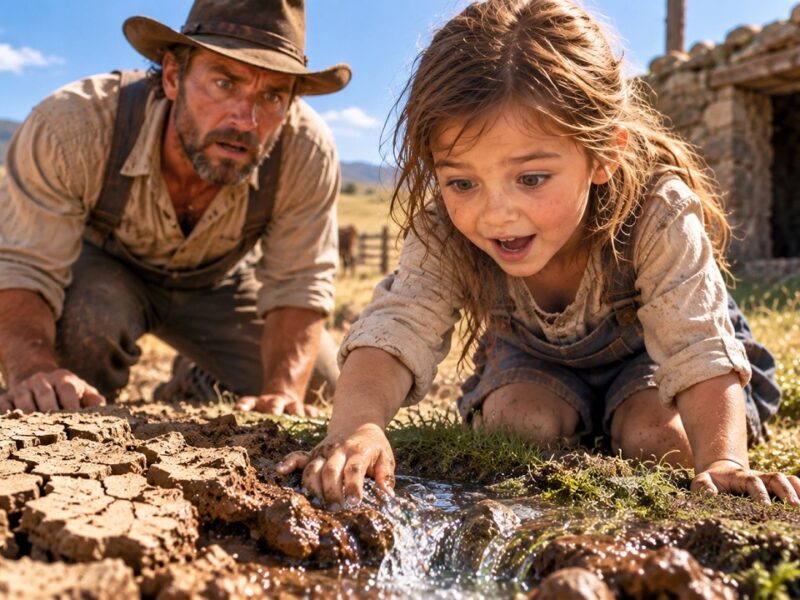
Two hundred yards up the steep hill behind Elias, hiding in the tall, brittle weeds behind an old, collapsed stone springhouse that absolutely nobody had touched in decades, was his daughter.
Wren was eight years old. She was crouched incredibly low to the earth, hiding from the heat, with her battered black-and-white composition notebook resting open on her skinny, scraped knee.
She wasn’t looking at the departing county truck. She wasn’t looking at her angry, defeated father.
She was staring intently at a specific, narrow strip of grass near the foundation of the ruined stones. It was a strip of grass that had absolutely no logical business staying a vibrant, deep green, while every single other living thing around it for three miles had already gone the pale, crispy color of old, frayed rope.
She didn’t call out to her dad. She didn’t say a word to anyone yet. She just kept looking at the green grass, observing it the exact way she looked at everything in the world: like it was a complex, beautiful puzzle that nobody else had even noticed was a puzzle.
What had an eight-year-old girl spotted in a dying, parched pasture that a whole water district full of educated engineers with clipboards had somehow managed to walk right past? And why was the ground behind that ruined old springhouse staying miraculously cool and green, when the rest of the Marsh farm was already cracking apart into deep, geometric fissures under a brutal summer sun that hadn’t let up in ten relentless weeks?
To truly understand the answer, you have to go back to where the water war actually started.
Because the answer to Elias Marsh’s devastating problem had been sitting quietly, patiently, deep under his own land for far longer than anybody in that county had been alive to remember.
Elias was thirty-nine years old. He was built like a man who had spent his entire life wrestling with livestock instead of conversing with people. He possessed the specific, heavy kind of quiet that made strangers assume he was slow, or simply had nothing of value to say. When in reality, he just fiercely hated wasting words on things that didn’t need saying twice.
He had taken over the farm from his aging father, Denny, who had taken it over from old Otis Marsh. Otis was a hard, silent man who had come out west after the great war with almost nothing to his name, and through sheer, bone-breaking will, had turned forty acres of useless, rocky scrub ground into something actually worth passing down to a son.
The Elias farm didn’t run on natural rainfall, the way naive outsiders driving through the valley assumed. The sky here was stingy. The farm ran entirely on an old, verbal, handshake water-sharing agreement. It was an agreement forged between Elias’s grandfather, Otis, and the grandfather of the man who currently owned the massive, sprawling mega-ranch directly next door.
That massive operation was now aggressively run by Garrett Voss.
The Voss family had spent the last three decades quietly, methodically buying up almost all the available agricultural water rights in that specific basin. While everyone else in the valley was busy just trying to keep their fields alive season to season, the Voss family was playing a much longer, colder game of monopoly.
The original water agreement between the grandfathers had never once been written down into anything resembling a modern, legally binding contract. It was just decades of assumed goodwill, and a shared, hand-dug irrigation ditch with a single, massive iron headgate sitting right precisely on the disputed property line.
That generation of goodwill completely, violently ran out the exact same year Garrett Voss signed a highly lucrative, multi-million-dollar water supply contract with a national beverage bottling company looking to aggressively expand their operations into the arid region.
It was a corporate deal that made Garrett’s water suddenly vastly more valuable sitting safely in a stainless-steel tanker truck headed for a factory, than it ever had been running freely through Elias Marsh’s struggling alfalfa fields.









