His Farm Was Dying Without Water… Until His Daughter Noticed Something Everyone Missed
The Return
The following summer, the drought tightened its merciless grip across the whole valley once again. It was worse than the year before. The earth cracked. The rivers ran low.
And Garrett Voss’s massive, sprawling corporate operation, stretched dangerously thin across vastly more acres than his bottling contract could comfortably water, suddenly found itself running desperately low. His shallow wells began pumping mud.
For the very first time in his entire, privileged life, Garrett Voss stood at Elias Marsh’s fence line, sweating in his expensive clothes, asking for something instead of arrogantly offering it.
He needed to buy water to save a herd of cattle.
Elias stood on his side of the wire. He looked at the man who had tried to ruin him. He looked at the dying grass on Garrett’s side of the fence.
Elias didn’t gloat. He didn’t raise his voice. He didn’t need to. He had won.
He set the exact same, fair, per-gallon terms he had offered every other struggling neighbor who came asking that brutal season. He based the price entirely on actual, physical need to keep the animals alive, instead of using his leverage to extort or punish history. He let the water flow.
Over the year that followed the hearing, Elias used part of the spring’s steady, abundant flow to put in a modern, highly efficient drip irrigation system across his most vulnerable alfalfa fields. The targeted system cut his overall water use nearly in half, while keeping his crops vastly healthier and greener than they had been in a decade.
With the surplus water, he built a small, shared reserve tank right at the property line near the road. He made it freely available to any neighbor in the valley whose well ran dry during a declared county emergency. He didn’t charge them a dime.
And he started walking the other, struggling farms in the valley with the owners. He showed people the exact same, quiet, invisible signs his own eight-year-old daughter had taught him to notice.
Look for the cool ground in the afternoon. Look for the wild grass that stays green two weeks too long. Notice where the cattle gather to stand for absolutely no obvious reason.
Two neighboring families, following exactly that methodical, observant method, found modest, life-saving springs of their very own hidden on their properties that same year.
On a cool, beautiful evening the following spring, Wren walked out alone to the springhouse.
Elias had painstakingly rebuilt the structure on its original stone foundation. The crystal-clear water was moving steadily past the mossy stones, pouring generously into a massive metal trough where their healthy cattle drank deeply, without frantically crowding or fighting each other. They drank the way animals drink when they inherently trust that the water will still be there for them tomorrow.
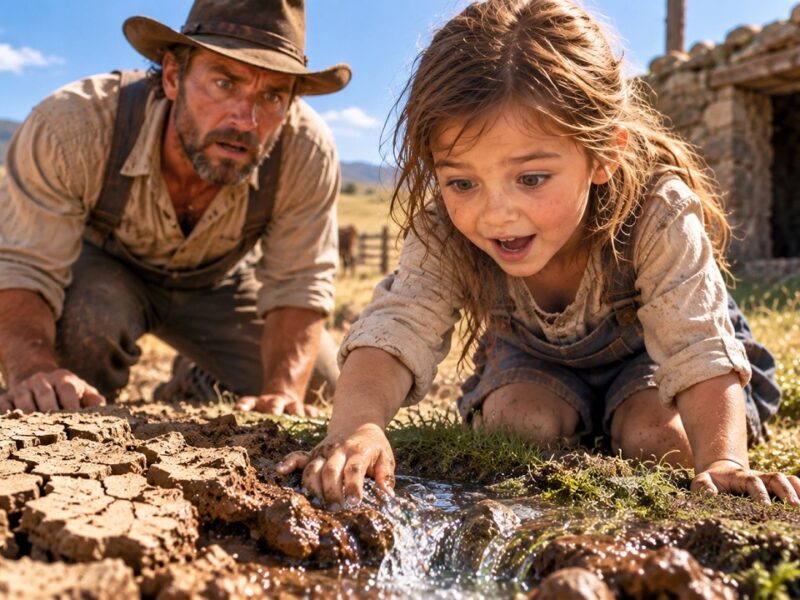
Wren knelt in the dirt. She reached out and touched the surface of the rushing water, exactly the way she had the very first time. Back when it was nothing but a single, cold bead of moisture pooling in her small palm, and a terrifying question that nobody could yet answer.
Elias walked up the hill and stood quietly beside her. He looked at the water, then down at his daughter holding her notebook.
“You saw it before any of us did, Wren,” Elias said softly, pride thick in his voice.
She shrugged, looking down at her muddy sneakers, the exact way nine-year-olds do when they don’t quite know how to hold a compliment that massive from their father.
“I was just paying attention,” Wren mumbled.
Elias knelt down beside her in the dirt. He put a heavy, calloused hand gently on her shoulder, watching the life-giving water move past the ancient stones that had hidden and protected it for sixty years.
“Sometimes, kiddo,” Elias said, pulling her close, “that’s the whole difference in the world.”









