His Farm Was Dying Without Water… Until His Daughter Noticed Something Everyone Missed
The Squeeze
Garrett Voss showed up at the wooden fence line himself the very evening after the county worker had snapped the padlock shut.
He left his massive, polished black truck idling, not even bothering to step out of the air-conditioned cab. He just rolled down the tinted window.
“Drought’s hard on everybody this year, Elias,” Garrett called out over the rumble of the diesel engine. He said it in a flat, rehearsed tone, exactly like a man reading off a cue card. “I’ve got corporate obligations now that I simply didn’t have five years ago. The county water board understands that reality. Maybe it’s time you should, too.”
Elias stood on his side of the wire. “That water’s been running down that ditch to this farm since before either one of us was even born, Garrett.”
“Paper doesn’t care about ‘before,’ Elias,” Garrett countered smoothly, tapping the steering wheel. “Paper only cares about ‘now.’ And right now, legally speaking, that water is completely spoken for.”
Garrett let the harsh reality sit in the hot air for a long second, watching Elias’s stoic face for a crack, a sign of surrender.
“Look,” Garrett said, his tone shifting to false sympathy. “I’ll give you a fair number for the whole place. More than fair, considering where things are obviously headed for you without water. It’s vastly better than watching the bank foreclose and take it for pennies in a year.”
Elias didn’t answer him. He didn’t need to.
Garrett read the heavy silence exactly the way he read every interaction in his life: like a man ruthlessly calculating a profit margin instead of actually listening to another human being. He rolled up his window and drove off before Elias could tell him to go to hell.
What followed over the next month wasn’t one massive, cinematic disaster. It was a hundred small, agonizing, humiliating ones, stacked meticulously until they made the undeniable shape of an entire ruined summer.
Elias desperately started hauling water from a rented, plastic 500-gallon tank in town. It was a forty-minute round trip, twice a day, every day, burning expensive diesel fuel with money that absolutely did not exist in their bank account. He was forced to sell his father’s beloved, restored old flatbed truck just to cover the widening financial gap.
He strictly rationed what little, precious water he hauled. He divided it carefully between keeping the cattle barely hydrated, and saving his wife Dana’s rows of heirloom tomatoes from turning to dust. He spent his days watching the things he fiercely loved get smaller, weaker, and closer to death by the week.
Dana, refusing to watch him drown alone, quietly picked up extra, grueling nursing shifts at the county health clinic, just to keep the farm’s mortgage payments from sliding irreversibly backward into default.
Their neighbors mostly kept their cowardly distance.
Garrett Voss had spent years carefully cultivating political friendships, donating to campaigns, and buying drinks for half the officials at the county water office. And Garrett had a famously long, vindictive memory for anyone who dared to help his enemies.
One older rancher, two farms over, who had known Elias since childhood, stopped returning his phone calls entirely. This happened shortly after Garrett casually mentioned in passing at the diner that he was “reconsidering” a massive grazing lease that the older rancher desperately depended on to survive. The message was received. Elias was officially an island.
Garrett’s insulting, lowball offers for the land kept coming in the mail. Each official letter was for a number slightly lower than the last. Each one was delivered with the same, unbothered, arrogant patience of a man who implicitly believed that time and physics were working entirely for him.
“Eighty thousand,” Garrett said the second time he showed up, standing at the fence line instead of driving up to the house, trying to assert dominance. “That offer drops again next month, Elias.”
“You’re negotiating against a drought you’re actively profiting from,” Elias told him, gripping the wire until it bit into his palm.
“I’m negotiating with reality,” Garrett smiled coldly. “Reality doesn’t care whose fault it is.”
Elias went to bed most nights staring at the ceiling, running desperate, impossible numbers in his exhausted head that violently refused to add up to survival. He woke most mornings long before the sun, walking his dry, dusty fence lines out of sheer, nervous habit rather than any actual hope.
It was on one of those early, quiet dawn walks that he first noticed the cattle.
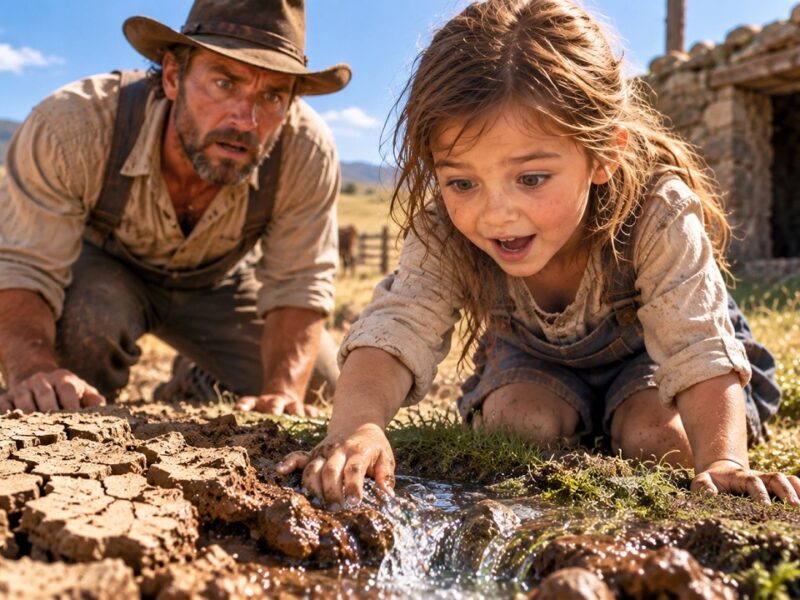
They were drifting, again and again, toward the exact same, specific corner of the lower pasture. It was near the old, collapsed stone springhouse that his grandfather Otis had built eighty years ago, and that nobody had ever bothered to fully repair after the roof caved in.
The cattle would stand there longer than anywhere else on the property. Their heavy noses were pointed down, sniffing the earth, their hooves pawing gently, almost hopefully, at the dry dirt.
Elias noticed the strange behavior. He filed it away in his tired brain as just one more small, frustrating mystery in a terrible season already far too full of them.
But Wren noticed it, too. And Wren didn’t let things go.









