His Farm Was Dying Without Water… Until His Daughter Noticed Something Everyone Missed
The Hidden Seep
The digging was agonizingly slow, and physically miserable.
The old stone structure had partially caved inward over the decades, creating a treacherous pile of heavy rubble. Clearing it meant hauling massive, jagged granite stones and decades of compacted, rooted debris entirely by hand, in punishing ninety-degree heat. And Elias had to do this while still exhaustingly hauling rental water for the cattle twice a day on the side.
Four days into the brutal excavation, disaster struck.
A heavy section of the collapsed stone lip they were trying to stabilize gave way without warning. Elias, standing in the hole, went down hard under a shower of rocks. He wrenched his shoulder violently enough to hear a sickening pop, losing the entire rest of the afternoon to blinding pain, and guaranteeing a massive medical bill from the clinic they couldn’t afford.
That night, sitting at the kitchen table with a bag of frozen peas strapped to his throbbing shoulder, Elias broke.
He stared at the phone on the wall. He came much closer than he ever wanted to admit to his wife to picking it up, calling Garrett Voss, and asking exactly what insulting dollar amount was still on the table for his family’s legacy.
Wren, sitting across from him doing her homework, didn’t say a word of encouragement. She simply slid her open composition notebook across the table to him.
It was open to the June entry. The precise, recorded data of the green grass. The cold earth. The sound of the water.
Elias looked at the numbers. He looked at his daughter’s unwavering belief in the facts.
He went back out the very next morning anyway, digging with one good arm.
Two days after the collapse, his shovel blade struck something hard that definitively wasn’t a natural rock. It was a dull, hollow clink.
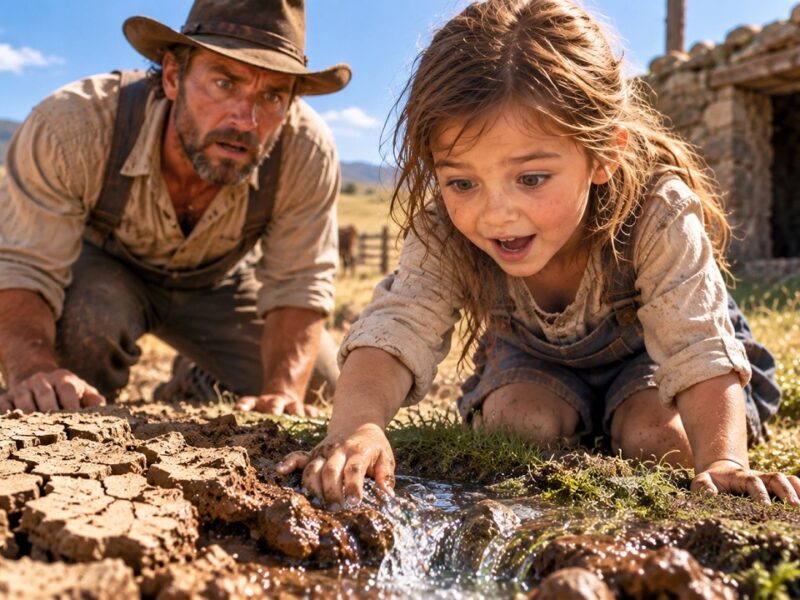
He dropped to his knees and cleared the mud away with his bare hands.
It was old, hand-laid channel stone. It was fitted perfectly together without a single ounce of mortar, curving elegantly down into the earth. It was built exactly the way an old-world spring box gets built by a master mason to gently guide and capture water, instead of aggressively blocking it.
And at the very bottom of the carved channel, in a shallow, perfectly smooth basin still holding the exact shape somebody had painstakingly chiseled for it sixty years earlier… water was moving.
It was crystal clear. It was freezing cold. And it was rising steadily, beautifully, out of a dark crack in the deep limestone bedrock, no wider than the blade of his shovel.
Wren scrambled down into the hole beside him. She cupped both her small hands under the flow, catching the freezing water like she was terrified it might vanish back into the earth if she blinked or looked away. She drank it greedily.
“Is this ours, Daddy?” she asked, wiping her chin, her eyes wide. “Actually ours?”
Elias didn’t answer her right away.
Because the honest answer—the legal answer that mattered vastly more right now than the physical water itself—was that he had absolutely no idea yet whether anybody else in the county was going to try to legally claim it, too.
A county well contractor, an older man whom Elias trusted, came out and confirmed the miracle within the week.
It was a genuine, deep-earth seep. It was fed entirely by a massive, fractured limestone shelf buried deep under the hillside. Crucially, the contractor explained, it was entirely geographically and hydrologically separate from the shared irrigation ditch that Garrett Voss controlled on the surface.
And it was running incredibly steady at close to thirty gallons a minute, completely regardless of the brutal drought baking the surface.
For a few, glorious, exhausting days, Elias allowed himself to believe the absolute worst was finally behind him.
He and Wren worked side-by-side, clearing the thick brush around the old stones. They watched a brand-new, galvanized metal trough fill to the brim with crystal-clear water on their very own land for the first time in months. They laughed together, splashing each other, for what felt like the first time all summer. The heavy, suffocating weight seemed to lift from the farm.
Then, the contractor’s young assistant, a talkative kid named Denny Cobb, made a mistake.
He casually mentioned the “miracle” water discovery in passing to his cousin at the local bar. His cousin happened to do seasonal fence repair work over at the massive Voss ranch.
Word moved the way it always does in a small, interconnected valley: quietly, incredibly quickly, and directly toward the one powerful man Elias least wanted to hear it.
Garrett’s polished black truck was back idling at the fence line three days later.
Garrett wasn’t offering a fake, sympathetic smile this time. His eyes were cold, hard, and rapidly calculating legal angles.
“Hear congratulations are in order, Elias,” Garrett called out, stepping out of the truck and walking up to the wire. “Found a little puddle in the dirt.”
“We found our spring,” Elias corrected him.
“Right. Well, that specific aquifer you tapped runs deep under both our properties, Elias,” Garrett said smoothly, leaning on the fence post. “You might want a very good lawyer to look real, real close at whose water that actually is before you get too comfortable filling your troughs. Just a friendly warning.”
The formal, aggressive legal claim followed within the week, delivered by a nervous county lawyer who clearly hadn’t enjoyed the long drive out to the farm.
The legal argument presented in the thick stack of papers was complex, heavily layered, and not entirely baseless in the confusing realm of Western water law. The claim stated that without a specific, historical state permit on file, and without definitive geological documentation proving the spring’s origin point sat exclusively on the Marsh parcel, the water legally fell under a “Shared Resource” designation.
This designation legally required Garrett Voss’s explicit approval for Elias to use the water at any agricultural scale. And Garrett was never going to give that approval.
But Garrett didn’t stop at just filing paperwork. He played dirty.
He casually mentioned to two powerful county officials over dinner that the “sudden discovery” on the Marsh farm might actually be an illegal, unregistered extraction pump operating during an active, county-wide draw emergency. He floated a vicious rumor at the local feed store that Elias was selfishly hoarding thousands of gallons of secret water while his neighbors’ cattle suffered and died.
A county water inspector showed up unannounced within days. He was polite, but incredibly thorough, asking Elias to produce extraction permits that simply didn’t exist yet, and taking photographs of the spring box.
It was Wren who saved them.
She was digging through Otis’s old, dusty trunk in the attic a second time, armed with a flashlight, looking for absolutely anything else that might be useful.
Tucked carefully inside the back cover of a crumbling Farmer’s Almanac from 1961, she found the first real thread of salvation.
It was a torn, yellowed fragment of an official survey map. It clearly referenced a “Protected Spring Structure, Built 1938,” located precisely within the Marsh property boundary.
However, the crucial paper was ripped. It cut off mid-sentence, exactly right where it seemed about to name the exact geological boundary line that would prove ownership.
“There’s more of this somewhere, Daddy,” Wren said, spreading the fragile pieces on the kitchen table. “This isn’t the whole thing. Grandpa Otis wouldn’t just keep half a map.”









