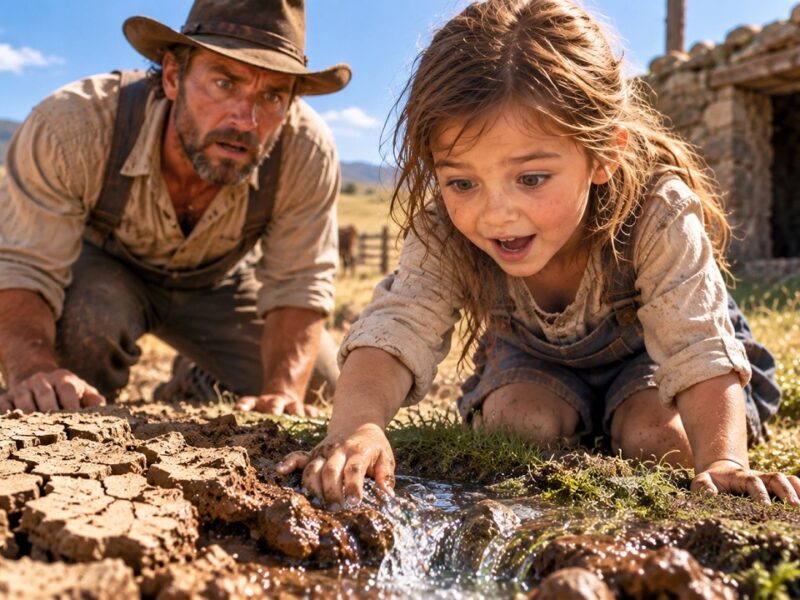
His Farm Was Dying Without Water… Until His Daughter Noticed Something Everyone Missed
The Paper Trail
Elias drove into town the next morning and found Louise Pruitt.
Louise was the county’s fiercely independent, retired land surveyor. She was a sharp-eyed woman in her late seventies who stubbornly still kept four decades of meticulous, hand-drawn county records filed away in her chaotic garage, long after anyone in the digital county office asked her to.
It took two long visits, three pots of coffee, and an entire afternoon of sneezing through dusty cardboard boxes before Louise finally found the rest of it.
It was a complete, notarized 1958 property survey.
It explicitly documented the natural spring and the stone springhouse structure sitting squarely, undeniably inside the Marsh land boundary. More importantly, it had been filed and stamped three full years before the municipal Water District that now claimed legal jurisdiction had even been formed by the state.
“That,” Elias said, tapping the paper, “is evidence one.”
The structure legally existed, and its recorded use predated the very bureaucratic authority currently trying to govern and steal it.
Digging further into her archives, her memory jogged, Louise turned up something even more valuable.
It was a highly detailed 1990s county hydrology assessment of the valley’s bedrock. The geological mapping clearly showed that the fractured limestone pocket feeding the Marsh spring was entirely, physically, and hydrologically isolated from the larger, shallower aquifer channel that Garrett controlled and pumped from. It was not part of any shared underground system at all.
“And that is evidence two,” Elias smiled grimly.
The spring wasn’t “shared water” dressed up as a new discovery to steal from Garrett. It never had been. They were separate buckets in the earth.
The third, and most explosive, piece of evidence came from an unexpected direction entirely.
Buried in the exact same dusty box of Louise’s old files was a carbon copy of a consulting letter, over a decade old. It was addressed directly to Garrett Voss himself. It had been commissioned and paid for by the Voss ranch to evaluate potential expansion possibilities for his bottling contract.
It referenced, almost in passing on the second page, an “unregistered, isolated spring source on the neighboring Marsh property, currently uncapped, unused, and highly vulnerable to acquisition.”
Garrett had known exactly about that spring for over ten years.
He hadn’t discovered a shared resource; he had simply waited. He’d waited patiently for a drought severe enough to bankrupt Elias, making him desperate enough to sell the farm for pennies. And when that vicious tactic had failed, he’d built a bogus legal fight he fully expected to win simply by burying Elias in lawyer fees he couldn’t afford.
“Evidence three,” Elias whispered, staring at Garrett’s name on the paper.
The fourth and final piece of the puzzle took much longer to secure, and it required somebody willing to talk who hadn’t been willing before.
Denny Cobb, the young well contractor’s assistant, came to the Marsh back door one evening, looking incredibly uneasy. He carried the particular, heavy guilt of a man whose careless bar gossip had accidentally started a war that was ruining a good man’s life.
Denny stood on the porch, twisting his cap in his hands, and confessed.
His own father, it turned out, had done the seasonal, mechanical maintenance on the massive Voss ranch’s irrigation system for years before he passed away.
“My dad once mentioned, almost as an aside over a beer,” Denny said nervously, looking at his boots, “that the shared headgate on your property line hadn’t been damaged, or restricted by the drought at all when it got shut off last month.”
Elias went very still. “What do you mean, Denny?”
“It had simply been locked manually,” Denny admitted, his voice dropping. “Weeks before any official county conservation order ever took effect. My dad always said Mr. Voss explicitly told him to close that specific valve early every dry year. Dad admitted it was strange… doing emergency maintenance to lock a valve that wasn’t broken, and wasn’t officially restricted yet.”
That was evidence four.
And it changed the entire, fundamental shape of the story Elias was going to tell at the hearing.









