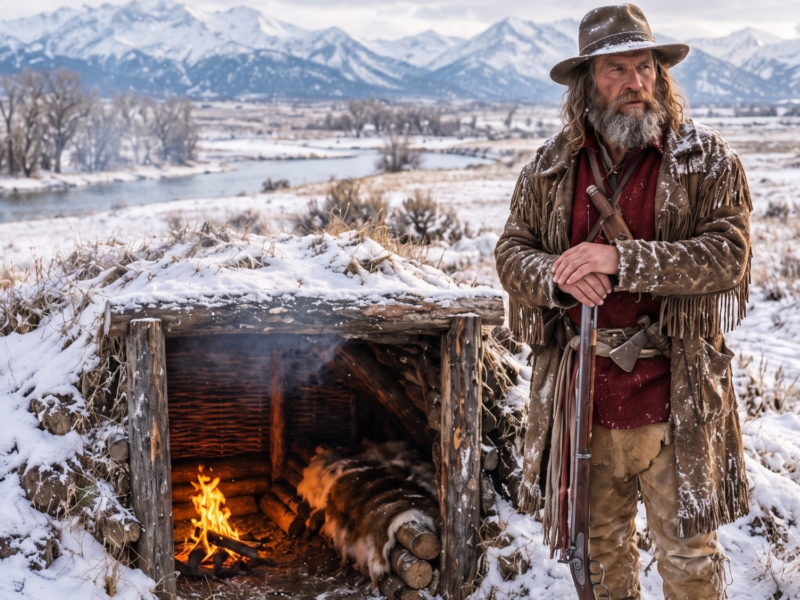
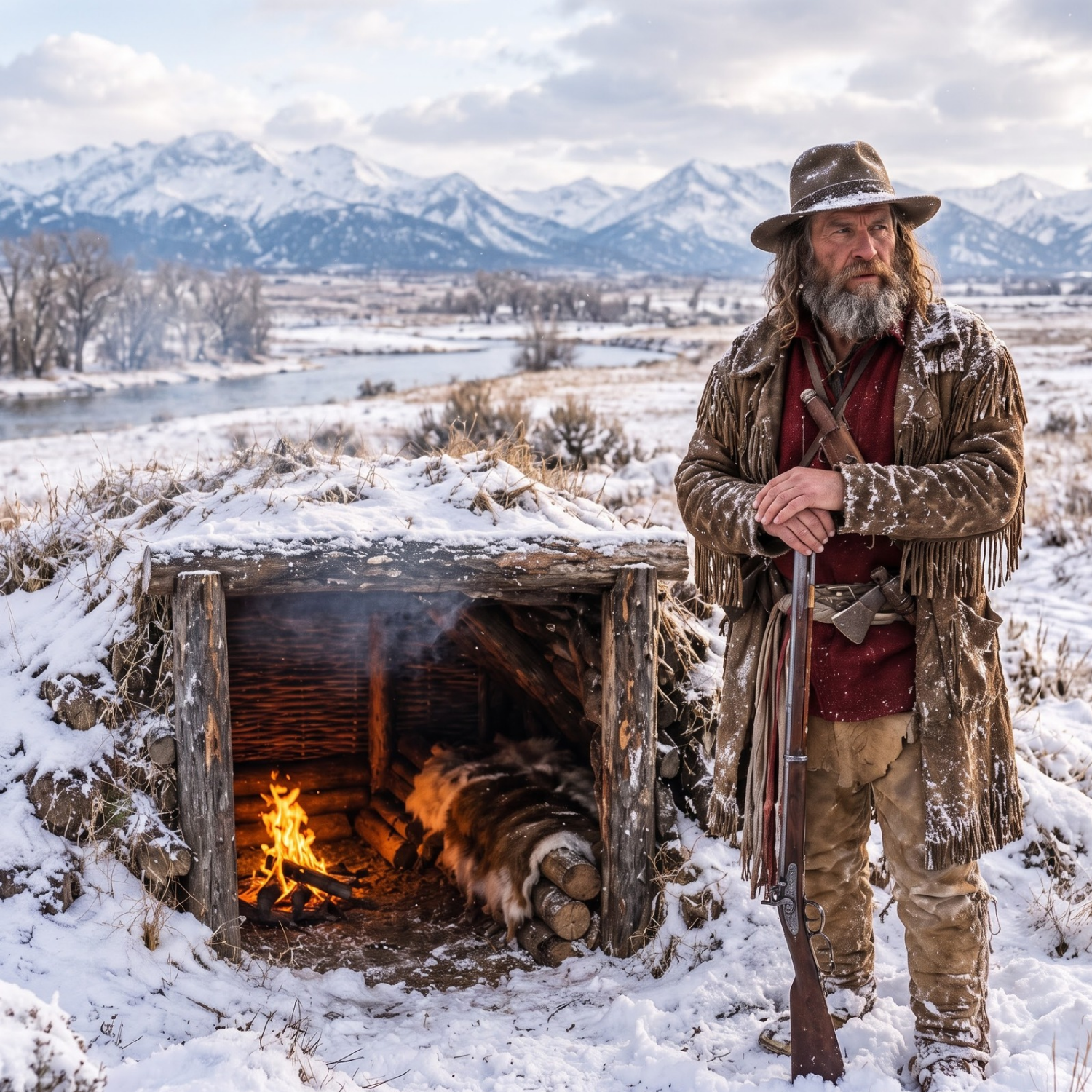
How Mountain Men Built Dugouts in 3 Days That Stayed 100°F Warmer Than Outside
How Mountain Men Built Dugouts in 3 Days That Stay…
How Mountain Men Built Dugouts in 3 Days That Stayed 100°F Warmer Than Outside
The thermometer on Dr. Harlon Cook’s front porch shattered at 38 degrees below zero. It did not bend. It did not slow. The mercury column that had measured every winter in Caldwell Crossing, Montana Territory, for eleven years simply reached the limit of what glass, metal, and human engineering could record.
And then it stopped being useful. The column froze solid at the bottom of the tube—a silver pillar that refused to move in either direction. And then the glass itself gave way. The crack sounded like a rifle shot in the pre-dawn stillness. Shards of the instrument scattered across the snow-dusted planks of the doctor’s porch, each fragment catching the pale moonlight like a piece of broken mirror, like something that had held truth and now held nothing at all.
Dr. Cook stood in his doorway in his nightcloak, staring at what remained of the instrument. He was a methodical man trained in Philadelphia, proud of his scientific approach to medicine and to the natural world. He had documented temperatures in Caldwell Crossing through blizzards, through the hard freeze of 1883, and through two winters that old settlers called the worst they could remember. His records were meticulous. They told the story of a brutal but survivable climate, a place where a prepared man with good walls and adequate firewood could outlast anything the Montana sky threw at him.
The shattered thermometer told a different story.
It told him that whatever was happening outside the walls of his house existed beyond the reach of his instruments. It told him that the cold had exceeded not just his records, but the very tools he used to make records. He did not know what temperature it was. He could not know. The morning of January 9th, 1889, had moved into territory that his science could not follow.
He went back inside and stacked more wood on his fire. It was the only thing left to do.
Three miles north of town, on a property that sat at the edge of the pine timber, where the flat grazing land began its gentle rise toward the foothills, a woman named Dela Foss had been awake for two hours.
She had not been awakened by the cold. The cold did not penetrate the walls she had built. She had risen because she always rose before dawn, because the animals needed tending before the light came, because the work of the land did not wait on comfort or on darkness.
She moved through her cabin with the ease of someone who knew every board by feel. The interior was warm—not the desperate, scorched warmth of a room where a fire is battling against an enemy and barely holding, but genuinely warm. The kind of warmth that fills a space so completely it seems to come from the walls themselves rather than from any single source.
The temperature inside that cabin sat at perhaps 50 degrees—cool by summer standards, but extraordinary given what pressed against every outer surface of the structure from every direction.
The fire in her stone hearth had been set the previous evening. She had not touched it since. The hearth did not need tending the way an iron stove did. She had built it from river granite quarried over three summers, stacked in a configuration that her grandmother’s notes described as a mass accumulator, a structure designed not to burn hot and then cool, but to absorb heat slowly and release it for hours after the fuel was consumed. The stones were warm to the touch even now. They would remain warm until mid-morning, at which point she would add fuel again, and the cycle would continue.
Dela pulled on her outer layers with practiced efficiency: wool first, then the heavy canvas work coat she had reinforced at the elbows and collar, then the fur-lined outer garment she had sewn herself from pelts traded from a trapper named Aldis Greer, who came through each autumn.
The garment was ungainly. It made her look, as Sheriff Cummings had once remarked at the general store, like a woman who had lost a fight with a bear and taken the bear home with her. The laughter that followed that remark had been the comfortable laughter of people who found her an easy target, and she had learned long ago not to waste energy on it.
She cracked the outer door open and felt the air hit her face. It was not like ordinary cold. Ordinary cold was a sensation, something that moved across skin and made the body respond. This was something more absolute. The air at the threshold of her door had qualities that suggested it was hostile to the basic processes of living tissue, that it existed in a register past discomfort, past pain, past even the body’s ability to signal damage.
She opened the door fully for three seconds, confirmed what she needed to confirm, and stepped back inside. The animals needed water. The water in the attached shelter where her mare, Greta, lived, would be frozen solid by now, despite the structure’s connection to the main cabin’s heat.
She would need to bring water from the root cellar’s secondary cistern, the one she had insulated with double-thickness straw bales, specifically because she had known this morning would come. She had known it for three years.
Related Articles

They Mocked the Widow’s Dirt Cellar—Then the Freeze Left Every Cabin Cold but Hers Warm
They Mocked the Widow’s Dirt Cellar—Then the Freeze Left Every Cabin Cold but Hers Warm…

A Homeless Veteran and His German Shepherd Inherited a Ridge No One Wanted — 35 Feet In, They Found
Chapter 1 / 7 A Homeless Veteran and His German Shepherd Inherit… A Homeless Veteran…

Neighbors Laughed When He Built A Cabin Inside An Old Barn—Until It Kept His Home 35 Degrees Warmer
Chapter 1 / 8 Neighbors Laughed When He Built A Cabin Inside An… Neighbors Laughed…

His Sod House Had No Woodpile in January – Until the Trains Stopped and the Town Came Begging
Chapter 1 / 10 His Sod House Had No Woodpile in January – Until t……

She Built Her Cabin Over the Woodshed and Never Burned Wet Wood Again
Chapter 1 / 8 She Built Her Cabin Over the Woodshed and Never Bu… She…

The Duke Abandoned Her on Their Wedding Day—Years Later, He Discovered What He Had Lost
Chapter 1 / 7 The Duke Abandoned Her on Their Wedding Day—Years… The Duke Abandoned…

He Wedged a Tiny A Frame Into a Crevice Before Winter and His Family Slept at 75°F While Town Hit
Chapter 1 / 7 He Wedged a Tiny A Frame Into a Crevice Before Win……

He Was Too Old to Ride—So He Bought the Ruined Ranch and Found the Room Behind the Fireplac
Chapter 1 / 5 He Was Too Old to Ride—So He Bought the Ruined Ran……

Settlers Laughed at His Underground Heat Recovery Duct — Until It Kept His Cabin 71°F Warmer
Chapter 1 / 9 Settlers Laughed at His Underground Heat Recovery… Settlers Laughed at His…

A Navy SEAL Built a Home Inside a Mountain—Then His Dog Warned Him Before the Storm
Chapter 1 / 5 A Navy SEAL Built a Home Inside a Mountain—Then Hi… A…