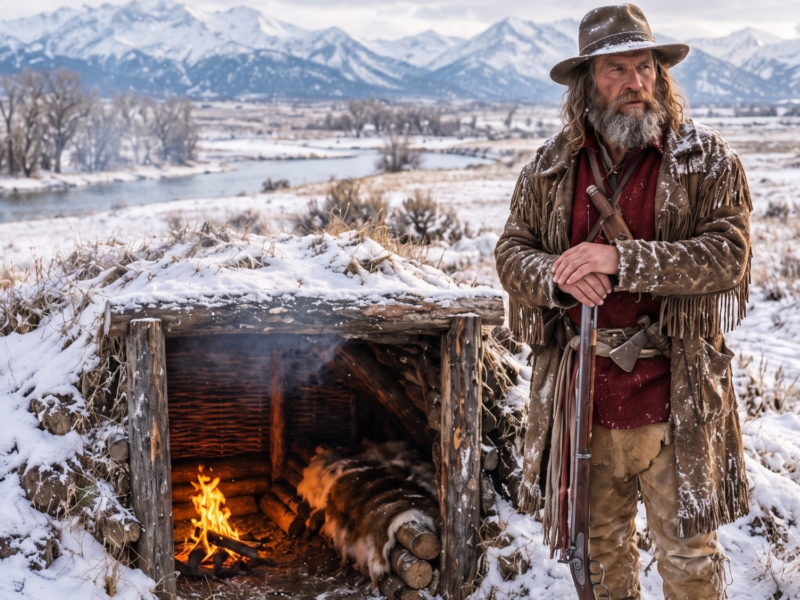
How Mountain Men Built Dugouts in 3 Days That Stayed 100°F Warmer Than Outside
The Logic of the Earth
If you had asked a mountain man in 1808 what kept him alive through winter, he would not have said his rifle and he would not have said his traps. He would have said the ground—not the fire, not the buffalo robe. The ground itself, the dirt under his boots, the hillside he chose before he ever picked up a shovel.
That answer sounds strange to modern ears because we think of soil as something you build on, not something you build with. But in the Rocky Mountains, in the years when beaver pelts were worth more than gold, a handful of illiterate trappers figured out something that building scientists are still trying to fully explain.
They figured out that the coldest place on Earth has a warm room hiding just beneath the surface. And they figured out how to find it, dig it, and live inside it in three days alone with nothing but a hatchet and a shovel. This is the story of the dugout, and it starts not with a hammer, but with a hillside.
The fur trade was not some gentle wilderness hobby. It was an industry, and a brutal one at that. Beaver pelts sold for around $6 a piece in St. Louis, which in today’s money works out to somewhere near $200 a skin. That kind of money sent men deep into unmapped territory alone for entire winters at a time. These were the mountain men—names like Jim Bridger and Kit Carson, and dozens more who never made it into any textbook. Most of them could not read. Almost none of them had ever studied construction or engineering or anything close to it.
What they had instead was something more convincing than an education. They had fear. The kind of fear that comes from watching other men die of the cold. Historical estimates suggest that roughly one in three men who went into the mountains for a trapping season simply did not come back. Not from bears, though bears killed some. Not from drowning, though the rivers took some, too. It was exposure, plain cold, that killed more trappers than anything else combined.
And so the men who survived their first winter learned a single lesson that shaped everything else they did: * You do not fight the cold above ground. You go underground into it and let the earth fight for you.*
Winter in the northern Rockies meant temperatures of 40 below zero and wind that could hit 60 miles an hour across an open ridge. A canvas tent in that kind of weather was not shelter. It was a slow way to die. So the mountain man needed something he could build alone, fast, that would outlast a season no ordinary structure could survive.
The dugout was not something a trapper dreamed up on his own. It was something the land itself had already taught generations before any European set foot in the Rockies. Native peoples across the plains—the Mandan, the Hidatsa, and others—had been building into the earth for centuries, long before beaver pelts were worth anything at all. They understood something simple that modern builders often forget: the ground itself is the best insulation there is.
Mountain men learned this the way they learned most things: not from a book, but by watching, trading, and eventually out of pure desperation. And then they did what trappers always did with borrowed knowledge. They stripped it down to only what one man alone in a hurry actually needed. No ceremony, no decoration, nothing extra. Just a hole in a hillside that could keep a man alive until spring.









