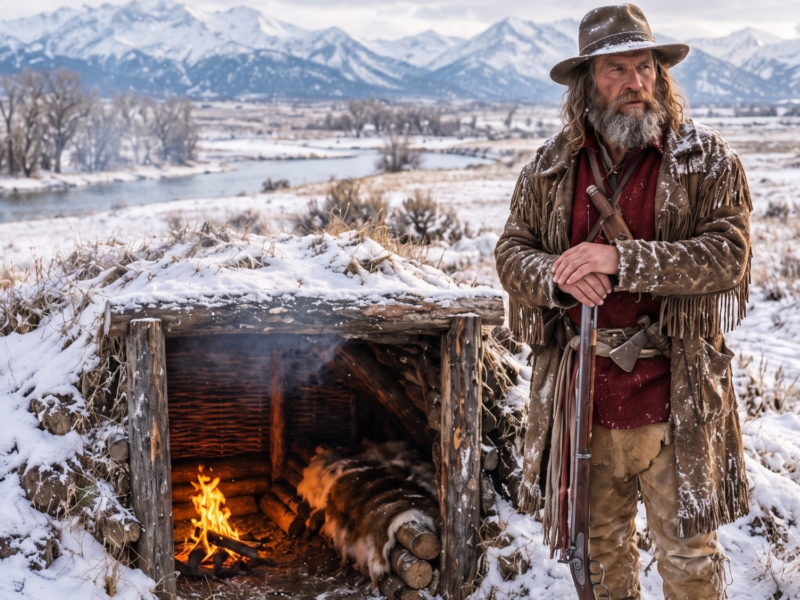
How Mountain Men Built Dugouts in 3 Days That Stayed 100°F Warmer Than Outside
The Lost Lore
None of this knowledge survived the way you might expect it to. Mountain men did not keep journals, with only a few rare exceptions. What they knew lived in their hands, in the feel of soil turning under a shovel, in the sound a ridgepole made when tested, in the way water moved down a slope after rain.
Nobody thought to write it down because to the men who knew it, none of it seemed remarkable. It was just what you did if you saw spring.
When the beaver market collapsed in the late 1830s and the rendezvous gatherings finally stopped in 1840, the men scattered, and the knowledge scattered with them. Army engineers who later tried to rebuild these dugouts with better tools in unlimited time failed again and again. They got the dimensions right, the framing right, the sod layering right—everything that could be written down and measured.
What they could not copy was the instinct. The years of reading a hillside the way another person reads a face. You could copy the recipe, but you could never copy the cook’s feel for when the bread was truly done.
Decades later, back in the quiet isolation of her Montana homestead, Dela Foss understood this better than anyone.
She had lived it. She had watched the mercury shatter on Dr. Cook’s porch, she had listened to the cynical laughter of Mayor Drifus, and she had tested her own granite hearth against the absolute abyss of the Great Die-Up winter of 1887.
When the freezing gale had howled across the Little Laramie Valley, driving temperatures far beyond the limits of glass and silver, the rectangular cabins of Caldwell Crossing had groaned, split, and surrendered to the ice. Men had burned their own furniture; children had suffered frostbite in their beds; eleven souls had perished in the dark.
Yet, up on the rise north of town, forty-one people had crowded into a single, three-walled, earth-bermed stone enclosure and survived. They had survived because Dela had remembered the notebooks of her grandmother, Hester Algate, and because she had respected the ancient, unwritten laws of the earth.
Epilogue: The Wall That Remained
Years after the blizzard of ’89, when the town of Caldwell Crossing had been rebuilt according to the Ashton Method—with triple-layer walls, mass-accumulator hearths, and subterranean root cellars—visitors would still hike up the northern ridge to look at the original homestead.
The cabin itself eventually weathered and grayed, but the stone hearth and the deep, earth-wrapped core of Dela’s home remained completely impervious to the passage of time.
Inside the cabin, mounted on a timber beam above the doorway, a simple wooden plaque bore two lines cut deep into the wood by a hand that had known both hardship and clarity:
THE COLD DOES NOT CARE WHAT YOU BELIEVE ABOUT IT. BUILD ACCORDINGLY.
Dela Foss had lived to see a valley of skeptics become a community of builders. She had watched young men like Hayes Drifus take up the surveyor’s chain and the mason’s chisel, teaching the next generation that survival was not a matter of luck or divine favor, but of disciplined attention to the world.
And long after she was gone—long after the old trails were paved over and the frontier had become cities and highways—the old truth remained embedded in the dirt.
If you walk the foothills of the Rockies today, searching for the remnants of the old mountain men, you will rarely find their iron traps or their rusted rifles. Those things rusted away, swallowed by the soil.
Instead, you will find the depressions. The quiet, grassy concavities in south-facing hillsides where the earth still remembers a fire that burned a century ago, and where a warm room waits quietly beneath the surface, daring the winter to do its worst.









