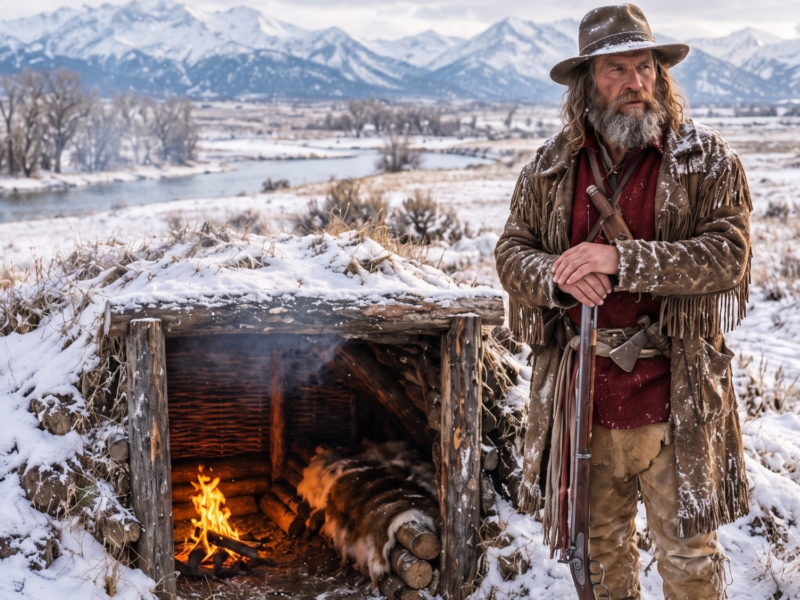
How Mountain Men Built Dugouts in 3 Days That Stayed 100°F Warmer Than Outside
Three Days to Survival
Once the site was chosen, the actual build began, and day one belonged entirely to excavation.
A trapper would mark out a footprint roughly 8 feet wide and 10 feet deep, cut straight into the face of the hillside. The back wall and both sidewalls were not built at all. They were simply the earth itself carved directly out of the slope. Only the front wall would need to be constructed from scratch.
He dug with whatever he had on hand: a short-handled shovel if he was lucky, a hand axe turned mad if he was not, or in the hardest ground, a sharpened elk antler—a trick borrowed straight from the Mandan. The excavation ran about 4 feet deep at the back and gradually shallowed as it reached the entrance. That was not laziness; that was drainage built in on purpose, so any water that got inside would run toward the door instead of pooling where he slept. No pumps, no drains, no membranes—just gravity, and a man who understood exactly where water wants to go.
Day two belonged to the frame. And the frame began with a single ridge pole. One long, straight piece of deadwood, usually lodgepole pine, was set from the back wall to the front, resting on two forked posts sunk into the ground at the entrance. That ridge pole would carry the entire weight of the roof—every ounce of sod and snow that piled on top of it through the winter.
So before it went up, a mountain man tested it the only way he could: he stood on it. If it held his full weight at the center without cracking, it would hold a roof.
Smaller rafters followed, laid from ridgepole to sidewall at roughly 12-inch intervals—no more, no less. Too far apart, and the sod would sag and eventually cave. Too close together, and he was wasting wood and time he did not have. Twelve inches was not written in any manual anywhere; it simply worked, and it passed from trapper to trapper the only way anything passed in that world: mouth to mouth at summer gatherings called rendezvouses.
Day three was roofing, and roofing was where the real cleverness showed itself.
Sod blocks were cut from a nearby meadow, roughly a foot by a foot and a half, about 4 inches thick. These went onto the rafters in overlapping courses like enormous shingles, starting low and working up toward the ridge. On top of that went a layer of loose earth, packed down simply by walking over it again and again.
Then came the part modern builders still find hardest to copy, not because it was complicated, but because it was strange: melted animal tallow, usually rendered from elk or buffalo fat, was worked into every seam between the sod blocks.
Tallow repels water naturally and, more importantly, stays flexible. Synthetic sealants today are technically stronger in a laboratory, but they are rigid, and rigid things crack when the ground shifts beneath them. Tallow simply moved with the structure because the mountain man had learned that lesson from experience, not from any material science course.
The front wall went up last: stacked logs or stone chinked with mud, grass, and more tallow, with a buffalo hide hung as a door.
And here is the part that still frustrates modern building scientists more than any other detail in the whole story: these dugouts held interior temperatures between 50 and 60 degrees Fahrenheit, even when the air outside dropped to 40 below.
That is a swing of nearly 100 degrees achieved with no power source beyond a small cooking fire. The Earth itself was doing the heavy lifting. Below the frost line, soil in the northern Rockies holds steady at around 52 degrees no matter what the sky is doing above it.
By burying himself in the hillside, a trapper was not just hiding from the wind. He was wrapping himself in a material that simply refused to freeze.
Modern insulation works by trapping still air—fiberglass, foam, rigid board. All of it slows heat loss, but none of it generates heat on its own. A dugout did both at once, absorbing warmth from the fire by day and releasing it slowly through the night. A foot of snow sitting on that sod roof added even more insulation, and it cost nothing, and it fell from the sky for free.









