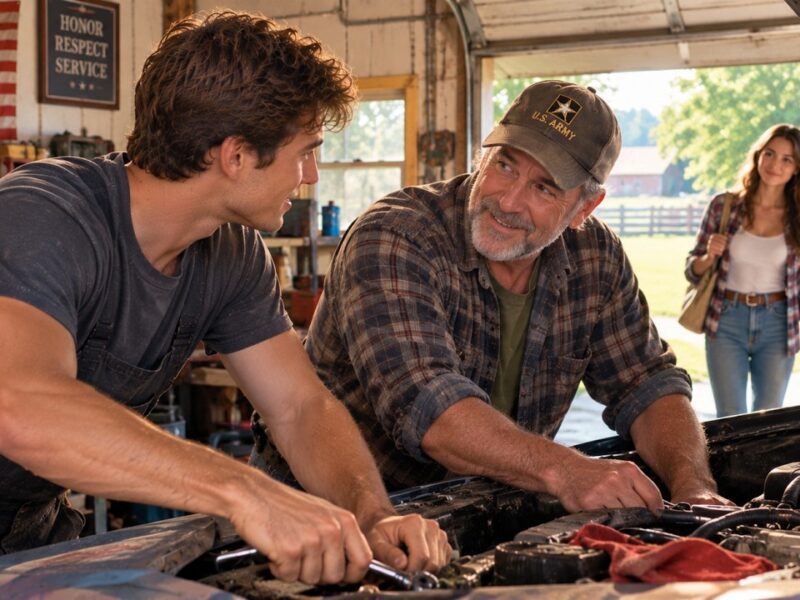
I Agreed to Help a Veteran Fix His Car… Then His Daughter Walked Into the Garage
The Archives of Margaret
When I arrived at Walter’s garage at eight o’clock on Saturday, I found that he was not an unprepared man.
He had already set up a heavy wooden workbench against the back wall. On it sat a stack of labeled cardboard boxes, a thick, grease-stained Haynes service manual, and a spiral-bound notebook.
“What’s the notebook?” I asked, setting my heavy steel toolbox on the floor.
Walter picked it up delicately, as if the pages were made of spun glass. “Margaret’s logbook.”
He opened it. The pages were filled with elegant, looping cursive handwriting. Margaret Briggs had recorded every single oil change, spark plug replacement, tire rotation, and mechanical quirk going back decades. It read less like a maintenance schedule and more like a diary of a companion.
June 14, 1992: Replaced alternator belt. Still squeals slightly when cold. Sounds like a wet cat. Remind Walter not to overtighten.
We began the mechanical triage. Before even thinking about the ignition, we had to ensure the heart of the machine wasn’t seized. We pulled the old spark plugs—they were fouled and black with old carbon—and sprayed penetrating oil down into each cylinder. Then, putting a heavy breaker bar on the crankshaft pulley bolt, I applied steady pressure.
“Come on, sweetheart,” I muttered.
With a low, metallic groan, the engine rotated. It was stiff, fighting the friction of a decade of slumber, but it moved.
“She’s free,” I said, wiping sweat from my forehead.
Walter exhaled a breath he seemed to have been holding for eleven years.
We spent the rest of the weekend doing the dirty work. We crawled under the chassis and drained the engine oil, which flowed out like thick, black molasses. The fuel in the tank smelled like rancid turpentine. Every rubber vacuum hose I touched snapped in my fingers like dry twigs.
None of that surprised me. What surprised me was Walter.
For a man who physically struggled to crouch down, his mechanical memory was razor-sharp. He remembered every bolt size before I asked for a wrench. He knew exactly which two-barrel carburetor had been installed in 1989, and he remembered the name of the mechanic who had cross-threaded the water pump bolts six years later.
His hands shook slightly when he tried to manipulate small washers, a tremor he tried to hide by putting his hands in his pockets. But when he talked about the history of the car, his voice lost its usual gruff edge. It became steady, anchored by memory.
By Sunday afternoon, we had drained all the toxic fluids, removed the cracked, sulfated battery, and compiled a long list of parts we would need before attempting to introduce a spark to the system.
Walter brought two faded canvas folding chairs out into the driveway and handed me a cold bottle of water. The late afternoon sun felt good on my grease-stained arms.
“You have children?” Walter asked suddenly, staring out at the quiet street.
“No.”
“Married?”
“Not anymore.”
He nodded slowly, taking a sip of his water, as though I had merely confirmed a piece of intelligence he had already gathered. Then, he glanced over his shoulder toward his dark, quiet house.
“My daughter thinks I should sell this place,” he said quietly.
“Do you want to?”
“No.”
“Then don’t.”
The corner of his mouth lifted in that familiar, microscopic way. “You haven’t met her.”
I assumed that was the end of the conversation. I packed my tools, washed the grease from my hands using a bottle of Fast Orange by the garden hose, and went home to my empty house.









