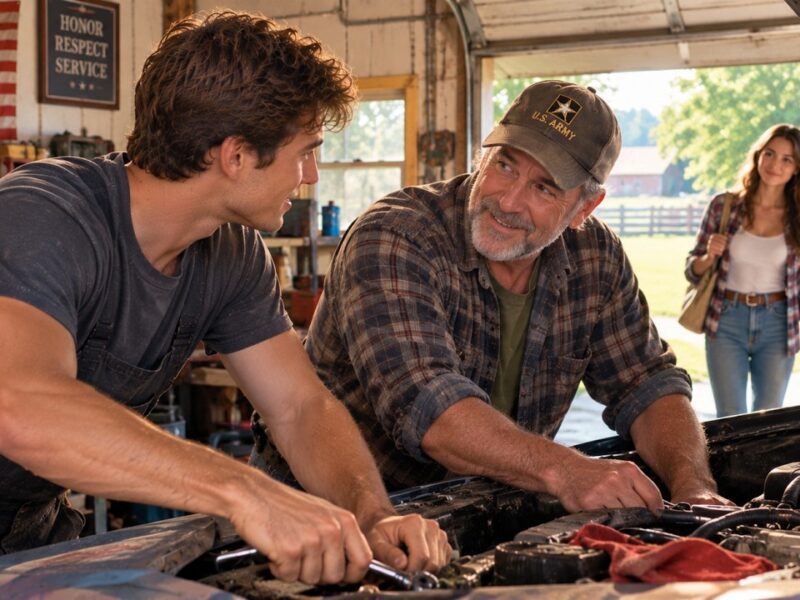
I Agreed to Help a Veteran Fix His Car… Then His Daughter Walked Into the Garage
Chicken Sandwiches and Confessions
The next evening, the air was warm for early October. I was in my backyard, wearing a faded t-shirt, wrestling with a power drill trying to replace a rusted, broken latch on my wooden privacy gate.
I heard footsteps on the driveway.
Clare was standing on the other side of the chain-link fence, holding two brown paper takeout containers that smelled incredibly of fried chicken and pickles. She was wearing jeans and a soft green sweater, and she looked nervous.
“I brought dinner,” she said over the fence.
“In my experience, spontaneous food usually means someone wants a favor.”
“I learned tactics from my father,” she smiled.
I unlocked the gate and swung it open. We sat across from each other at a small, weathered iron table on my back patio, eating spicy chicken sandwiches while the last of the orange sunlight bled out behind the rooftops of the subdivision.
Clare told me the details of her marathon conversation with Walter.
“He finally admitted that he wanted to sell the car because keeping it in the garage made him feel incredibly guilty,” she said, wiping her mouth with a paper napkin. “He said he would go out there at night, look at the tarp, and hear Mom’s voice telling him that she hated seeing something valuable and beautiful just sit unused and rotting.”
“What do you think she would have said?” I asked.
“I think she would have hated the dust on the windshield,” Clare laughed softly. “That sounds consistent with her personality. But… I also think she would have slapped both of us on the back of the head and told us to stop treating grief like a competitive sport.”
She folded the greasy paper wrapper neatly beneath her hands, avoiding my eyes.
“I owe you an apology, Ethan.”
“You already apologized for the argument in the garage.”
“I apologized for the volume of the argument,” she corrected, looking up at me. “I didn’t apologize for initially assuming you were some scam artist trying to take financial advantage of a grieving old man.”
“You didn’t know me. You were protecting your dad.”
“I didn’t even ask. I just attacked.”
I understood the reflex far better than she probably realized. Suspicion was an infinitely easier emotion to carry than vulnerability or disappointment. Suspicion let you believe you had maintained control. It let you build a wall.
“What happens to the Mustang after the benefit is over?” I asked, changing the subject to safer ground.
“We keep it. But not locked under a canvas cover,” she said, her eyes brightening. “Walter agreed to that. And he explicitly agreed to let me take it out and drive it once a month.”
“Once a month is an unusually specific contractual term.”
“He tried to make it once every two weeks. I had to negotiate him down. I have a demanding job.”
I realized then that there had been no mention of her leaving. No mention of another city, a job transfer, or anything that would pull her away from Dayton. Clare worked as a physical therapist at a busy sports rehabilitation clinic a mere ten minutes from Walter’s house. She had lived in her little brick house for seven years.
The vast, uncrossable distance between father and daughter had never been measured in geographic miles.
She looked past me, staring at the newly repaired metal latch on my gate.
“Will you come back and help us finish the car, Ethan?”
“To finish the car?” I asked softly.
She met my gaze. Her amber eyes held a quiet, terrifying courage. “Yes,” she said. Then, after a brief, electric pause: “And maybe not only for that.”
I looked at her sitting across my patio table, the evening shadows falling across her face. I felt the tight, heavy knot that had lived in my chest since my divorce begin to loosen, strand by strand.
Clare held my gaze, visibly nervous but stubbornly unwilling to take the risky words back.
“I’ll come back,” I said.









