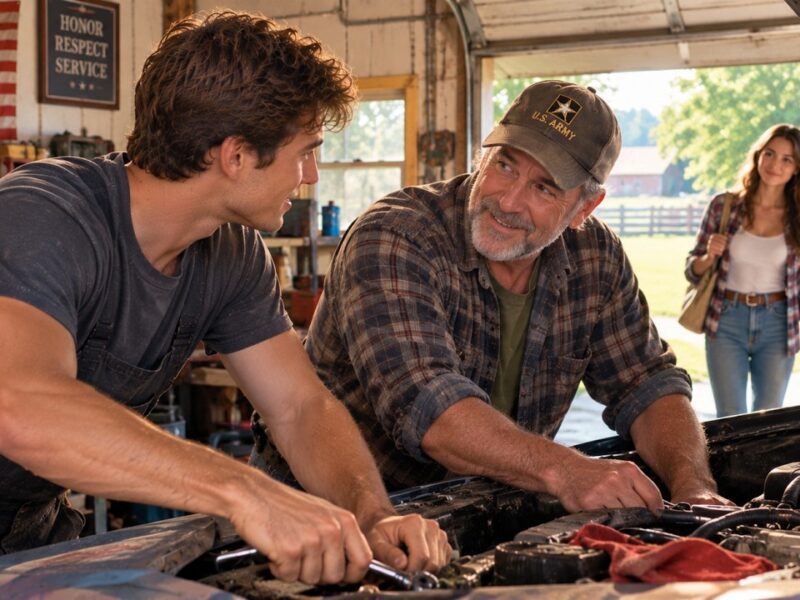
I Agreed to Help a Veteran Fix His Car… Then His Daughter Walked Into the Garage
Ignition
We resumed work early Saturday morning. The atmosphere in the garage was fundamentally altered. The heavy, oppressive ghosts had been cleared out, replaced by a frantic, mechanical energy.
Walter had already swept the entire garage floor. He had neatly arranged the new rubber front brake hoses, bottles of fresh DOT-3 fluid, and the heavy cast-iron replacement master cylinder on the workbench.
“You two settle your diplomatic border dispute?” Walter asked, leaning against his toolbox.
Clare handed him a steaming cup of coffee. “Careful, old man. We can still vote to donate your pickup truck to the charity instead.”
We attacked the braking system. I unbolted the failing master cylinder from the firewall. Before installing the new one, I clamped it in a vice on the bench and “bench-bled” it, using plastic tubes to route fluid back into the reservoir, pushing the piston with a screwdriver until every microscopic bubble of trapped air was purged from the internal bore.
We bolted it to the firewall, connected the steel lines, and fitted the new, flexible rubber hoses to the front calipers.
“Alright, Clare, you’re up,” I said.
Clare climbed into the driver’s seat. I crawled under the chassis at the right rear wheel—the furthest point from the master cylinder—with a wrench and a clear plastic catch bottle.
“Pump the pedal three times, slowly, and hold it down hard!” I yelled up.
“Pumping… holding!” she called back.
I cracked the bleeder screw. Dark, air-filled fluid spat violently into the bottle. The pedal sank to the floor. “Close it! Release the pedal!”
We repeated the agonizing process at all four wheels, moving closer to the master cylinder, until nothing flowed through the clear plastic tube but clean, golden, air-free hydraulic fluid.
Walter stood over me at the final wheel. “No bubbles.”
“No leaks either,” I replied, wiping the fittings with brake cleaner.
We adjusted the star-wheels inside the rear drums until they dragged perfectly, checked the pedal pressure—which was now rock hard—and inspected every single threaded connection twice.
Then, we returned to the heart of the beast. The engine.
The meticulously rebuilt two-barrel carburetor was bolted to the intake manifold with a fresh, thick paper gasket. The fuel tank had been dropped, professionally boiled out, and reinstalled. The damaged, brittle rubber fuel lines had all been replaced with modern, ethanol-resistant hose. The new inline filter showed clean, fresh, high-octane gasoline waiting to move through it.
We installed the eight new Motorcraft spark plugs, gaped perfectly. We traced the firing order along the distributor cap, replaced the corroded battery cables, and dropped a massive, heavy-duty battery onto the tray.
Because the engine had sat dry for a decade, I refused to just crank it. I removed the distributor, inserted a specialized priming shaft attached to an electric power drill down into the block, and spun the oil pump manually for three minutes. We watched as fresh, amber oil was forced up through the pushrods, lubricating the dry rocker arms, ensuring metal wouldn’t grind against metal on startup.
I dropped the distributor back in, aligned the rotor to Top Dead Center, and stepped back.
Walter stood beside the driver’s door. Clare stood near the workbench, gripping a large red fire extinguisher tightly against her chest.
“That seems overly encouraging,” Walter noted dryly, eyeing the extinguisher.
“It’s a necessary precaution,” Clare shot back. “You moved it closer to the door after I arrived.”
“That is entirely unrelated.”
Walter slid his stiff frame behind the large steering wheel. I leaned heavily over the engine bay, my eyes darting between the fuel line connections and the carburetor bowl, watching for any sign of a catastrophic fuel leak.
“Turn the key to the ‘Run’ position, but do not engage the starter yet!” I commanded.
Walter turned the key. The red ALT and OIL warning lights glowed brightly on the dashboard. The electric fuel pump ticked, pushing fuel into the dry carburetor bowl. I waited. No smoke. No overwhelming smell of raw, spraying fuel.
I gave a sharp nod. “Try it. Pump the gas twice to set the choke, and crank it.”
Walter pumped the pedal. He turned the key hard.
The heavy starter motor engaged with a loud, grinding rur-rur-rur. The engine turned over slowly, fighting the cold oil. It coughed once—a hollow, metallic pop through the exhaust—and then died.
Walter looked at me through the windshield, his eyes wide.
“Give the starter motor a few seconds to cool,” I said calmly. “It takes a minute to wake the dead.”
On the second attempt, Walter turned the key. The engine caught for less than a second, sputtering a frantic rhythm, before stalling out. Clare gripped the fire extinguisher so tightly her knuckles went white.
“Third time pays for all,” I muttered. “Hit it.”
Walter turned the key.
The starter whined, the engine caught, stumbled violently, and then, with a deafening roar that shook the dust from the garage rafters, the 289 cubic-inch V8 thundered to life.
The engine shook aggressively against its rubber mounts, misfiring on one cylinder, before suddenly clearing its throat and settling into a loud, fast, uneven idle. A massive, choking cloud of gray dust, cobwebs, and unburned hydrocarbons blew forcefully out of the twin tailpipes, drifting across the driveway.
Walter did not cheer. He did not pump his fist.
He simply took his foot off the gas, placed both of his trembling hands firmly on the top of the steering wheel, and closed his eyes, letting the vibration of the running engine travel up his arms and into his chest.
Clare slowly lowered the fire extinguisher to the floor.
I reached over the spinning fan blade, adjusted the idle mixture screws on the carburetor by a quarter-turn, and watched the engine smooth out beautifully into a rhythmic, steady purr. I checked the mechanical gauges. Oil pressure was strong. The temperature needle was slowly climbing but remaining perfectly stable. The alternator was charging the battery at fourteen volts.
After eleven years of silence, Margaret’s Mustang was breathing again.
Clare moved away from the bench and stepped up beside me. She stood close enough that her shoulder pressed firmly against mine. We both leaned over the fender, letting the mechanical heat wash over our faces.
But Clare’s eyes were not on the spinning belts or the shining carburetor. Her eyes were fixed entirely on her father through the dirty glass.
“I haven’t seen him look like that since before Mom got the diagnosis,” Clare whispered, her voice cracking.
Walter slowly opened his eyes. He looked at the two of us standing shoulder-to-shoulder through the windshield.
And then, he smiled. It was not the restrained, guarded, microscopic half-smile he usually rationed out to the world. It was a real, broad, unguarded smile that reached his eyes and erased a decade of sorrow from his face.
We let the engine reach full operating temperature, letting the thermostat open to circulate the coolant. Then, Walter reached forward and turned the key off. The engine shuddered and fell silent. The ticking of hot exhaust manifolds filled the garage.
The car was absolutely not ready for the open road yet. It still required fresh tires, a professional front-end alignment, working exterior light bulbs, and a highly cautious, low-speed shakedown test in the neighborhood to evaluate the transmission shifting and steering play.
But the hardest, heaviest silence in the Briggs family had been permanently broken.
Walter remained sitting in the garage, leaning back in his chair, simply listening to the engine block tick as it cooled.
Clare followed me outside to my truck. The autumn air felt impossibly fresh.
“Are you free tomorrow evening?” she asked, leaning against the bed of my pickup.
“I can be.”
“Good. No wrenches, no brake fluid, no grease, and absolutely no father supervising us from ten feet away pretending to read a newspaper.”
“What did you have in mind?”
“Dinner.”
I leaned against the truck next to her, looking at the sky, waiting just long enough to make her anxious.
Clare narrowed her eyes, a mock threat in her tone. “Don’t make me regret asking you, Cole.”
“I was just deciding whether I should bring a fire extinguisher to the restaurant.”
She laughed loudly, a brilliant sound, and shoved my shoulder hard.
“Six-thirty,” she said, turning to walk toward her car. “And Ethan?”
“Yeah?”
She stopped and looked back over her shoulder. “This time… I’m asking because I actually want to see you.”
Then she walked away, getting into her car before I could formulate an answer that wouldn’t sound foolish.









