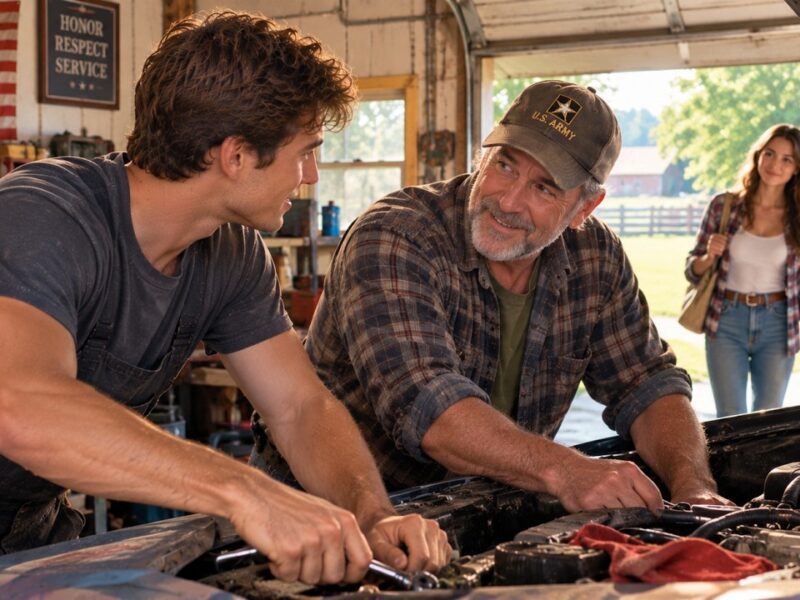
I Agreed to Help a Veteran Fix His Car… Then His Daughter Walked Into the Garage
Bleeding the Lines
Saturday morning arrived crisp and cold, hinting at the approaching autumn.
Clare arrived at my driveway at 7:52 AM. She was carrying a cardboard tray holding three large coffees and a grease-spotted paper bag from a local bakery that smelled heavenly of glazed sugar.
We walked down to Walter’s together. He threw open the garage door at exactly eight.
“You’re both early,” he grumbled, though he didn’t look entirely displeased.
“You raised me,” Clare replied smoothly, walking past him. “This is a product of your own rigid scheduling. It’s your fault.”
She handed me a steaming cup without asking how I took it. I took a sip. “Black. No sugar.” I looked at her, surprised.
“My father told me,” she said with a shrug.
Walter lifted his own cup, looking smug. “I provide useful intelligence to the troops.”
Clare had traded her professional attire for a pair of paint-splattered work pants and a heather-gray college sweatshirt, the sleeves pushed aggressively above her elbows. Her dark hair was tied back tightly in a no-nonsense braid. She looked entirely prepared to work, not merely supervise.
We began the dirty work of the brakes.
I slid the heavy hydraulic floor jack under the front crossmember, raised the Mustang, and lowered it securely onto heavy-duty steel jack stands. Before I even reached for a lug wrench to remove the wheels, I stood up and violently shoved the body of the car from both sides, ensuring it wouldn’t shift or crush me when I crawled underneath.
Clare watched the violent shaking with wide eyes. “What are you doing?”
“Testing the stability,” I explained. “Never trust a jack. Trust gravity.”
“Dad usually just kicks a block of scrap wood under the axle and calls it engineering.”
“It has worked so far,” Walter protested defensively from his folding chair.
“That is not a legal defense in coroner’s court, Walter,” I said.
The front brakes were disc brakes, a conversion kit someone had installed in the late seventies. The heavy iron calipers showed nasty surface corrosion, but when I applied pressure with a C-clamp, the pistons compressed smoothly. However, the flexible rubber brake hoses connecting the lines to the calipers were terrifying. They showed deep, dry-rotted cracks along the outer casing. I immediately added both front hoses to the growing replacement list.
The rear of the car was a different nightmare. It still utilized the original drum brakes.
When I wrestled the rusted left drum off the hub, a puddle of dark, viscous fluid immediately dripped onto the concrete. The interior of the drum and the brake shoes were entirely saturated in toxic fluid.
“The wheel cylinder blew a seal,” Clare observed, leaning over my shoulder.
“And those brake shoes are ruined,” I replied, pointing to the thick lining. “Once brake fluid soaks into the friction material, it’s garbage. They’ll never grip.”
Walter crouched painfully beside us, keeping all his weight shifted off his bad right knee. He looked at the mess with dismay. “Can they be cleaned with solvent?”
“I wouldn’t trust my life to them,” I said firmly. “We’re replacing the shoes on both sides, both rear wheel cylinders, and all the spring hardware. Then we’re flushing every inch of the steel lines.”
Walter nodded slowly without arguing the cost. That silent agreement told me exactly how much this car mattered to him. Walter argued with the mailman about the weather; if he wasn’t arguing a repair bill, it was sacred.
For the next two hours, Clare lay on a piece of cardboard beneath the rear axle, holding a Maglite steady while I inspected the hard steel brake lines running the length of the chassis. Most were coated in years of road grime, but structurally solid. One small section near the differential showed deep surface rust. It wasn’t enough to instantly condemn the line, but it was enough that I wanted it wire-brushed and checked obsessively before any road test.
She was an incredible assistant. She followed every mechanical explanation without ever pretending to know more than she did. When I used a term she didn’t know, she stopped me and asked. When she remembered a trick her mother used, she stated it plainly.
“My ex-wife used to accuse me of turning every home repair into a college lecture,” I muttered, wrestling with a rusted flare nut.
“She lacked curiosity,” Clare said simply, holding the light perfectly on the nut. “I like knowing how things stop.”
Around eleven o’clock, Walter grunted, stood up, and disappeared into the house.
Ten minutes passed. Clare glanced toward the closed back door.
“He does that when his knee flares up,” she said quietly. “He told us he was going to get more clean rags. There are forty clean rags sitting in the cabinet right behind you.”
I wiped sweat from my eyes. “Should we stop for the day? Give him an excuse to rest?”
“No. If we pack up, he’ll come back out here, pretend nothing hurts, and insist on sweeping the floor just to prove a point.” She pulled herself out from under the car and sat on an overturned five-gallon bucket. “I keep begging him to go back and see the orthopedic specialist at the VA. He keeps telling me the doctor already knows he has a knee.”
“That sounds exactly like him,” I smiled. “He thinks being difficult is a substitute for a personality.”
“Sometimes it is.”
Clare laughed quietly. It was a warm, musical sound.
I realized then that it was the very first time the two of us had been entirely alone. Without Walter’s looming, protective presence buffering the space between us, I became hyper-aware of exactly how close she was sitting.
There was a faint, dark streak of axle grease smeared across her left cheekbone. I raised my hand, almost intending to wipe it away with my thumb, then stopped myself, deciding I liked it exactly where it was. It made her look grounded. Real.
She noticed my hesitation. Her eyes dropped to my left hand, resting on my knee.
“You still wear your wedding ring,” she said softly.
I glanced down at my hand. The gold band was long gone, resting in a drawer in my bedroom. But a distinct, pale, indented line remained permanently etched into the skin of my ring finger, a ghost of twelve years of wear.
“I took it off eight months ago,” I said, rubbing the pale skin. “Takes the body longer to forget than the mind, I guess.”
“How long were you married?”
“Twelve years.”
She waited in silence, offering no platitudes, giving me the choice to stop there or continue.
“We became incredibly good at managing a house,” I confessed, looking at the rusted brake drum on the floor. “Bills, groceries, scheduling the plumber. We were excellent roommates. But somewhere along the way, we stopped looking at each other. The logistics became the entire marriage. One day we woke up and realized we didn’t actually like the people we were living with.”
“Was there someone else?”
“No,” I said, offering a sad smile. “Honestly, that almost would have been easier to explain to people. A betrayal makes sense. A slow fade is just… sad.”
Clare nodded slowly, picking at a frayed thread on her sweatshirt. “My parents were married for forty-six years before Mom died. At the funeral, everyone kept coming up to me, patting my arm, telling me how lucky they had been to have a perfect, unbroken love story.”
“They weren’t wrong.”
“No,” Clare agreed. “But sometimes people say that like a long marriage happens purely by magic. Like it happens because two people never, ever disappoint each other. They disappointed each other all the time. My father is infuriating. My mother was stubborn as a mule. But they stayed.”
The back door opened with a loud clatter before I could ask what made them stay.
Walter returned, carrying a plastic plate piled high with hastily assembled ham and cheese sandwiches. His limp was noticeably more pronounced, his face pale with pain, but Clare did not mention it. Neither did I. We played the game.
We dragged the folding chairs to the very edge of the driveway, sitting in the crisp autumn air to eat.
Walter, perhaps feeling talkative through the pain, told me a story about Margaret. He recounted a time she had successfully replaced the Mustang’s heavy alternator in the parking lot of a Kroger grocery store, using a basic toolkit she kept in the trunk.
“And Clare,” Walter chuckled, pointing a sandwich half at his daughter, “who was maybe nine years old at the time, was tasked with holding a golf umbrella over her mother’s head to keep the engine dry.”
“It was raining sideways!” Clare protested, laughing. “And she kept yelling at me that I was blocking her light!”
“You complained the entire time,” Walter teased.
“I was nine! I wanted to go home and watch cartoons.”
“You had developed the skill of complaining very early in life.”
After lunch, a brown delivery truck hissed to a stop at the curb. The driver handed Walter a heavy cardboard box containing the brake parts he had overnighted.
We spent the next four grueling hours replacing the rear wheel cylinders, mounting the new brake shoes, stretching the agonizingly stiff return springs into place, and securing the hold-down hardware. Clare worked shoulder-to-shoulder with me, meticulously cleaning the metal backing plates with brake cleaner and carefully ensuring that my greasy hands kept fluid far away from the pristine new friction linings.
By late afternoon, the rear system was fully assembled, but the lines were empty of fluid and full of air.
“We can’t bleed them today,” I said, stretching my aching back. “We still need to wait for the new rubber front hoses to arrive on Monday. Once those are on, we flush the whole system with fresh DOT-3 fluid and check for pressure leaks.”
Clare stood up and stretched, wiping her hands on a rag. She walked over and sat down in the driver’s seat of the Mustang again while I gathered my sockets into their red metal tray.
This time, she reached out and wrapped her right hand around the chrome T-handle of the automatic gear selector.
“Dad was always the one who drove,” she said quietly, staring through the steering wheel. “He drove us to church, to vacations. But Mom was the one who actually understood the machine. She knew how it breathed.” She looked at me. “Maybe that’s why he asked you for help. He couldn’t fix her, and he can’t fix her car.”
“Maybe.”
Walter had gone inside the house to make a phone call to the parts supplier.
Clare stared intently through the dusty windshield toward the quiet suburban street. “There’s something he isn’t telling us, Ethan.”
“What makes you think that?”
“He has never cared whether this car ran again. Not for eleven years. He treated it like a tombstone. Not until this week. And when my father suddenly decides that a monumental task absolutely has to happen right now, there is always a specific date or event attached to it.”
“Did you ask him?”
“I tried. He answered like a man being interrogated by an enemy combatant.”
“That also sounds like him.”
She smiled, turning her head toward me. Because she was sitting in the car and I was leaning against the doorframe, our faces were very close. Close enough that I could see a tiny, microscopic spot of dried blue paint near her left eyebrow. Her eyes were a deep, mesmerizing amber in the fading light.
For a few heavy seconds, neither of us spoke. The air felt charged, pulling taut like a guitar string.
Then, Clare accidentally leaned her weight forward against the center of the steering wheel.
The Mustang’s ancient horn, awoken from a decade-long coma, blasted a deafening, discordant HONNNNNK that echoed like a gunshot inside the small garage.
Clare screamed and jumped so violently in the seat that her shoulder collided hard with my chest. I stumbled backward, laughing in sheer shock.
Walter appeared instantly in the doorway, his eyes wide, looking for a fire.
When he realized what had happened, he let out a long breath. “Good,” he grunted. “At least one electrical component still works.”
Clare buried her face in both of her hands, her shoulders shaking. When she finally lowered them, her face was bright red, and she was laughing uncontrollably.
The laughter died, however, when Walter slowly raised his hand. He was holding a small, formal white envelope.
“Since you’re both here,” Walter said, his voice stripped of all humor, adopting a rigid, formal tone. “I suppose it’s time I told you exactly why I need the car ready and reliable by October.”









