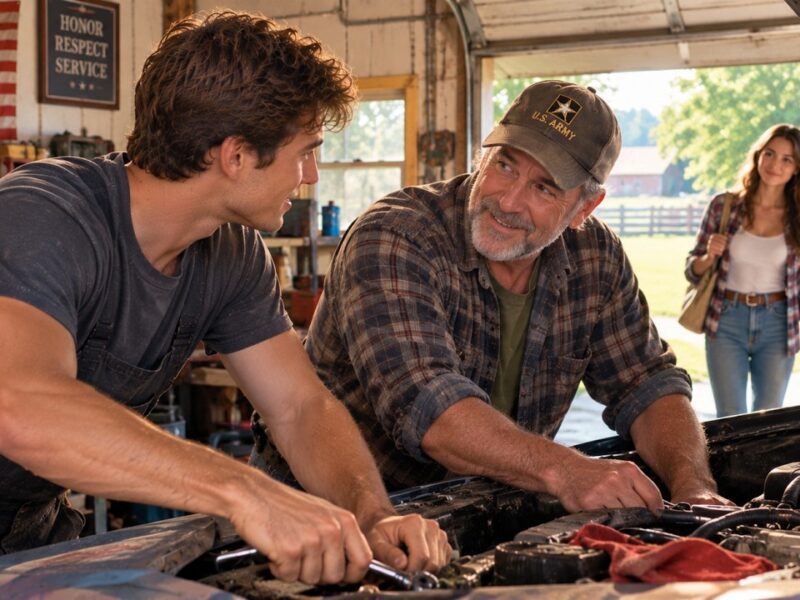
I Agreed to Help a Veteran Fix His Car… Then His Daughter Walked Into the Garage
Hidden in Plain Sight
With the tension dialed down from a boil to a simmer, Clare walked deeper into the garage. She moved closer to the Mustang, staring down into the cavernous engine bay. Her suspicion gave way to a deep, analytical concentration.
“What have you done so far?” she asked.
I walked her through the triage. I explained the drained fuel tank, the fresh oil, the removed spark plugs, and the hand-rotation of the crankshaft. I showed her the pile of cracked, useless vacuum lines we had pulled, and then I pointed to the carburetor parts I had laid out in meticulous order on a clean white towel on the workbench.
She leaned over the passenger-side fender, careful not to let her coat touch the dusty paint.
“That PCV hose is routed wrong,” she said.
I followed her gaze. “It hasn’t been connected to the valve cover yet.”
“No, I mean the original route.” She reached carefully past my arm, her sleeve brushing my forearm, and pointed a slender finger at a rusted metal clip bolted near the firewall. “It runs behind that bracket, not in front of it. Otherwise, when the engine torques, the hose rubs against the throttle linkage and binds the accelerator.”
I leaned in and examined the clip. I traced the line. She was absolutely right. If I had routed it the obvious way, it would have been a disaster waiting to happen.
I looked at her, impressed. “You’ve worked on this car.”
A shadow passed over her amber eyes. “My mother did.”
For the next hour, a strange, unspoken truce formed between us. I handed her tools, and I pretended I wasn’t listening intently when she casually explained the eccentricities of the old Ford V8. That’s a very specific thing to remember, I thought, as she pointed out a grounding wire that always vibrated loose.
While pretending not to listen, she caught me looking at her more than once.
The atmosphere in the dusty garage fundamentally changed when Clare spoke about Margaret. The grief didn’t disappear, but it became less sharp, less jagged. It became a shared space rather than a battlefield.
She opened the heavy driver’s door. The hinges creaked. She ran her fingertips lovingly over the worn, cracked rim of the black steering wheel.
The interior of the car smelled strongly of old vinyl, trapped dust, and the faint, nostalgic sweetness of aged upholstery. A small, jagged crack split the dashboard right above the glove compartment door. I noticed that the passenger seat had a patch near the lower edge that looked uneven, clearly hand-stitched with heavy thread.
“My mother drove this car everywhere,” Clare said softly, still touching the wheel. “To work, to my elementary school, to the grocery store in the snow. She refused to call it a ‘classic.’ She said that was what pretentious people called a car when they were too afraid to actually use it.”
“She sounds incredibly practical.”
“She was.” Clare sat down sideways in the driver’s seat, her feet remaining on the concrete floor. She did not pull the door closed. Her hands rested at the six o’clock position on the wheel. “When she got sick… Dad kept coming out here. He kept telling her they would take it out for a long drive again when she felt better.”
I did not ask what kind of illness had taken Margaret. Clare’s tone made it perfectly clear that the clinical details were not mine to request.
“After she died, he parked it in here,” Clare continued, staring blankly at the dusty windshield. “He threw the tarp over it. He wouldn’t sell it, but he wouldn’t look at it either. Eleven years.” She turned her head toward me. “He told you that?”
“The maintenance notebook told me.”
Clare’s eyes darted to the workbench, landing on the spiral-bound logbook. A sad smile touched her lips. “My mother wrote in that thing like the car was her second child.”
“I heard that,” Walter’s voice rumbled.
We both jumped. Walter had returned, carrying a plastic tray bearing three glasses of iced tea, condensation beading on the glass. “You were supposed to,” he added gruffly.
He handed one glass to me, passed one to Clare, and kept the third.
Clare stood up from the car seat. The temporary peace evaporated. “Dad. Why now?”
Walter looked stubbornly at the Mustang instead of meeting his daughter’s eyes. “Because waiting another decade hasn’t improved its condition.”
“That isn’t an answer.”
“It’s the one I have to give today.”
Clare took a slow, measured breath. I stood holding my iced tea, acutely aware that I was witnessing an argument that had been raging between them in various forms for over a decade.
Walter, clearly wanting to escape the emotional crosshairs, changed the subject by pointing a thick finger toward the disassembled carburetor on the towel. “Ethan thinks the carb can be rebuilt instead of replaced.”
“It can,” I jumped in, eager to talk about mechanics instead of grief. “But the rubber accelerator pump diaphragm is brittle, and the brass float may need replacing. We’ll know once it’s soaked and cleaned.”
Clare walked over to the bench. She picked up an old, crumbling paper gasket without bending it. “There should be another rebuild kit in the red metal cabinet.”
Walter frowned, shaking his head. “There isn’t.”
“There was,” Clare insisted. “Mom bought two of them from a catalog after the first one arrived with a crushed needle valve.”
She walked confidently to a tall, rusted metal cabinet standing against the far brick wall and pulled the squeaky lower door open. Kneeling down, she reached behind a stack of dusty Quaker State oil cans. Her hand emerged holding a small, faded cardboard box.
Walter stared at it as if she had pulled a rabbit from a hat.
Clare walked over and handed it to me. I blew the dust off the top and opened the flaps. Inside was an immaculate, factory-sealed carburetor rebuild kit, complete with fresh gaskets and brass fittings. Tucked inside the box was a faded, yellowed paper receipt dated nearly fifteen years earlier.
I checked the stamped part number on the box against the metal tag attached to the carburetor body. “It’s the exact correct kit,” I said, amazed.
Walter shook his head, looking bewildered. “Your mother could hide things in plain sight. She called it ‘organizing.’ She was wrong.”
Clare smiled. Fully, this time. It lit up the dark garage. Walter looked between the two of us with an expression I could not quite decipher—part sorrow, part calculation.
I spent the next hour scrubbing the aluminum carburetor body with solvent and a brass brush. Clare stayed. She didn’t hover, and she didn’t try to dictate the process, but she sorted the microscopic springs and check-balls, matching them perfectly against the exploded schematic diagram in the Haynes manual.
She noticed the small things. She found a missing lock-washer that had rolled under a rag. She pointed out a return spring that a previous mechanic had installed backward during some long-ago repair. At one point, she found a handwritten note from Margaret tucked between the pages of the manual—a grocery list mixed with torque specs—and quietly slipped it into her pocket without showing Walter.
By the time the daylight outside the garage faded into a deep purple twilight, we had successfully rebuilt the carburetor and identified our next major hurdle.
“The brake master cylinder is leaking internally,” I announced, wiping my hands. “The seals are shot. Even if we get the engine to fire, this car cannot safely leave the garage until the entire braking system is overhauled.”
Walter looked visibly disappointed by the delay. Clare, conversely, looked subtly relieved.
“I’ll order the master cylinder from the catalog tonight,” Walter said heavily.
“I’ll pull the rear drums and check the wheel cylinders on Saturday,” I replied. “If the master has failed, the wheel cylinders aren’t far behind.”
Clare closed the heavy service manual with a definitive thud. “I’m coming Saturday.”
Walter raised a bushy eyebrow. “You told me you had plans this weekend in Columbus.”
“I changed them.”
She looked directly at me as she said it. It wasn’t a suspicious look this time. It felt almost like a challenge.
She picked up the empty iced tea glasses, placed them on the tray, and followed her father toward the house. At the back door, she stopped and glanced over her shoulder.
“Eight o’clock,” she said.
“Walter said nine.”
“He says nine because he thinks normal people sleep late. I’ll be here at eight.”
“I’ll put on a pot of coffee,” I said.
Clare nodded once and disappeared inside.
Walter remained standing in the doorway, half in the shadows. He looked at me, his face unreadable. “You don’t have to come early just because she told you to, Ethan.”
“I know.”
Walter looked toward the dark silhouette of the Mustang, then back at me. His voice dropped to a rough whisper. “She hasn’t sat in that car since the day of her mother’s funeral.”
Before I could formulate a response, he closed the heavy door, leaving me alone in the darkening driveway.









