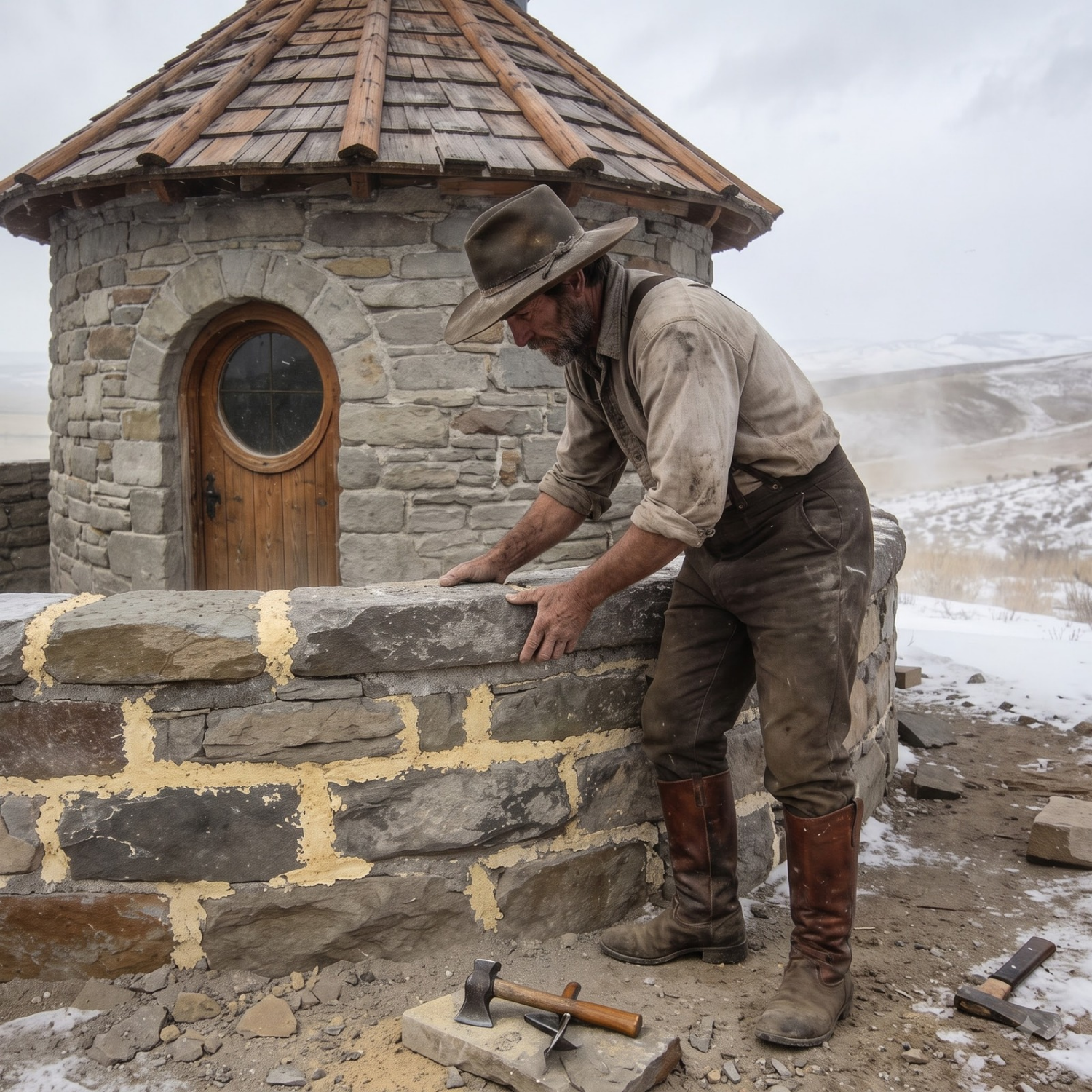
Neighbors Laughed When He Built A Round Stone House — Until The Wind Couldn’t Freeze It
The Old Country and the River
Anders Krugstad had not pulled his ideas out of thin air. He had learned his trade laying up coastal stone in western Norway, where ferocious North Sea gales could strip heavy turf thatch from a roof in a matter of minutes, and where the old-timers knew that sharp corners caught wind the way fishnets caught drifting kelp.
When he filed his homestead claim under the Homestead Act in the spring of 1876, he carried more than the usual immigrant’s bundle of rusty tools and fading dreams. Three summers working the Missouri River country had shown him earth lodges—circular, earth-mended homes where Mandan and Hidatsa families sat warm and comfortable while the prairie wind scoured the open ground harmlessly above their domed roofs.
The 160 acres he claimed lay in a gentle swale where the Little Laramie River curved through the grassland. It was sheltered enough to grow wild hay, but open enough to catch the relentless westerlies that defined Wyoming weather.
While his frantic neighbors walked their property lines, calculating board feet and window placement, Anders drove his stake into the center of a level spot and tied on his thirty-foot rope.
The circle he scribed in the prairie sod measured twenty-four feet across. It provided ample floor space for a growing family, visiting travelers, and the heavy central chimney he envisioned.
His wife, Astrid, ran her hand along the curved chalk line he’d marked in the dirt, a slight frown touching her brow. “How will we set our furniture against walls with no straight edges?” she asked.
Anders pointed toward a dense grove of cottonwoods nearby, where the prairie wind split smoothly and rejoined around each massive trunk.
“The wind goes around,” he said in his careful, heavily accented English. “Square, it hits like a fist. Roundhouse, like water around a stone.”
The foundation alone required moving vastly more earth than his neighbors thought sensible. Anders dug down three full feet, creating a circular trench that would anchor walls designed to carry an enormous, crushing weight.
Local sandstone, quarried from exposed cuts along the riverbanks, came in blocks weighing sixty to eighty pounds each—dense enough to test a strong man’s back, but light enough for one man to handle alone. The stone ran roughly 140 pounds per cubic foot, meaning the completed walls would hold over a hundred mass-tons of stone around the perimeter. It was a massive thermal battery that would warm slowly and cool slowly, fighting the vicious temperature swings that made thin-walled cabins utterly miserable.