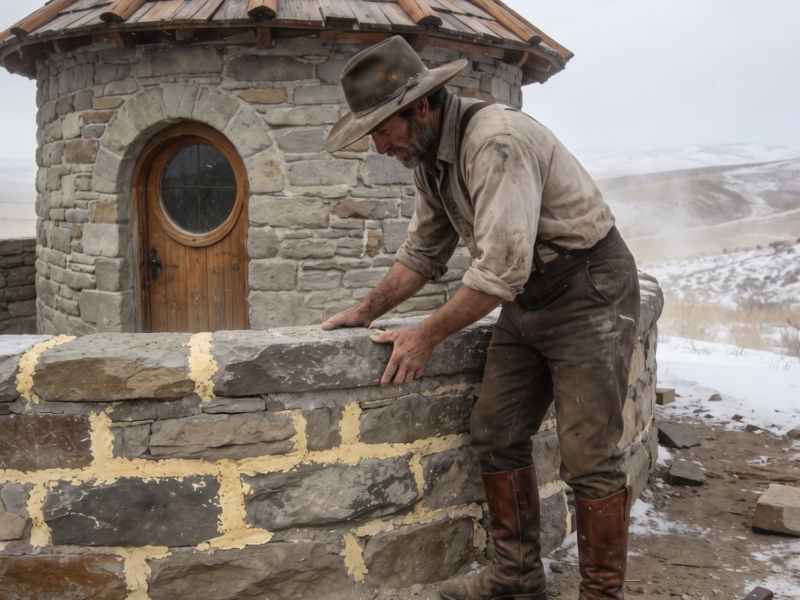
Neighbors Laughed When He Built A Round Stone House — Until The Wind Couldn’t Freeze It
The Fuel Crisis
The fuel consumption numbers provided the clearest, most undeniable measure of each building’s performance.
Talbot estimated his winter consumption at close to five cords of mixed wood and buffalo chips—dried bison dung that had become the standard heating fuel across much of the treeless prairie. The chips burned hot, but they burned fast, requiring constant attention and frequent, freezing trips to the outdoor fuel pile during the coldest nights.
Neighbors who lacked access to adequate timber supplies often burned four to six cords’ worth of equivalent fuel, sometimes desperately mixing in twisted prairie hay or anything else that would sustain combustion.
Anders’s family, maintaining comfortable, livable conditions in the round stone house, used approximately three and a half cords’ worth of equivalent fuel through the exact same brutal winter period.
The thirty percent reduction came not from superior fuel or more efficient combustion, but from the building’s sheer ability to retain heat once it was generated. The thick stone walls absorbed warmth during active firing periods and released it slowly over many hours, moderating the wild temperature swings that forced other families to choose constantly between freezing and exhausting their finite fuel supplies.
The most telling proof, however, came during a late-winter blizzard that brought sustained winds of forty miles per hour and driving snow that found every microscopic gap in conventional construction.
Inside Talbot’s cabin, lamp light flickered constantly as drafts moved through the structure, and fine snow accumulated on window sills despite closed wooden shutters. The Talbot family spent the night huddled near the fire, feeding it continuously to maintain any warmth at floor level.
Anders, checking his own house during the very peak of that same storm, found conditions that seemed to defy the weather outside. A candle placed near the curved stone wall burned with barely a flicker, demonstrating how effectively the round shape shed wind pressure. The interior temperature dropped only a few degrees from its normal range, and the family slept comfortably in the loft where the rising warm air naturally collected under the conical roof.
These early demonstrations drew mixed reactions from neighbors who had invested their personal reputations in conventional wisdom. Sarah Nevin, whose initial skepticism had given way to careful observation, began adopting small modifications that showed Anders’s influence. She convinced her husband to add an interior baffle wall near their front door, creating a crude air-lock that reduced drafts.
The improvement was noticeable, but it could not address the fundamental problems of corner leakage and inadequate thermal mass that afflicted the basic rectangular structure.
Others remained fiercely committed to their original criticism, attributing Anders’s success to factors that preserved their own building philosophy. “He’s got better stone,” Talbot insisted after visiting during a January cold snap. “Quarry stone holds heat different than what we can haul.”
The explanation allowed neighbors to acknowledge the roundhouse’s performance without ever admitting that shape and mass were doing work that their own traditional designs could not match.
More telling, though, were the quiet adoptions that began appearing around the valley. One family moved their heating stove from against the outside wall to a more central position, improving heat distribution. Another began banking earth around the north side of their cabin, creating a partial windbreak that reduced fuel consumption.
These modifications fell short of Anders’s fully integrated approach, but they demonstrated that his methods were yielding results too obvious to ignore completely.
Act II: The Great Die-Up
Chapter 6: The Scorched Prairie
The seasonal pattern established during that first winter would repeat with variations over the next several years. Each cold season provided fresh examples of the round stone house’s superior performance—measured in fuel saved, comfort maintained, and the simple ability to function normally when conventional cabins became barely habitable.
The thick walls continued storing and releasing heat in daily cycles that moderated temperature swings while the aerodynamic shape shed wind pressure that tested every corner and joint of rectangular construction. By 1885, as another building season approached, Anders had acquired a reputation that balanced grudging respect with persistent mockery.
His fuel savings were undeniable, his comfort levels envied, and his construction methods increasingly studied by neighbors who remained unwilling to abandon the rectangular tradition that defined proper housing in their minds.
The round stone house had proven itself through normal winters, but the real test was coming.
The summer of 1886 broke records across the northern plains in ways that old-timers would discuss for decades. Temperatures climbed into the nineties week after week, with rainfall so sparse that the Little Laramie River dropped to levels not seen in living memory.
Grass that should have stood knee-high by July barely reached a man’s ankles, and what growth existed had been cropped ruthlessly to the roots by cattle numbers that had swollen far beyond the land’s fragile capacity to support them.
The open-range system that had made fortunes for territorial ranchers depended entirely on abundant grass and mild winters. But 1886 was testing both assumptions to their absolute limits.
Jim Talbot, whose cattle operation had expanded to over eight hundred head, watched his animals competing desperately for dwindling forage on ranges that had supported half that number in previous years. Prairie fires, sparked by lightning or careless campfires, swept across ridges already stripped bare, leaving vast expanses of blackened earth that would provide no winter shelter for livestock or wildlife.
Through these brutal conditions, Anders Krugstad observed environmental signs that his neighbors dismissed as mere coincidence or foolish superstition.
In late August, when migrating birds should have been gathering for their usual September departure, flocks of geese and cranes were already moving south in numbers that seemed bizarrely premature. Beaver along the river worked with frantic intensity, cutting willows and banking their dams higher than he had seen in previous years. Even the domestic farm animals seemed affected: horses grew thicker coats earlier, and cattle bunched together abnormally in low draws rather than spreading across the available range.
The clearest warnings came from Bear-by-the-River, an elderly Arapaho man who occasionally stopped at homesteads to trade or share news from the reservation. During a September visit, he studied the sky and wind patterns with the intense attention of someone whose survival had once depended on reading such signs accurately.
“Cold winter coming,” he told Anders in careful English. “Animals know, birds know. White men, they don’t watch.”
He gestured toward the round stone house with profound approval. “Earth house good like the old people made. Wind goes around.”
Anders had learned to trust such observations during his years in the Missouri River country, where native families had perfected winter survival through centuries of experience with prairie conditions. Their earth lodges—some measuring sixty feet across and housing extended families through the harshest months—represented engineering solutions developed long before European settlement brought rectangular construction and thin-wall building techniques to the high plains.









