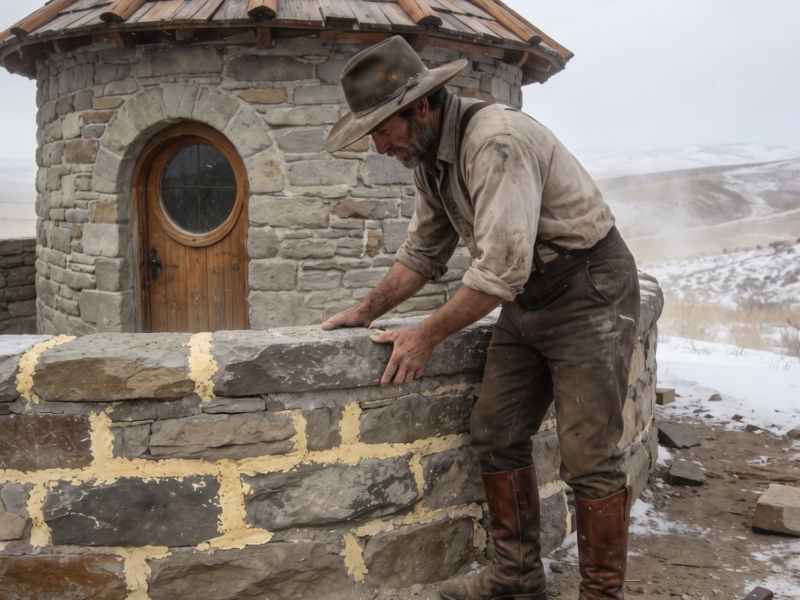
Neighbors Laughed When He Built A Round Stone House — Until The Wind Couldn’t Freeze It
Fortifying the Circle
Acting on these accumulated warnings, Anders began modifications to his house that seemed excessive to neighbors who had not learned to read environmental signs.
He spent three weeks in September hauling additional earth to raise the berms around his north and west walls from three feet to four and a half feet—a change that would add significant thermal mass and wind protection during severe weather. The extra eighteen inches of earth represented several tons of additional material that would help moderate interior temperatures and deflect wind pressure.
More significantly, he added a second door system that created a proper air-lock entry. The modification required building an interior wall that divided the existing dog-leg passage, creating two separate doors with a small, unheated chamber between them.
The design followed principles he had observed in earth lodge construction, where families routinely created multiple physical barriers against wind infiltration. During severe storms, the air-lock would prevent frigid air from rushing directly into the living space each time someone entered or left the house.
Anders also modified the fresh-air supply to his heating system, running a small duct from outside directly to the area near the base of his stove. The improvement would eliminate the need to crack windows or doors for combustion air during extreme cold, preventing the drafts that plagued conventional cabins where families had to choose between adequate oxygen for their fires and protection from freezing air currents.
His fuel stockpiling efforts drew the most visible criticism from neighbors who saw such preparation as wasteful or pessimistic. While most families aimed for three to four cords’ worth of mixed wood and buffalo chips—enough for a typical Wyoming winter—Anders accumulated nearly six cords’ equivalent: a fifty percent increase that required significant additional labor and storage space. He cut and split wood through early October, continuing long after his neighbors had declared their winter preparations complete.
Jim Talbot responded to the same environmental signs by doubling down on expansion rather than preparation. He invested in a larger rectangular bunkhouse that would accommodate twelve men during winter months, betting that his cattle operation would continue growing despite the overgrazed conditions.
The new structure followed conventional design principles—thin walls, large windows, and minimal attention to wind resistance—representing a philosophy that trusted in normal weather patterns and rapid economic growth.
Sarah Nevin’s family made similar calculations, adding a half-story to their existing frame cabin to create additional living space. The modification increased the building’s wind exposure and added joints and connections that would be tested by severe weather, but it provided the extra room needed for their growing household. Like most frontier families, they optimized for normal conditions rather than worst-case scenarios.
The first clear signs of an abnormal winter appeared in early November, when snow fell two weeks ahead of the usual schedule and in quantities that suggested the beginning of a severe season. More ominous were the weather patterns that followed: repeated cycles of Chinook winds that brought temporary thaws, followed by sudden, violent freezes that created hard ice layers over the existing snow.
These conditions would prove deadly for livestock, creating crusts that prevented animals from reaching grass beneath, but most ranchers interpreted the early storms as isolated events rather than harbingers of systematic failure.
By late November, with temperatures already dropping well below normal ranges and snow accumulating in drifts that would not melt until spring, Anders completed his final preparations. His house stood ready for conditions that most neighbors still believed would moderate according to historical patterns.
The round stone structure with its enhanced thermal mass, improved air-sealing, and aerodynamic shape represented the kind of systematic preparation that native communities had practiced for generations. The coming months would test whether such preparation remained relevant in an age of cattle fortunes and conventional wisdom.









