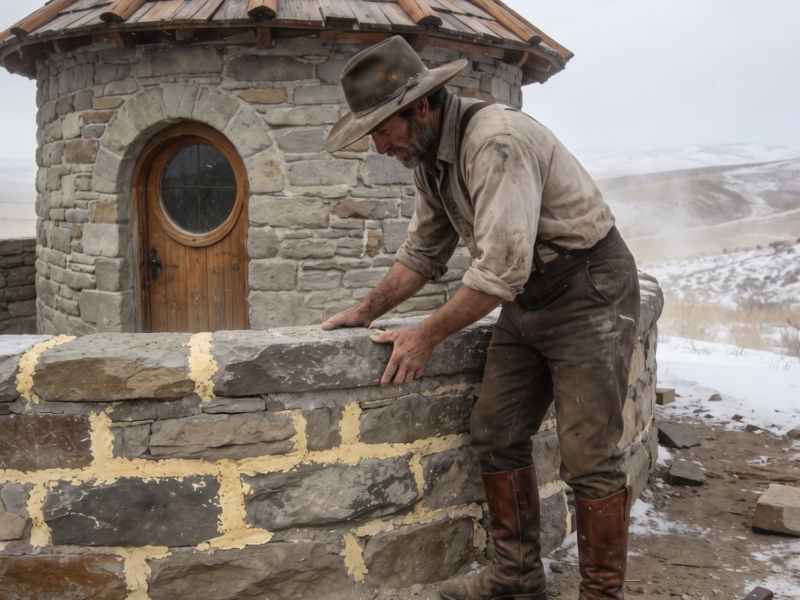
Neighbors Laughed When He Built A Round Stone House — Until The Wind Couldn’t Freeze It
The Chimney and the Burm
By late September, with the stone walls complete and the roof timbers cut from local pine, Anders began the work that would define his house’s performance through decades of brutal Wyoming winters.
He hauled earth up around the exterior stone walls by the cartload, creating an earthen berm that rose three feet high on the north and west sides where the prevailing storms would hit hardest. This earth berm followed patterns he had observed in earth lodge construction, where families routinely banked their homes with tons of sod and dirt that served as both dual-purpose insulation and active wind deflection.
The conical roof, framed at a steep forty-five-degree pitch, would shed wind and heavy snow like the tip of a wedge. Local lumber merchants shook their heads at the sheer waste of having no flat roof for attic storage or future expansion. But Anders had watched enough Wyoming storms to know that any flat surface that caught the wind would eventually surrender to it.
The roof sheathing went on tight, covered with hand-split pine shingles arranged in overlapping courses that would turn water and driving snow without creating the flat planes and sharp edges that gave the wind something to grab.
As October snow began dusting the high alpine ridges, Anders lit his very first fire in the massive central chimney he had built from the same local sandstone as the walls. The interior temperature climbed steadily and held, the thick stone storing heat during the day and releasing it slowly and persistently through the night.
His neighbors, watching smoke rise straight and true from the conical roof with no sideways drift or backdraft, began asking different questions about the man they had called a fool for spending an entire building season on a single, windowless-looking room.
The winter of 1878 arrived with the unyielding punctuality that defined Wyoming weather: early November snow followed by a steady, punishing cold that would hold relentlessly until March.
Anders Krugstad’s first season in the round stone house provided the kind of comparative data that frontier families rarely had the luxury to gather, since survival typically left little time for scientific measurement and record-keeping.
Jim Talbot’s rectangular cabin—built with fourteen-inch pine logs chinked with clay and moss—followed the standard pattern that had served homesteaders from the Ohio Valley to the Oregon Territory. The structure measured sixteen by twenty feet, with windows facing south and east for morning light, and a stone chimney built against the north wall to save precious interior space.
On a typical December night without a moon, with temperatures holding steady around fifteen degrees and the wind gusting to twenty-five miles per hour, the interior temperature near the floor of Talbot’s cabin rarely climbed above thirty-five degrees unless the fire was stoked to a roaring inferno that consumed cordwood at an alarming, unsustainable rate.
The problem lay not just in the thin walls, though fourteen inches of pine provided far less thermal mass than Anders’s twenty-four inches of stone. The rectangular shape created dangerous pressure differentials that plagued every similar cabin in the valley. When a northwest wind hit the broad face of Talbot’s cabin, it created high pressure against that wall and suction at the trailing corners that literally pulled warm air right out from the interior.
Chinking gaps that seemed tight during construction opened under this relentless pressure, allowing steady streams of frigid air to flow along the floor while heated air escaped through the eaves.
Inside the round stone house during those exact same December nights, conditions told a profoundly different story. The curved walls presented no broad face to catch the full force of prevailing winds. Instead, the airflow split and rejoined around the cylindrical structure like water flowing smoothly around a smooth river boulder.
With the same size heating stove burning similar fuel, the interior temperature at head height held steady around fifty degrees, while the floor temperature near the stone walls measured forty to forty-two degrees—cold enough to require warm wool clothing, but well above the freezing point that made water buckets and morning washing impossible in neighboring cabins.









