Neighbors Laughed When He Built A Round Stone House — Until The Wind Couldn’t Freeze It
The Great Die-Up
The blizzard that would define the Great Die-Up winter struck the Little Laramie Valley on January 9th, 1887, arriving with the terrifying violence that characterized the worst storms in Wyoming history.
Weather records from military posts across the territory would later document winds sustained at fifty to sixty miles per hour with gusts exceeding seventy, driving snow that reduced visibility to absolute zero and creating drifts that buried entire buildings. Temperatures plunged to twenty-five below zero and held there for days, testing every structure and survival strategy across the northern plains.
Jim Talbot’s rectangular bunkhouse—designed to shelter twelve men through normal winter conditions—revealed its fundamental weaknesses within hours of the storm’s arrival. The broad west face of the building caught the full force of the northwest wind like a sail, creating pressure that strained every joint and connection.
High pressure against that wall combined with suction at the trailing corners to create airflow patterns that literally pulled chinking from between the logs. Gaps that had seemed adequately sealed during construction opened under the relentless wind pressure, allowing streams of frigid air to flow across the floor while heated air escaped through any available opening near the ceiling.
Inside the bunkhouse, men huddled around a heating stove that glowed red from continuous firing, yet could not raise the interior temperature above the mid-thirties. Water buckets froze solid despite being positioned near the fire, and fine snow accumulated on bunks as wind-driven particles found their way through gaps in the log construction. The men took turns feeding fuel to the stove throughout the night, burning through their carefully hoarded supply at a rate that would exhaust their reserves within days if the storm continued.
Sarah Nevin’s frame cabin, with its recent half-story addition, suffered even more dramatic failures. The increased wall area and additional joints created by the expansion provided more surfaces for wind to exploit.
On the second night of the storm, a window shattered under flying debris, and despite desperate efforts to cover the opening with blankets and boards, the breach could not be sealed against the hurricane-force winds. Snow accumulated inside the cabin faster than the family could remove it, and the interior temperature dropped toward the freezing point despite continuous firing of their heating stove.
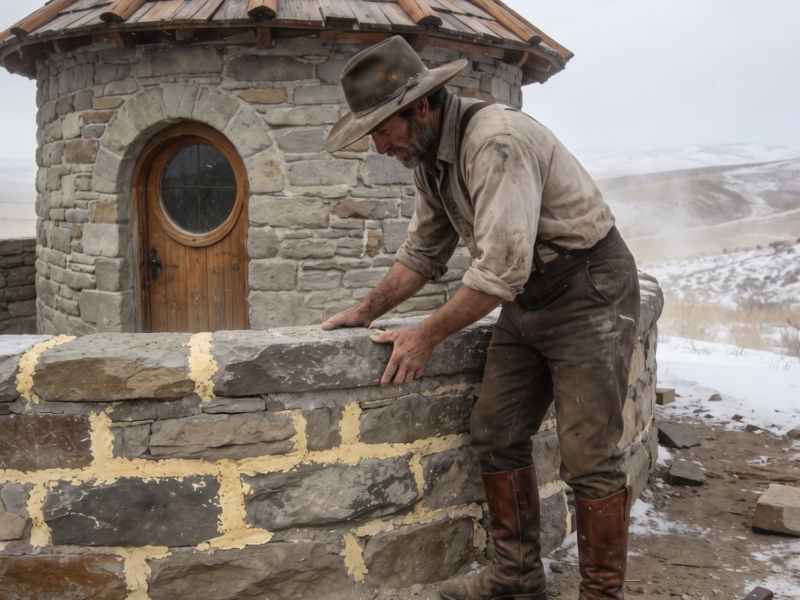
The round stone house, by contrast, demonstrated the engineering principles that Anders had incorporated based on traditional designs proven over centuries of prairie winters. The curved walls presented no broad face for the wind to strike, causing the airflow to split and rejoin around the cylindrical structure like water flowing smoothly around a river boulder.
This aerodynamic advantage eliminated the pressure differentials that plagued rectangular buildings where high pressure on one side and suction on the other created the driving forces that opened gaps and pulled heated air from interiors.
The technical measurements that Anders recorded during the storm’s peak revealed the dramatic difference that shape and mass could make. With outside temperatures holding at twenty-five below zero and winds averaging fifty-five miles per hour, the interior temperature at chest height remained steady between forty-eight and fifty-two degrees.
Even more remarkably, the temperature at floor level against the thick stone walls measured thirty-eight to forty degrees—cold enough to require warm clothing, but well above the freezing point that made normal activities impossible in neighboring structures.
The fuel consumption inside the roundhouse increased to approximately one and a half wheelbarrows of wood per day compared to the single wheelbarrow used during normal cold weather. But this represented manageable consumption that could be sustained for weeks rather than the desperate overfiring required in failing rectangular cabins.
The thick stone walls continued their thermal battery function, absorbing heat during active firing periods and releasing it gradually, maintaining relatively stable conditions even when the fire died down to coals.









