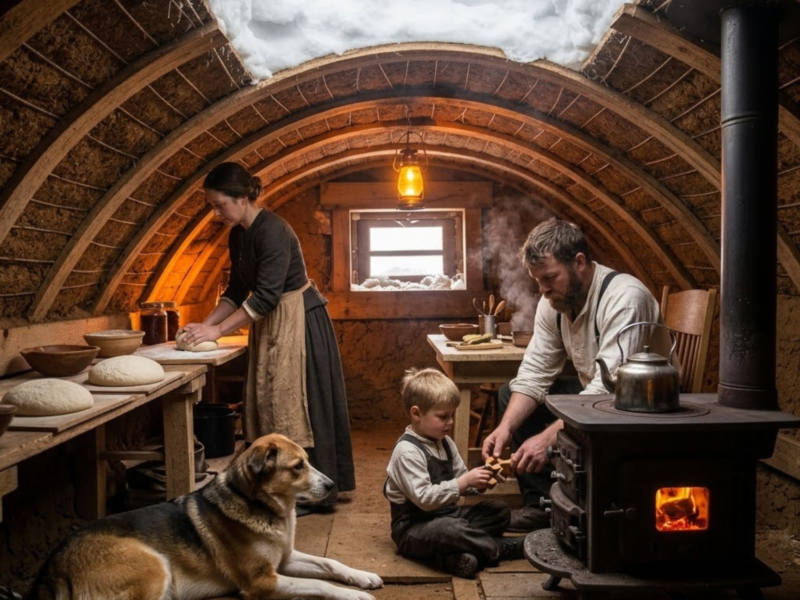
Neighbors Laughed When He Built A Secret Dugout Beneath His Barn – Until He Kept Warm All Winter
THE SECRET LABOR
The renovation took six weeks of stolen hours—stolen from sleep, stolen from the early spring chores that threatened to overwhelm them.
Thomas reinforced the cottonwood ceiling beams with fresh oak braces he salvaged from an abandoned wagon bed. He added a second layer of sod bricks along the interior to double the insulation value, and he dug a narrow, hidden ventilation shaft that snaked upward into the loft, disguised beneath rotting piles of old chaff and discarded harness leather.
The work was backbreaking. Every bucket of excavated clay had to be hauled up by hand and scattered across the fields so no fresh earth piles would arouse suspicion. His hands split open, callous meeting raw blister until they wept blood. His lower back became a constant, throbbing ache that followed him into his dreams.
By late May, the subterranean room was finished. The final touch was a trapdoor constructed of two-inch oak planks, fitted flush with the barn floor and covered by a permanent layer of loose hay. Step on it, and it felt like solid flooring; pull the hidden iron ring, and it swung open into the earth.
Summer arrived with the usual Kansas fury—a blinding, brassy sun that baked the wheat fields and turned the dirt to iron. Thomas planted his thirty acres of wheat, tended the vegetable garden with Ingrid, and repaired broken machinery.
Yet, throughout the long months of heat, he noticed the cautious glances of his neighbors.
Eric Thorson, a broad-shouldered Swede whose farm abutted the north edge of Thomas’s homestead, ambled over in August to inspect the modest woodpile stacked behind the Henrikson house.
Eric poked a heavy boot against a log, shaking his head. “That’s not enough wood for winter, Thomas. That’s six weeks’ worth if you burn it lean. You planning to freeze come January?”
“I’ll manage,” Thomas said, wiping sweat from his brow.
“Manage how?” Eric frowned. “You can’t heat a farmhouse with optimism. The wind off the plains doesn’t care about your bank account.”
“I’ve got some ideas,” Thomas replied mildly.
Eric gave him a look that clearly communicated his opinion of young men and their foolish ideas, but he didn’t press further. Thomas let him think whatever he wanted.
As September cooled into October, Thomas began the delicate, clandestine task of stocking the dugout. He couldn’t do it all at once; a sudden influx of supplies carried across the yard in broad daylight would set tongues wagging.
Instead, he moved items in dribs and drabs. Extra wool blankets and quilts were brought down under the guise of “reorganizing house storage.” Two old wooden chairs and a small pine table left behind in the farmhouse attic were lowered into the earth. A wooden crate of cheap books bought from a traveling salesman in town joined them, alongside Thomas’s leatherworking tools.
Then came the fuel.
Thomas calculated the math over and over in his head. The underground chamber possessed roughly eighty square feet of floor space, compared to the house’s four hundred. More importantly, the dugout was surrounded by earth—twelve inches of packed sod on all sides, maintaining a stable ambient temperature regardless of the weather above.
A house built of thin pine boards leaked heat through every nail hole. Earth held it.
Thomas estimated, with a mixture of hope and scientific deduction, that heating the dugout would require roughly one-sixth of the fuel needed to heat the house to the same temperature. That meant the meager pile of wood he’d gathered for six weeks of house heating would theoretically last six months down below.
Instead of stacking his autumn firewood out in the open where Eric Thorson and every other curious neighbor could count the logs, Thomas hauled the wood directly into the barn loft, stacking it quietly right above the hidden trapdoor. He also gathered dried prairie corn cobs and wild grass—inferior, fast-burning fuels that would be more than adequate for the tiny, high-efficiency iron stove underground.
To anyone looking from the outside, Thomas Henrikson was a foolish young immigrant heading into winter with a dangerously inadequate supply of fuel.
In reality, he was sitting on a subterranean mountain of heat.









