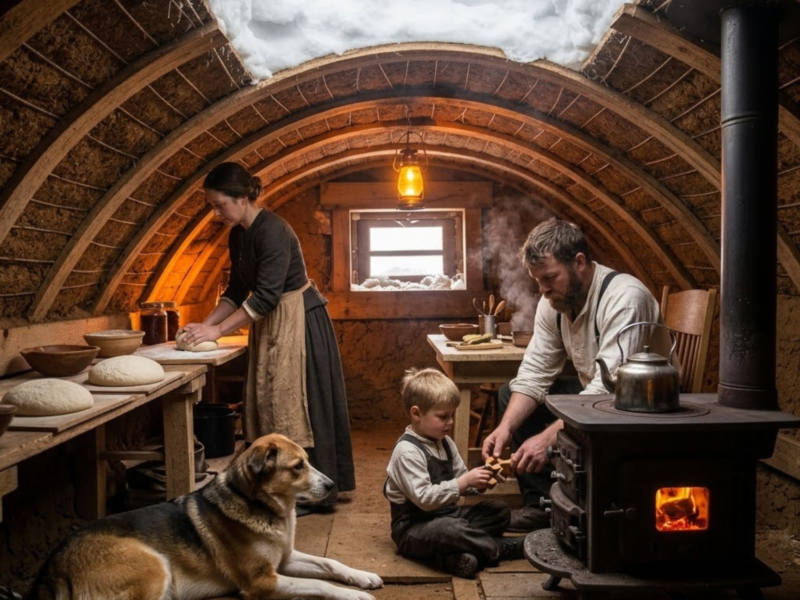
Neighbors Laughed When He Built A Secret Dugout Beneath His Barn – Until He Kept Warm All Winter
THE LONG VIEW
Thomas lived on that homestead for forty-three prosperous years.
He and Ingrid raised four healthy children there. By 1895, having farmed successfully and banked enough capital, Thomas replaced the original three-room homestead cabin with a spacious, modern six-room frame house.
Yet, he refused to abandon the subterranean refuge. He continued utilizing the dugout as a private winter workshop until 1898, when he finally constructed a properly insulated above-ground workshop.
Even then, he left the original dugout completely intact and functional, treating it like a trusted old friend. Whenever curious visitors came by asking about the local legend of the “Barn Bunker,” the aging Norwegian would gladly lead them out to the northwest corner of the barn, pull up the hay, and swing open the heavy oak trapdoor.
Thomas sold the property in 1926, retiring to a quiet life in town with his eldest daughter.
The grand farmhouse he’d built in 1895 was eventually demolished in 1935 to make room for modern agricultural warehousing. But the old barn stood proud until 1968, and the hidden dugout beneath its floorboards remained completely operational and dry for eighty-five years after Albert Cooper first struck a spade into the dirt.
When the barn was finally torn down in the summer of 1968 to clear space for a massive machinery shed, a bewildered construction crew broke through the ceiling of the forgotten chamber.
“What the hell is this?” one young worker muttered, shining a flashlight into the dusty void. “Why would someone build a room under a barn?”
The demolition foreman—a sixty-year-old local whose grandfather had homesteaded the adjoining county back in the 1880s—walked over, looked down the ladder hole, and smiled softly.
“It’s a winter dugout,” the foreman said, shaking his head in nostalgic wonder. “My granddad told me about these. Homesteaders used ’em to beat the deep freezes when they couldn’t afford coal. He said they saved half the county during the bad winters.”
They ultimately filled the excavation in with heavy rubble from the demolished barn, sealing the chapter for good.
But the historical record survived. Faded black-and-white photographs from the early 1900s still show Thomas Henrikson’s barn—looking thoroughly ordinary from the outside, hiding its incredible secret beneath the floorboards.
Two men lived in the shadow of that secret, and their choices defined their legacies:
-
Albert Cooper possessed the brilliance to engineer a masterpiece of subterranean survival, but guarded it with bitter pride, living comfortably while his neighbors suffered, and dying a lonely, embittered man whose genius withered away with him.
-
Thomas Henrikson stumbled onto that same brilliance by pure chance, recognized its profound value, and chose the path of radical generosity—handing the blueprint to anyone who knocked on his door.
In the end, humanity is not measured by the cleverness of what we build in isolation, but by whether we have the grace to share it when the bitter winds blow. Albert Cooper survived comfortably and died alone. Thomas Henrikson survived comfortably, and was carried to his rest surrounded by a community that loved him as the man who kept them warm.









