Neighbors Laughed When He Built A Secret Dugout Beneath His Barn – Until He Kept Warm All Winter
THE BATTLE FOR HEAT
November melted into a brutal, unforgiving December.
Nighttime temperatures routinely plummeted into the single digits, occasionally clawing down below zero when the northern winds whipped across the treeless flats. During daylight hours, the mercury struggled to climb into the teens.
Across the county, homesteaders burned through their firewood piles at a terrifying, unsustainable rate. When Thomas went into Red Willow for supplies, he saw the physical toll etched into people’s faces—the hollow eyes, the pinched skin, the silent panic of watching a woodpile shrink week by week while the calendar still showed three months of winter ahead.
Meanwhile, Thomas and Ingrid established a quiet, highly efficient winter routine.
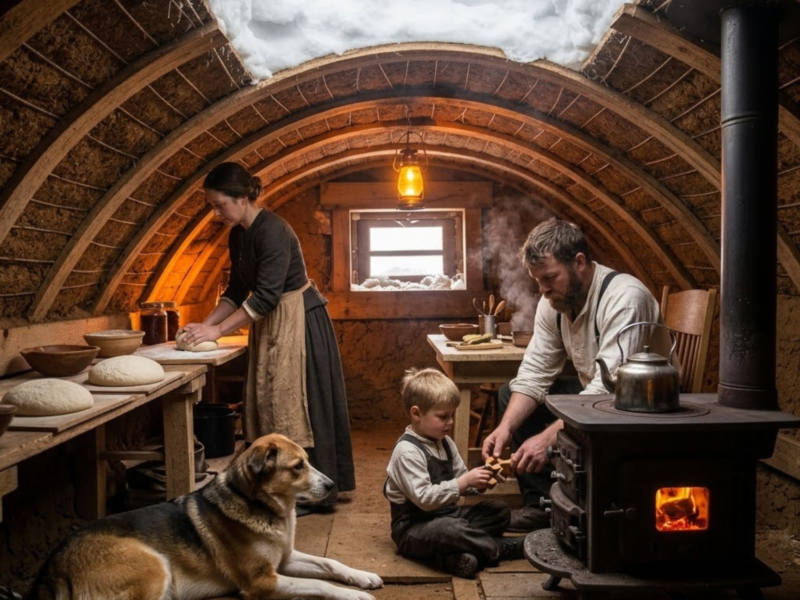
By day, they practically lived in the dugout. Thomas moved his entire workshop underground—harness repair, tool sharpening, woodworking—all the noisy, detailed tasks that winter demanded. Ingrid brought down her sewing basket, mending clothes by the warm glow of the stove.
Their five-year-old son, Niels, treated the subterranean room like an enchanted castle, playing quietly with a set of wooden blocks carved by his father, completely oblivious to the howling gales thrashing the prairie above.
They kept a small, steady fire burning in the dugout stove, fed with modest amounts of wood that produced maximum heat in the confined space. A log that wouldn’t even take the chill off a single room in the farmhouse kept the entire underground bunker cozy for hours.
At night, they returned to the house to sleep, maintaining a bank fire in the main stove just to keep the water pipes from bursting and to take the absolute edge off the bedrooms. They slept in heavy woolens, piled under a mountain of heavy quilts. It was cold, uncomfortable, and shivering work—but it was entirely bearable because they knew a warm refuge awaited them at sunrise.
The fuel savings were nothing short of miraculous. By mid-December, Thomas calculated they had burned barely one-sixth of the firewood consumed by their closest neighbors. His hidden woodpile in the barn loft remained largely untouched.
Yet maintaining the secret required the vigilance of a spy.
When Eric Thorson stopped by on a blustery Tuesday afternoon to borrow a brace-and-bit, Thomas made certain the house stove was chugging along with a visible plume of smoke, and that everyone was bundled in layers of wool.
Eric stepped into the front room, stamping snow off his boots, his sharp eyes scanning the space. He noted the visible breath pluming from Thomas’s mouth, the moderate fire in the hearth, and the heavy sweaters everyone wore.
“You’re looking better than I expected, Thomas,” Eric remarked, studying him closely. “Your boy doesn’t have chilblains. Your wife’s hands aren’t cracked open. How are you managing it? You’ve got half the wood pile I do, yet you look twice as comfortable.”
Thomas felt his pulse spike, but he kept his voice light and steady. “Good Norwegian blood, Eric. We’re stubborn. We just layer our clothes and tough it out.”
Eric looked thoroughly unconvinced, but he let it drop. “Well… if you need help, wood, food, whatever—you let me know. I don’t want to hear about the Hendricksons freezing to death because your pride was bigger than your common sense.”
“We’ll be fine,” Thomas smiled. “But thank you.”
After Eric departed, Ingrid let out a long breath she’d been holding. “He knows something’s different, Thomas. He suspects we have a trick.”
“Let him suspect,” Thomas said. “When we finally tell him, he’ll understand.”
That “eventually,” however, arrived much sooner than expected—courtesy of Christmas week.









