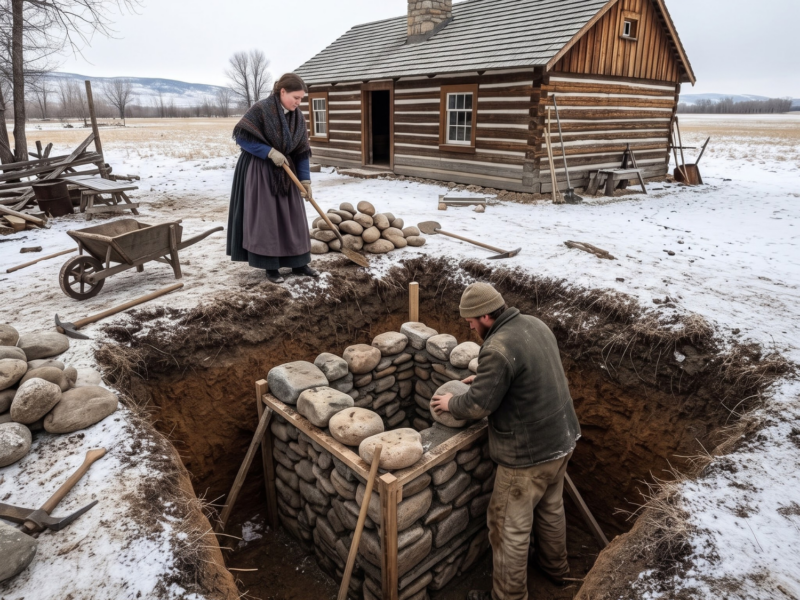
Neighbors Laughed When She Installed a Chimney Beneath His Cabin — Until Made It Warmer All Winter
THE SKEPTICS OF STILLWATER CREEK
Thomas Rearen rode over from his place three miles north the exact day Ingred was mortaring the last stones into place. Rearen had been a sergeant in the Union Army, had spent a brutal winter garrisoned at Fort Laramie, and he didn’t suffer fools gladly.
He dismounted, walked to the open threshold, studied the excavation through the gaps in the floorboards she had temporarily removed, and said what everyone else was thinking aloud.
“Ma’am, you’ve got maybe five cords of wood split, and you’re burning through it twice as fast trying to heat the ground. Come February, you’ll be burning your own furniture for fuel. Come March, we’ll find you frozen solid.”
Ingred looked up from her work, clay caked on her hands and forearms, possessing the quiet confidence of absolute certainty in her eyes.
“By February, Mister Reirdon, I’ll be burning half the wood you are, and sleeping warmer than you’ve slept since you left whatever heated house you grew up in back east.”
Rearen snorted, shaking his head. He wasn’t a cruel man, just rigidly practical. “Heat rises, Mrs. Halverson. Always has. You’re fighting nature.”
“Heat radiates,” she corrected softly, wiping her brow with a mud-stained wrist. “In all directions, and stone holds it—through the night, through the next day, through times when the fire’s low.”
He adjusted his saddle, shook his head again, and mounted up. As he wheeled his horse around to ride away, he called back over his shoulder, “I’ll check on you come January. If you’re alive, I’ll bring you a cord of wood. If you’re not, I’ll dig a hole and bury you next to Lars.”
By mid-December, Ingred had carefully replaced the heavy oak floorboards over her underground chamber and could finally feel the first tangible benefits of her labor.
The cabin interior measured sixty-four degrees Fahrenheit at dawn—eight degrees warmer than it had ever been the previous winter with the exact same amount of fuel burned. The massive stone mass beneath the floor, now supercharged to temperatures exceeding two hundred degrees during evening burns, released its stored warmth slowly and steadily through the dead of night. She could let the fire die down to mere coals after midnight and still wake to a cabin that didn’t have a skim of ice on the water bucket or frost creeping up the inside walls.
Yet the real test was coming. Everyone on Stillwater Creek knew it in their bones.
The Crow elders had seen too many magpies flocking early to the valley floor. Too many beavers were building their dams higher than usual along the riverbanks. The woolly bear caterpillars crawling across the frozen grass showed significantly more black than brown. All the traditional signs pointed toward a winter that would make men question whether this untamed territory was truly worth settling at all.
Sarah Brennan, who lived closest to Ingred with her husband Daniel and their three young children, stopped by in the third week of December. Sarah was twenty-nine, Texas-born, and had survived hardships Ingred couldn’t even begin to imagine. She had lost two babies to illness on the wagon trail north, had walked forty-seven miles on foot when their only ox went lame, and she approached frontier life with a stark pragmatism that bordered on grim.
She didn’t mock Ingred’s subterranean project, but she didn’t endorse it either, standing cautiously on the boards.
“Feels warm,” Sarah admitted, her hands wrapped around her woolen shawl. “But you’ve been burning steady for weeks. What happens when you run low on wood? That big stone pit’s going to suck heat just trying to keep itself warm.”
Ingred had prepared coffee—real coffee, a precious luxury that winter—and she poured two steaming tin cups.
“The stones don’t suck heat once they’re charged. They hold it, and release it slow. I burn hot fires twice a day instead of keeping low, smoldering fires all day long. It uses forty percent less wood for the exact same warmth.”
Sarah’s eyes narrowed. She was calculating, running the merciless mathematics of survival in her head. “How long to charge the stones?”
“First time took three weeks. Now, four hours of good, roaring burning maintains them for twenty hours of steady warmth.”
“And if you’re wrong?”
Ingred met her gaze squarely. “Then Thomas Rearen can bury me next to Lars, and you can tell everyone the Swedish woman died proving nothing.”
Sarah didn’t smile, but she could feel it—the deep, ambient warmth rising upward from beneath the floorboards. The way the cabin held its temperature in a manner no frontier dwelling she had ever inhabited had managed. She left without fully committing to belief, but also without mocking. On the frontier, that was as good as an endorsement.









