Neighbors Laughed When She Installed a Chimney Beneath His Cabin — Until Made It Warmer All Winter
THE ECHO BENEATH THE FLOORBOARDS
Yet in that valley along that creek, the knowledge persisted like roots beneath the snow.
Sarah Brennan’s son, William—the same boy whose life had been saved by the rising warmth of the granite stones—grew up to be a skilled carpenter. He built seventeen houses across western Montana between 1895 and 1920, and every single one of them incorporated some form of thermal mass heating. They weren’t always as elaborate as Ingred’s subterranean setup—growing towns had different requirements than isolated homesteads—but they were always meticulously designed to store heat in dense mass and release it slowly rather than burning fuel continuously.
Martin Keller taught his sons, who in turn taught theirs. When the Great Depression hit in the 1930s and fuel economy suddenly mattered desperately to people who had forgotten it ever had, three families in Stillwater County still knew how to heat an entire house through a bitter Montana winter on a quarter of the wood anyone else required.
Ingred Halverson lived quietly in her cabin until 1891, when she was fifty-five years old. She sold the property to a German couple newly arrived from Bavaria, showed them step-by-step how the system operated, and moved to Helena to live out her remaining years near a niece.
The German couple, the Schmidts, maintained the thermal system faithfully for thirty-two years. When they sold the homestead in 1923, the new owners—who had grown up with modern coal furnaces and industrial steam heat—covered over the underground chamber with extra timber and installed a conventional, upright cast-iron stove.
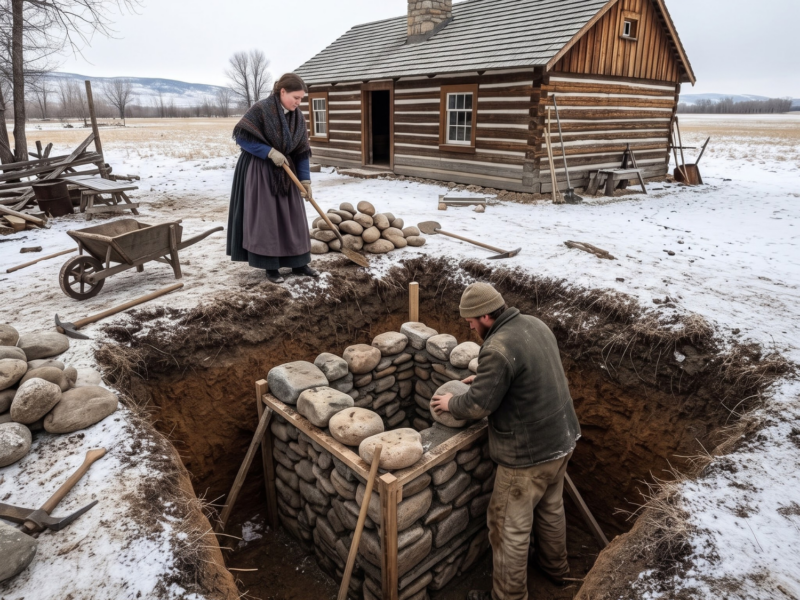
The stones, however, remained right where they were. Four tons of dense river granite resting quietly in a seven-foot-deep cavity beneath floorboards that someone nailed shut without ever understanding what lay hidden below.
In 2019, a history-minded couple from Seattle purchased the old Halverson property as part of a regional land trust acquisition. While beginning meticulous restoration work on the historic structure, they noticed something odd: floorboards that ran noticeably warmer than the rest of the room, even in mid-winter, even without an active fire burning.
Curious, they carefully pulled up a section of the old floor.
There lay four tons of river granite, still perfectly in place after one hundred and forty-two years. The clay-lined flue channels were partially collapsed by time, but their purpose was unmistakable. It was a functioning, brilliant antique heating system that had kept human beings alive when survival was never guaranteed, cutting fuel consumption in half when fuel meant the exact boundary between life and death.
They documented every inch of the find and contacted Montana State University’s Department of History. A graduate student wrote her master’s thesis on vernacular thermal mass heating systems on the American frontier, using the Halverson cabin as her primary case study. She tracked down the descendants of the families who had implemented the design, located Edward Voss’s long-lost census report in the territorial archives, and successfully pieced back together the story of how one widowed immigrant’s memory had saved lives that a harsh Montana winter had intended to claim.
The physics were simple, elegant, and timeless. The heat capacity of granite is extraordinarily high. A four-ton mass heated to two hundred degrees and surrounded by insulating earth loses thermal energy slowly enough to warm a living space for more than twenty-four continuous hours.
Ingred did not invent the laws of thermodynamics, nor did she invent the hypocaust. She simply remembered them, adapted them, and proved their worth in a landscape that punished innovation failures with death.
On Stillwater Creek today, remnants of five different underground heating systems still exist in various states of preservation beneath old homesteads. None of them are functional anymore; modern convenience won out long ago. But they remain embedded beneath floorboards and packed earth—silent, enduring testaments to an era when people solved life-or-death problems with stone, sweat, and inherited wisdom.
Sometimes, the old ways work best. Sometimes, immigrants bring treasures far more valuable than gold in their memories. And sometimes, a widow with nothing left to lose has everything left to teach the world.









