Neighbors Laughed When She Installed a Chimney Beneath His Cabin — Until Made It Warmer All Winter
THE WITNESSES
The storm raged for three full days. Word spread across Stillwater Creek with the fierce, necessary speed of isolated communities where survival depends entirely on knowing who is in trouble and who might have answers.
By the second day, seven more frost-bitten people had crowded into Ingred’s small cabin—not merely seeking warmth, but because Thomas Rearen had ridden through the dying tail-end of the wind to tell Martin Keller what he had seen with his own eyes, and Keller had set aside his stubborn pride long enough to admit they had all terribly miscalculated.
Ingred’s cabin—sixteen by twenty feet, identical to every other homestead dwelling in the valley—now held thirteen people. Yet the temperature inside never dropped below fifty-seven degrees. Her wood consumption, even while feeding and warming far more bodies, was less than any other single family on Stillwater Creek was burning just to keep two adults alive.
They weren’t refugees or guests anymore by the third day. They were witnesses.
Martin Keller sat heavily on the floor right above the stone chamber, feeling the gentle, steady heat rising upward through century-old oak planks that had originally been in Lars’s family back in Sweden. He was fifty-three years old, had built structures across three different territories, and he was feeling something he had only experienced once before in his life—decades ago in the basement of a brick municipal building in Philadelphia where boilers heated water below, and the warmth rose through the floor like magic.
“It’s a hypocaust,” Keller said finally, his voice hushed in sudden realization. “Just like the ancient Romans built.”
Ingred nodded. “My grandfather called it a kakelugn system—tile and stone masonry heating utilizing thermal mass. The Romans had the right idea two thousand years ago. Korea still uses it. Russia uses it. We simply forgot it when we crossed the ocean.”
Thomas Rearen, who had sat in silent contemplation for two full days, finally spoke up. “How much stone did you move down there?”
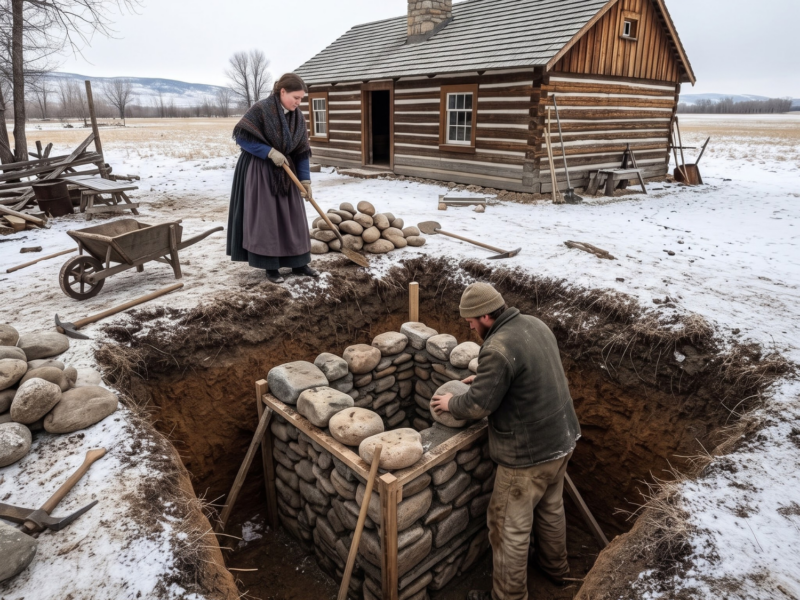
“Four tons, roughly. Maybe a bit more. River granite, mostly—dense, heavy, holds heat far better than sandstone.”
“And the flue system? How’d you keep the smoke from backing up into the room?”
Ingred stood and lifted a loose section of floorboard, exposing the clay-lined channel curving gracefully through the massive stone accumulation. “Negative pressure from the main stack still pulls the draft upward through the chimney. But before the hot gases escape, they surrender their thermal energy to the stone mass. I lose maybe ten percent to backdraft drag. It’s a cheap price for tripling my heat retention.”
Daniel Brennan, who had been watching his son William sleep peacefully for the first time in three days, said what everyone in the crowded room was thinking: “You could have kept this secret. Sold it. Made a fortune off it.”
Ingred replaced the floorboard carefully. “Lars always said knowledge that keeps people alive shouldn’t be hoarded like gold. Besides, who’d I sell it to? We’re all trying to survive the exact same winter.”









