She Bought a Deserted General Store for $5—What Was Hidden in the Rafters Was Untouched for Years
The Gift of Iron
The next three days were a masterclass in physical suffering. Cora slept in her rusted Subaru Outback, parked in the overgrown lot behind the store. Her mornings began with lukewarm instant coffee and a handful of ibuprofen. Her days were spent hauling trash.
She bought thick leather gloves, industrial trash bags, and a respirator mask. The locals watched her from across the street. Old men in faded denim and trucker hats sat on the porch of the diner, sipping their coffee, waiting for the city girl to crack. They were taking bets—she was sure of it. Over or under on how long before she packed up and drove back to wherever she came from.
She didn’t give them the satisfaction of a glance. Cora dragged out the rotted merchandise first: bag after bag of molded cardboard, rusted tins, and shattered glass. The work was mindless, brutal, and exactly what she needed. Every bag she hauled to the rented dumpster in the alley was a tiny, measurable victory.
The muscles in her back screamed. Her knuckles were constantly bleeding from unseen nails and sharp edges, and her hair was permanently coated in a layer of fine gray dust.
By Thursday afternoon, the front of the store was relatively clear. The sweeping, cavernous space of the original architecture was beginning to reveal itself. The oak floors, though scratched and dull, were solid. The stamped tin ceiling in the front—once she wiped away the cobwebs—showed traces of original copper paint.
But the back room remained a problem.
The sagging beadboard ceiling had worsened over the last few days. With the doors open and the cross-breeze pulling air through the building, the pressure had shifted. The bow in the center of the drop ceiling looked critical. Flakes of cheap white paint drifted down continuously like diseased snow.
Cora stood beneath it, hands on her hips, her breathing raspy through the respirator.
A shadow fell across the threshold. Cora turned.
An older man stood in the doorway. He wore faded Carhartt overalls and a baseball cap that read Oak Haven Feed and Seed. His face was a map of deep, sunbaked wrinkles, and his eyes were sharp, evaluating her with unapologetic skepticism.
“You’re the one bought the Hayes place,” he said. It wasn’t a question. His voice sounded like boots on gravel.
“I am,” Cora said, pulling down her mask. “Can I help you?”
“Name’s Gibson. Owned the hardware store down the block.” He stepped inside, his heavy boots sounding loud in the cleared-out space. He looked around, nodding slowly. “You cleared a lot of junk. More than I thought you would.”
“Thanks.”
“Don’t thank me. It’s still a teardown.” Gibson pointed a calloused finger toward the back room. “Especially that. The foundation in the rear is cracked. That drop ceiling—old man Hayes put that in during the winter of ’74 to save on heating. Didn’t want to heat the whole damn cavern. Did a terrible job of it. It’s going to cave in on you.”
Cora looked back at the sagging boards. “I know. I’m taking it down today.”
Gibson snorted. “You got a hard hat? Because when that beadboard gives, half a ton of rat shit and rotted insulation is going to come down on your head.”
“I’ll be careful.”
“Careful don’t stop gravity, girl.” Gibson reached into his pocket and pulled out a heavy forged-steel pry bar. He held it out. “Saw you buying those bolt cutters. You look like you’re trying to fix this place with a butter knife. Use this. Drop it back at the shop when you’re done, or when you quit. Whichever comes first.”
Cora looked at the iron bar, then at Gibson. She took it. It was heavy, perfectly balanced. “I’m not quitting.”
Gibson turned to leave. “We’ll see. Don’t stand directly under it when you pull. It’s bearing weight.”
He walked out, leaving Cora alone with the silence of the store. She weighed the pry bar in her hands. It gave her a strange sense of comfort.
She walked to the back room and dragged a heavy wooden crate—one of the few solid pieces of furniture left—directly under the edge of the drop ceiling near the wall where it seemed most stable. She stepped up onto the crate. The beadboard was just inches from her face. The smell of decay was overpowering here; it wasn’t just dust. It was the sharp, acrid scent of ammonia, dried pine, and something else—something heavy and metallic, like old grease.
Cora wedged the flat, wedged end of the pry bar into the seam where the beadboard met the wall. She tapped the heel of her hand against the heavy iron shaft.
Crack.
The sound was shockingly loud in the empty store. Cora froze. She waited, listening to the building. The structural groans settled. She took a deep breath, gripped the pry bar with both hands, and leaned her weight back.
The rusted nails shrieked as they were pulled from the joists. A jagged three-foot piece of beadboard snapped and tore away.
A cloud of black dust exploded downward. Cora squeezed her eyes shut and turned her face away, coughing violently even through the mask as the debris rained over her shoulders. She heard a heavy, wet thud hit the floorboards behind her, followed by the patter of dried dirt and nesting material.
She waited for the dust to settle, her heart hammering against her ribs. When she opened her eyes, she looked up into the breach she had made.
Gibson was right about the insulation and the rat nests, but he was wrong about the weight.
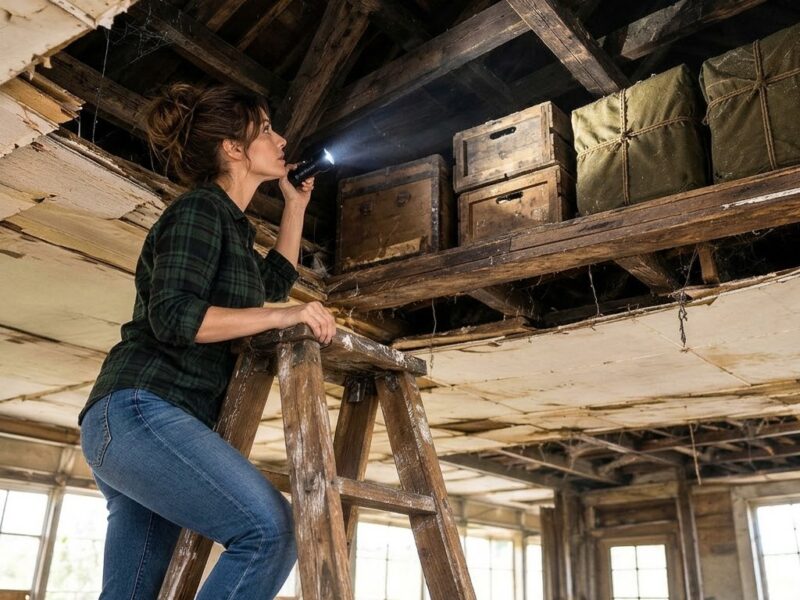
Cora blinked, trying to pierce the gloom of the newly exposed space. The gap between the cheap drop ceiling and the original high roof was about four feet. It was a dark, cramped crawl space, and it wasn’t empty.
Resting directly on top of the flimsy beadboard, resting on the cross-joists that were bowing under the strain, were shapes. Heavy, rectangular shapes wrapped in thick, dark material. They were stacked methodically, pushed far back into the shadows of the rafters, hidden entirely from the world below.
Cora reached into her back pocket and pulled out her phone. Turning on the flashlight, she aimed the harsh LED beam into the dark cavity. The light caught the dust suspended in the air, swirling like galaxies.
Then the beam hit the shapes.
They were bundles—five of them—wrapped in heavy olive-drab canvas and tied tightly with thick hemp rope. The canvas was coated in a layer of grime so thick it looked like fur, but the edges were perfectly square. Beneath the canvas, Cora could see the unmistakable rigidity of wooden crates.
These weren’t forgotten boxes of inventory. They were deliberately concealed, pushed into the deepest, darkest corner of the rafters before the false ceiling had been sealed up.
“What in the hell?” Cora whispered.
She reached her hand up, stretching her arm through the hole, her fingertips brushing the rough canvas of the nearest bundle. It was freezing cold to the touch and unyielding, solid as a rock.









