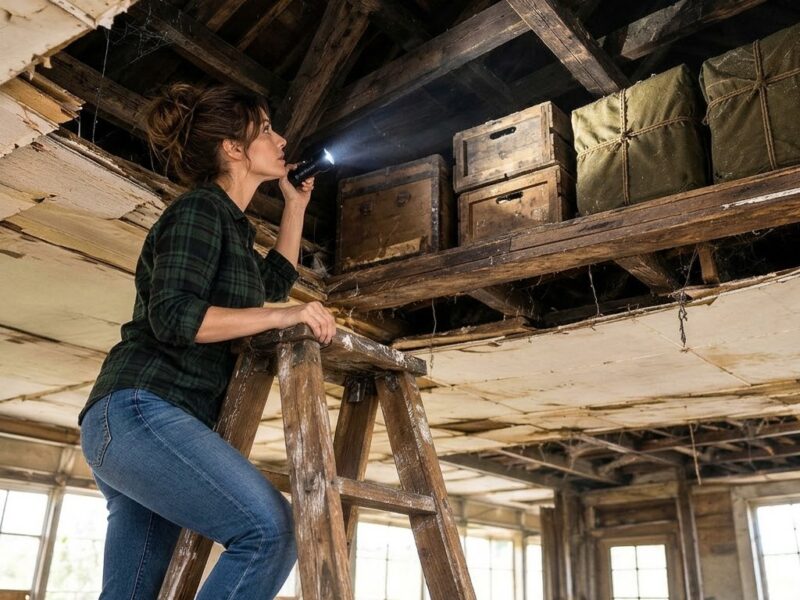
She Bought a Deserted General Store for $5—What Was Hidden in the Rafters Was Untouched for Years
The Phone Call
Cora didn’t sleep that night. She couldn’t.
She spent the remaining hours of daylight dragging heavy sheets of plywood across the front of the store, boarding over the cracked windows from the inside. She drove three-inch construction screws into the oak frames until the battery on her drill died. Then she used a hand screwdriver until her palm blistered.
By nightfall, the Hayes General Store was a fortress.
She sat cross-legged on the floor in the glow of a single battery-powered camping lantern, surrounded by the five open crates. The smell of indigo dye and cedar wood filled the stagnant air, masking the decades of rot.
Paranoia was a heavy, cold blanket. If word got out in Oak Haven—a town where the median income was hovering just above the poverty line and most storefronts were boarded up—people would talk. Talk would lead to curiosity, and curiosity would lead to crowbars in the middle of the night. $5 bought her the deed, but legal ownership felt incredibly fragile when you were guarding a literal treasure chest in a building with no locks on the back doors.
At dawn, she took a single pair of the cinch-back jeans, folded them carefully into a black plastic trash bag, and locked the store.
She drove her Subaru thirty miles east to a chain motel off the interstate, rented a room for the day, and connected to their secure Wi-Fi. She sent three emails. Each contained just four photographs: the leather patch, the copper rivets, the stencled crate, and a full-length shot of the rigid, dark denim. She sent them to three prominent vintage workwear dealers she found listed on an archivists’ forum.
She expected to wait days for a response.
Her phone rang twenty minutes later. The caller ID was a Los Angeles area code.
Cora stared at the screen, her heart drumming a frantic rhythm against her ribs. She swiped to answer.
“My name is Arthur,” a voice said. He didn’t say hello. He sounded breathless, like a man who had just run up a flight of stairs. “The photos you sent. Where are the garments right now?”
“They’re safe,” Cora said. Her voice was surprisingly steady.
“Are they washed? Did you wash them? Please tell me you didn’t put them in a machine.”
“They are exactly as I found them,” Cora replied. “Stiff, unworn, still in the wooden crates.”
Arthur let out a sound that was half-laugh, half-groan. “Listen to me very carefully. Do not touch them without clean, dry hands. Do not expose them to direct sunlight. I am booking a flight to Chicago right now. I can be at your location by tomorrow morning.”
“I haven’t agreed to sell them to you,” Cora said, leaning back against the cheap motel headboard.
“I know,” Arthur said, “but you’re going to want me to appraise them. If those are authentic 1930s Levi’s 501s in dead-stock condition, you don’t have a pile of old clothes. You have museum artifacts. A single pair in that condition sold in Tokyo last year for $85,000. How many pairs did you say you found?”
Cora looked out the motel window at the highway traffic blurring past. “120,” she whispered.
The line went dead silent. For a second, Cora thought she had lost the connection. Then she heard Arthur exhale sharply.
“Don’t talk to anyone,” he said. “I’ll text you my flight info.”









